ORBITAL CLOCK LAB / 10
Which effect wins at this altitude?
Choose a circular-orbit altitude. The model compares an ideal orbiting clock with a stationary clock at Earth’s equatorial radius, ignoring Earth’s rotation and other operational corrections.
At the GPS altitude, weaker gravity wins. One day of uncorrected clock offset is equivalent to about 11.53 km of light travel.
Simplified weak-field model: spherical, nonrotating Earth; circular orbit; stationary surface comparison. It is an explanation, not operational navigation software.
The adjustable calculator is unavailable until it loads. The GPS example remains valid: +45.66 μs/day from weaker gravity, −7.21 μs/day from motion, and +38.45 μs/day net.
GPS measures time before it measures place
A GPS receiver does not ask a satellite, “Where am I?” It receives radio signals carrying the satellite’s position and the time each signal was transmitted. Because radio waves travel at the speed of light, the receiver can turn a signal’s travel time into a distance.
One distance places the receiver somewhere on a sphere around one satellite. More satellites narrow the possibilities. A receiver normally needs at least four signals because it must solve for three spatial coordinates and the offset of its own imperfect clock. The GPS constellation is arranged so that at least four satellites are visible from nearly every point on Earth. [1, 2]
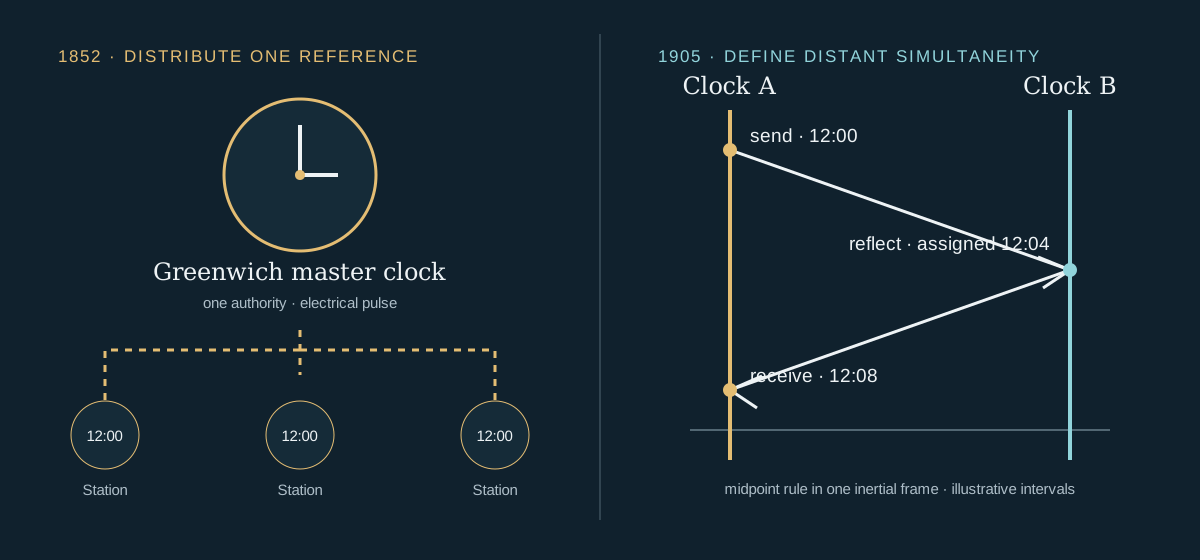
This makes time an input to position. A nanosecond of timing corresponds to about 30 centimetres of light travel. The clocks do not need to agree merely in spirit; their relationship must be modeled precisely. [3]
Motion makes the satellite clock slower
GPS satellites move at roughly 3.9 kilometres per second in an approximately circular medium-Earth orbit. Special relativity says that a moving clock accumulates slightly less proper time than a clock at rest in the chosen reference frame.
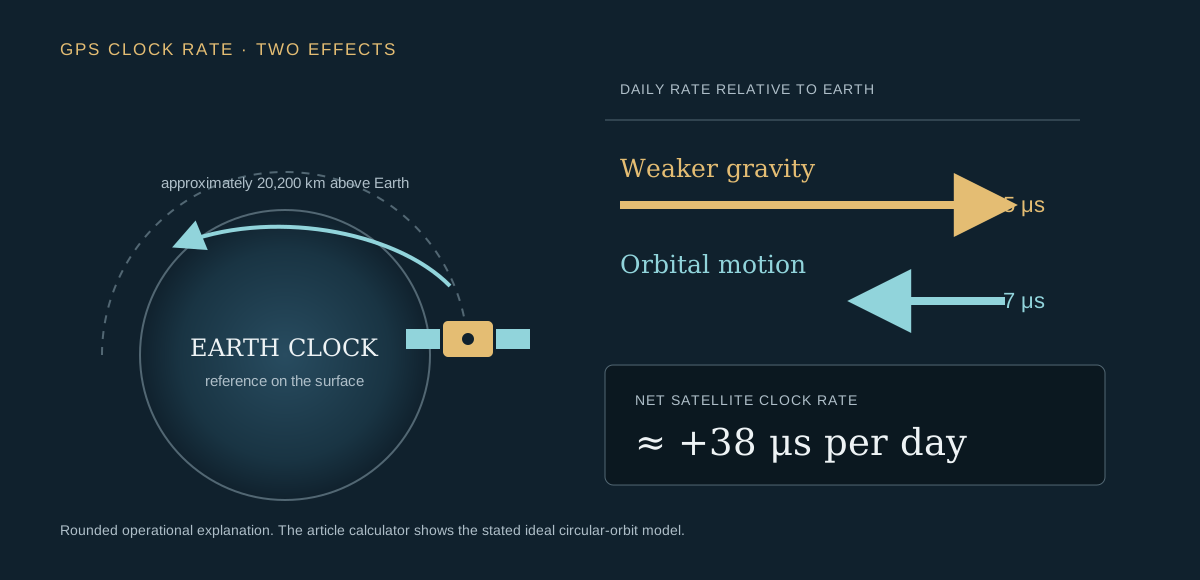
For the standard GPS altitude of about 20,200 kilometres, the motion-related difference is approximately −7 microseconds per day relative to clocks on Earth. The minus sign means the satellite clock loses time from this effect. [1, 4]
This is the same physics introduced in our time-dilation explainer, but at an everyday engineering scale rather than near light speed.
Weaker gravity makes it faster
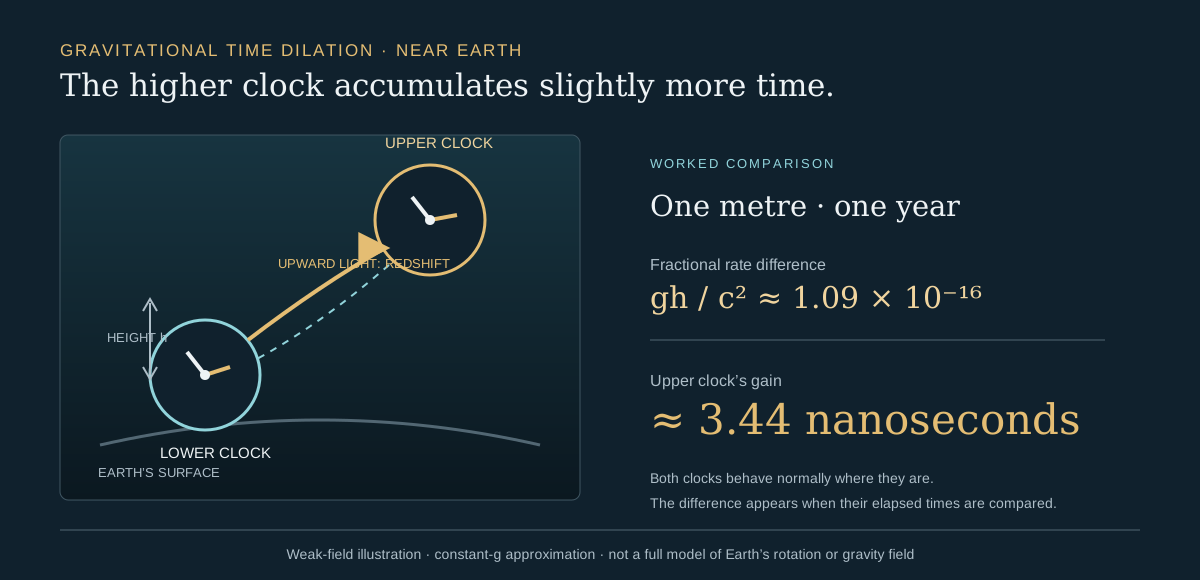
General relativity supplies an effect in the opposite direction. Clocks deeper in Earth’s gravitational potential run more slowly than clocks higher up. A GPS clock is far above Earth’s surface, where the gravitational potential is higher and gravity’s rate effect is smaller.
At GPS altitude, the gravitational contribution is approximately +45 microseconds per day. It is larger than the motion contribution, so the two do not cancel. Their familiar combined value is about +38 microseconds per day: the orbiting clock advances relative to an Earth clock. [4, 5]
A transparent altitude model
The calculator above uses a deliberately simple model: a circular orbit around a spherical, nonrotating Earth. It estimates the gravitational contribution from the potential difference and the special-relativistic contribution from the circular orbital speed.
At 20,200 kilometres, the model gives +45.66 microseconds per day from gravity and −7.21 from motion, for a net +38.45. That is close to the rounded engineering explanation above. At roughly 3,189 kilometres, the two terms cancel in this idealized circular-orbit comparison. Below that altitude, speed can dominate; above it, the weaker-gravity effect dominates.
This crossover is a result of the stated model, not a magic shell around Earth. A real navigation solution uses a defined coordinate system and more complete corrections. [5, 6]
Why 38 microseconds cannot be ignored
Thirty-eight microseconds sounds negligible. Light travels about 11.4 kilometres in that time. If the clock-rate difference simply accumulated without correction, the ranging information would quickly become unusable; NIST describes the resulting positioning error as roughly 10 kilometres per day. [4]
The correction is not an optional improvement applied by a map app after the fact. Relativistic effects are built into the system’s timekeeping, navigation messages, and receiver calculations. The official GPS interface specification explicitly includes relativistic corrections in the clock model used by receivers. [6]
Your phone does not perform a fresh philosophical debate about spacetime. It follows an engineering specification whose numbers would be wrong if Newtonian universal time were assumed.
Relativity is necessary, but it is not the whole system
The +38-microsecond figure is the headline, not a complete GPS model. Satellite orbits are not perfectly circular. Their changing speed and gravitational potential require an additional periodic correction. Earth’s rotation introduces the Sagnac effect because transmission and reception are evaluated in a rotating terrestrial frame.
Engineers must also account for satellite clock offsets, orbit information, ionospheric and tropospheric signal delays, antenna effects, and receiver geometry. Relativity does not replace those corrections; it belongs among them. Scholarly reviews of GPS treat gravitational shifts, motion, synchronization, and rotation within one consistent relativistic framework. [5, 6]
A technology can be evidence without being a laboratory demonstration
GPS was designed for positioning, navigation, and timing—not as a clean standalone experiment to prove relativity. Yet it operates only because relativistic clock relationships are modeled continuously. That makes it a powerful practical application and an ongoing consistency check, while dedicated clock experiments provide more controlled tests.
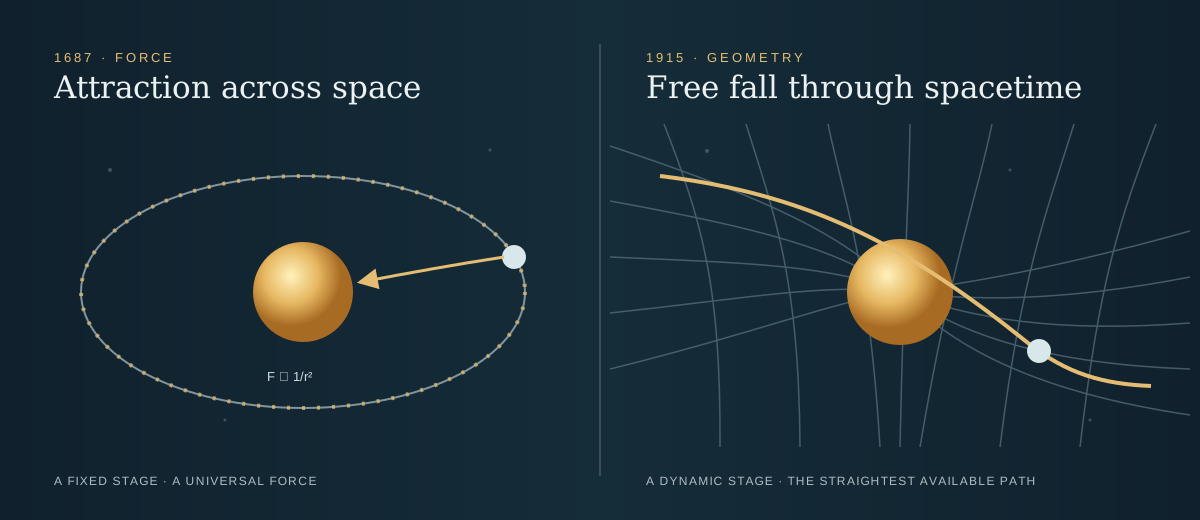
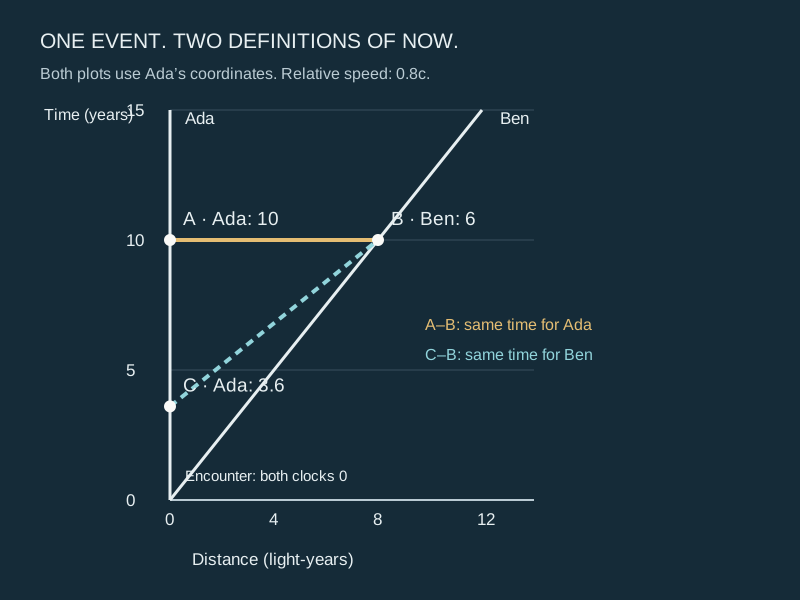
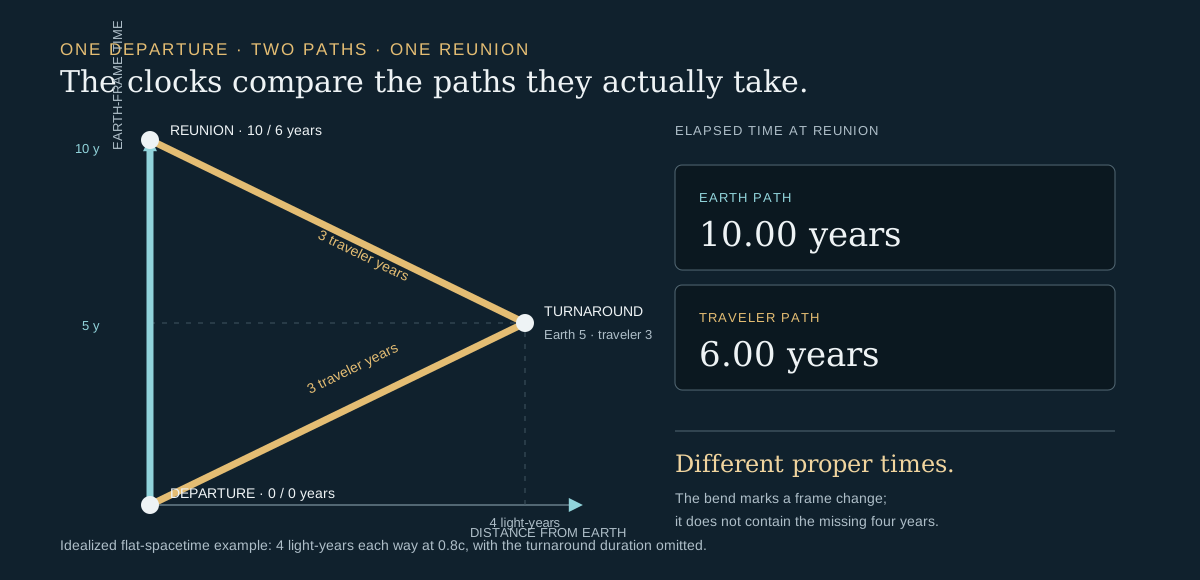
The deeper lesson is not simply “Einstein is in your phone.” It is that a location can depend on a convention for distant time, a gravitational potential, a reference frame, and clocks moving along different paths.
It coordinates clocks that spacetime gives different elapsed times.
Next, compare special and general relativity side by side, or see how synchronizing distant clocks became a physical problem.
Sources & further reading
- GPS.gov — Space Segment ↗
- NIST — How Do You Measure Your Location Using GPS? ↗
- European Space Agency — Galileo and GPS “synchronise watches” ↗
- NIST — Putting Einstein to the Test With the World’s Most Accurate Clocks ↗
- Neil Ashby, Living Reviews in Relativity — Relativity in the Global Positioning System ↗
- U.S. Coast Guard Navigation Center — IS-GPS-200N Interface Specification ↗
Prepared with AI assistance. Sources are linked for verification. See our editorial approach.
Keep a little room for curiosity.
Save the journal for your next visit, or get new articles in a reading app.
Ways to stay updated ↗