CLOCK-HEIGHT EXPLORER / 16
How far ahead does the higher clock get?
Set a vertical separation and comparison time. The model estimates the gain of the upper stationary clock near Earth’s surface.
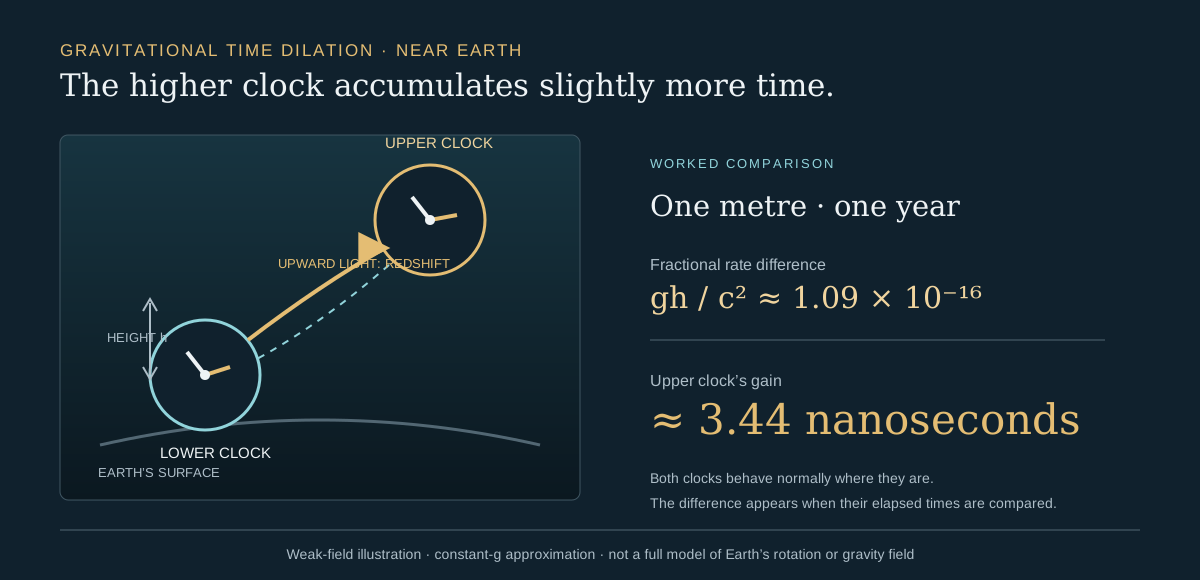
Across 1 metre for 1 year, the higher clock gains about 3.44 nanoseconds.
Weak-field, near-surface estimate Δf/f ≈ gh/c² using g = 9.80665 m/s² and a Julian year. Both clocks are stationary relative to Earth. Rotation, motion, local geology and the change of g with height are excluded.
The adjustable comparison is unavailable until it loads. The default remains valid: across one metre for one year, the higher clock gains about 3.44 nanoseconds.
Gravity changes clock comparisons
Place two identical clocks at rest at different heights above Earth. After enough time, the higher clock will be slightly ahead. Nothing is wrong with the lower clock. Its atoms, electronics, and every local physical process behave normally. The difference appears when the clocks are brought together or compared by exchanging signals.
This is gravitational time dilation: clocks following different paths through a gravitational field can accumulate different amounts of proper time. Near a roughly spherical body, a clock deeper in the gravitational field generally accumulates less time than a clock farther away. [1, 2]
“Gravity slows time” is useful shorthand, but it needs a comparison. A clock never feels itself running slowly. The statement means that specified clocks on specified paths disagree when a valid comparison is made.
Einstein’s elevator turns acceleration into a clue
Imagine a rocket accelerating upward through otherwise empty space. A light pulse leaves the floor and travels toward the ceiling. During the light’s flight, the ceiling gains speed. The receiver therefore measures the incoming light at a lower frequency than the source emitted it: a redshift.
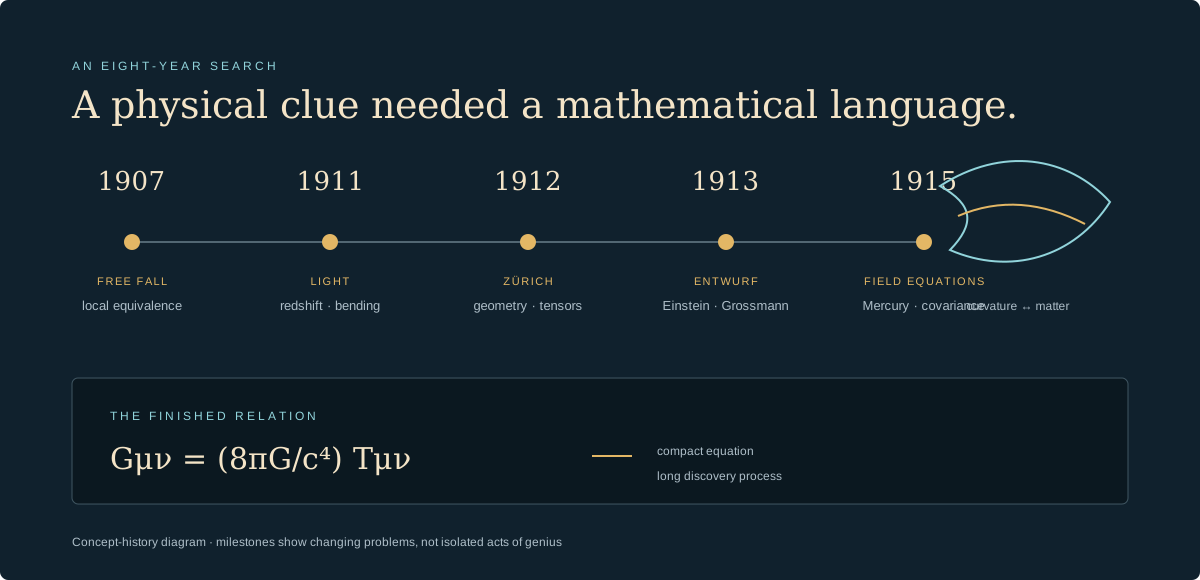
Einstein’s equivalence principle says that, within a sufficiently small region, experiments in that accelerating rocket reproduce experiments in a laboratory supported in a gravitational field. The rocket’s frequency shift therefore points to a gravitational frequency shift between the floor and ceiling. [1]
The thought experiment is local. A real gravitational field is not perfectly uniform across a large region; tidal effects reveal differences that no single accelerating cabin can remove. The equivalence principle links gravity and acceleration locally, not as a claim that every global gravitational situation is simply an accelerating box.
Redshift and time dilation are two views of one comparison
Atoms can act as clocks because their transitions define stable frequencies. Send light upward from a lower atom to an otherwise identical atom higher in the field. The higher receiver finds the arriving light redshifted relative to its own local transition frequency. Light sent downward is correspondingly blueshifted. [2]
That frequency comparison can be described in clock language: the higher clock completes slightly more cycles while the lower clock completes a given number. Gravitational redshift and gravitational time dilation are closely related descriptions of the same difference in clock rate.
This does not require light to “lose energy” in one universal bookkeeping system. Energy and frequency in general relativity depend on the observer and spacetime geometry. The operational result is the comparison of emitter, signal, and receiver.
Near Earth, the difference is tiny but calculable
For two stationary clocks separated by a modest height h near Earth’s surface, the weak-field approximation gives the fractional rate difference:
At one metre, the upper clock gains about 3.44 nanoseconds over one Julian year. Over a human lifetime the difference is still far too small to feel, yet modern optical clocks can resolve much smaller height changes. NIST researchers measured the effect across 33 centimetres in 2010. [3, 4]
The calculator above uses this near-surface formula. It is not a global Earth model: it treats g as constant, ignores rotation and motion, and is intended for height differences small compared with Earth’s radius.
A tower experiment caught the redshift
In 1959 and 1960, Robert Pound and Glen Rebka tested gravitational redshift across the roughly 22-metre height of Harvard’s Jefferson Laboratory. They used the extremely sharp nuclear resonance made possible by the Mössbauer effect, then introduced a controlled Doppler shift to compare source and absorber. [5, 6]
The predicted fractional shift was only about two parts in 1015. Detecting it required more than placing a detector upstairs: temperature gradients, vibration, line broadening, and instrumental effects had to be understood. The experiment is valuable not because one dramatic observation “proved all of general relativity,” but because it tested a precise gravitational-frequency prediction.
Later clock experiments brought the effect to laboratory and geodetic scales. Precision clocks can now serve not only as timekeepers but also as sensors of gravitational-potential differences.
Why GPS is related but not the same problem
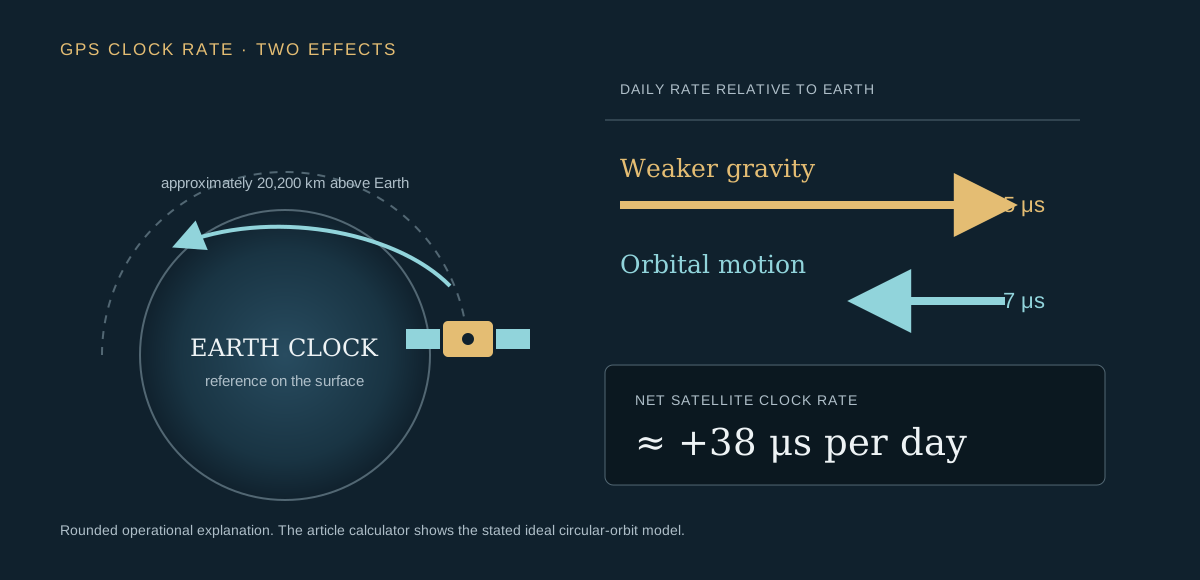
GPS satellite clocks are higher in Earth’s gravitational field, so the gravitational contribution makes them run faster than clocks on the geoid. But the satellites are also moving rapidly, and special-relativistic time dilation makes them run slower. Operational navigation accounts for both contributions and additional details. Our GPS calculator separates those two effects.
The height explorer here deliberately removes orbital motion. It compares clocks supported at different heights in a simple, near-surface field. That cleaner model shows the gravitational term without pretending to reproduce a complete satellite system.
Strong gravity needs the full geometry
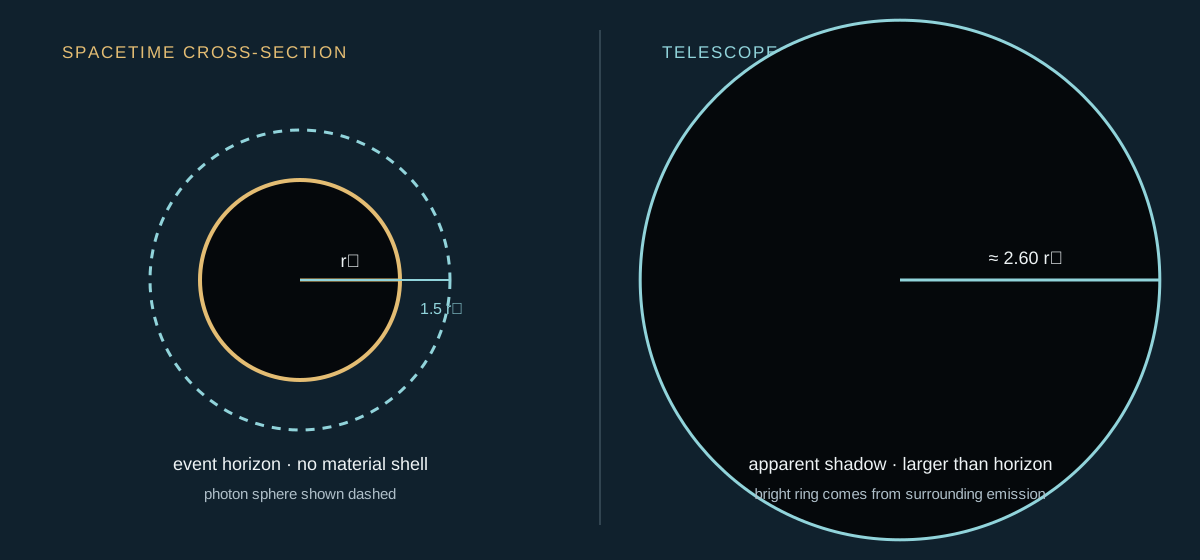
The approximation gh/c² works near Earth over modest height differences. Near a compact object, or across a large region, gravitational acceleration is not constant and the full spacetime metric matters. For an ideal, nonrotating spherical mass, stationary-clock comparisons involve the Schwarzschild geometry; at an event horizon, the notion of a stationary clock itself reaches a limit.
This is why the statement “time stops at a black hole” is dangerous. A distant coordinate description can assign an ever-slower approach to the horizon, while an infalling clock crosses it in finite proper time. Our event-horizon guide keeps those viewpoints separate.
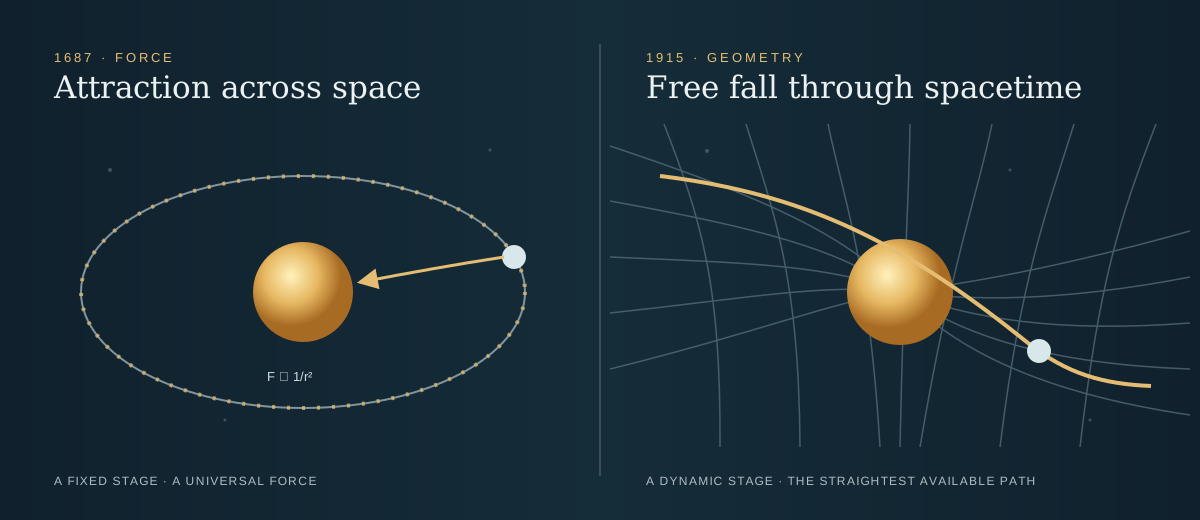
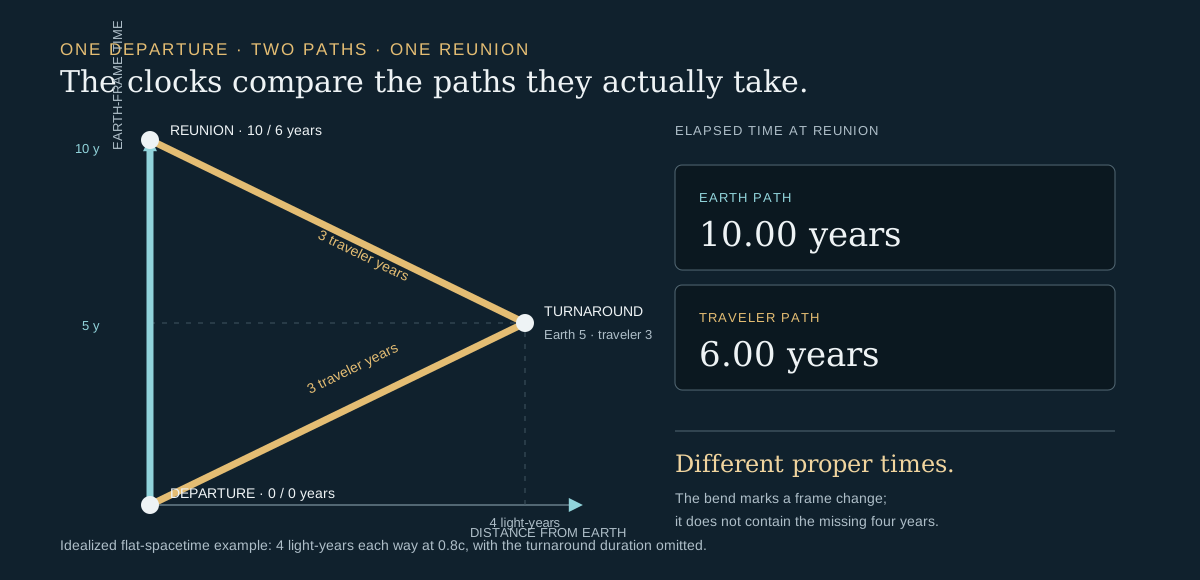
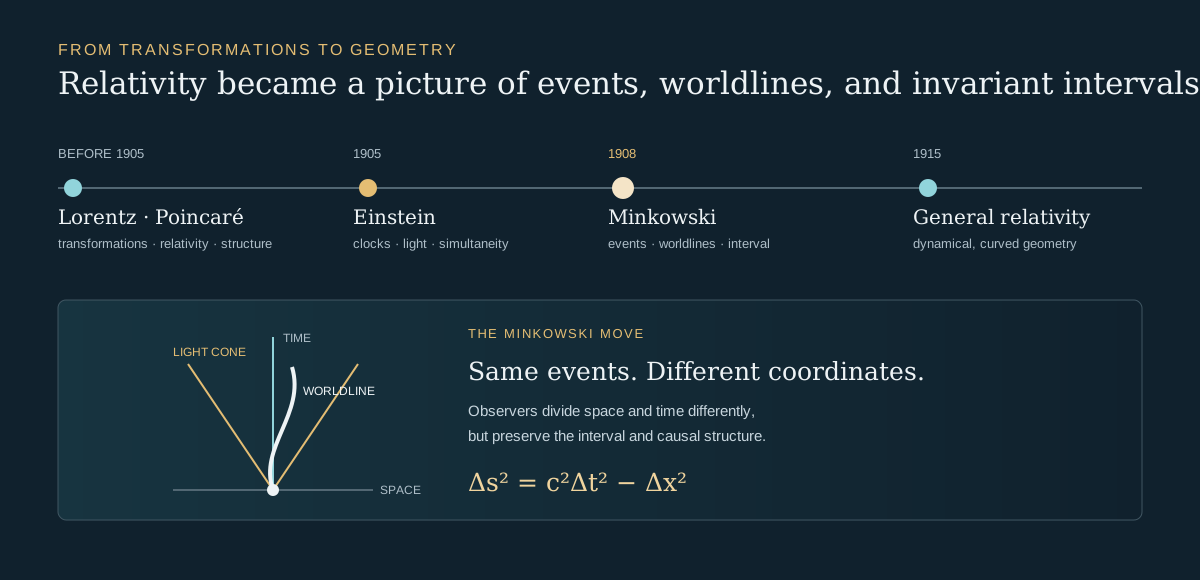
General relativity’s deeper claim is not that gravity applies a brake to a universal time. There is no single master clock to slow. Matter and energy shape spacetime, and clocks measure proper time along their own paths. Special versus general relativity explains how that extends the flat-spacetime picture introduced in the Minkowski history feature.
Different paths through spacetime simply contain different amounts of time.
Sources & further reading
- Einstein Online — The elevator, the rocket, and gravity: the equivalence principle ↗
- Einstein Online — Gravitational redshift ↗
- Chou, Hume, Rosenband & Wineland (2010) — Optical Clocks and Relativity, NIST ↗
- NIST — Atomic clocks reveal relativity at a personal scale ↗
- Pound & Rebka (1959) — Gravitational Red-Shift in Nuclear Resonance ↗
- Harvard Physics — Historical Focus: The Pound–Rebka Experiment ↗
Prepared with AI assistance. Sources are linked for verification. See our editorial approach.
Keep a little room for curiosity.
Save the journal for your next visit, or get new articles in a reading app.
Ways to stay updated ↗