CALCULATE THE BOUNDARY / 08
How large would the horizon be?
Enter a mass or choose an example. The calculator uses the Schwarzschild model: nonrotating, uncharged, and isolated.
Ten solar masses in the ideal Schwarzschild model. Radius grows directly with mass.
The adjustable calculator is unavailable until it loads. The default worked example is still valid: ten solar masses gives a horizon radius of about 29.53 kilometres.
The shortest useful definition
A black hole’s event horizon is the boundary beyond which no future-directed signal—not even light—can reach the distant outside universe. It is not a crust, a force field, or a material surface. An object can cross it while moving normally through its immediate surroundings. What changes is the set of places its future can reach. [1, 2]
“Point of no return” is therefore more precise than “place where gravity becomes infinite.” Curvature and tidal forces at the horizon can be modest for a sufficiently massive black hole. The defining fact is causal: after crossing, every possible future path remains inside.
How large is the horizon?
For an idealized black hole that does not rotate and carries no electric charge, the event-horizon radius is the Schwarzschild radius:
Because the radius is proportional to mass, one solar mass corresponds to about 2.95 kilometres. A ten-solar-mass black hole has a horizon radius of about 29.5 kilometres; four million solar masses gives about 11.8 million kilometres. Use the calculator above to compare scales. [3]
This is a radius defined through the horizon’s area, not the radius of a solid object. Real astrophysical black holes rotate, so the simple Schwarzschild model is a baseline rather than a complete portrait.
What does a falling observer experience?
A freely falling observer reaches and crosses the horizon in a finite amount of their own time. For a very large black hole, they might detect no sharp local marker at the crossing. There is no wall to strike. Tidal forces—the difference in gravity between nearby parts of an object—eventually become destructive, but their strength at the horizon decreases as black-hole mass increases. [2, 4]
This does not mean the horizon is imaginary. It means an event horizon is not defined by a local material property. Its significance becomes clear when you ask whether an outgoing light signal can ever escape to distant space.
Why a distant observer never sees the crossing
Signals sent outward by the falling observer arrive increasingly delayed and redshifted as the horizon is approached. A faraway observer does not receive a final image showing the object pass through. The source instead fades from view as its light loses energy and becomes impractically weak to detect.
The falling observer’s finite crossing time and the distant observer’s ever-later signals are not rival verdicts. They describe different measurements using different coordinates and different paths for light. Saying “time freezes at the horizon” without naming the observer hides this distinction. [2]
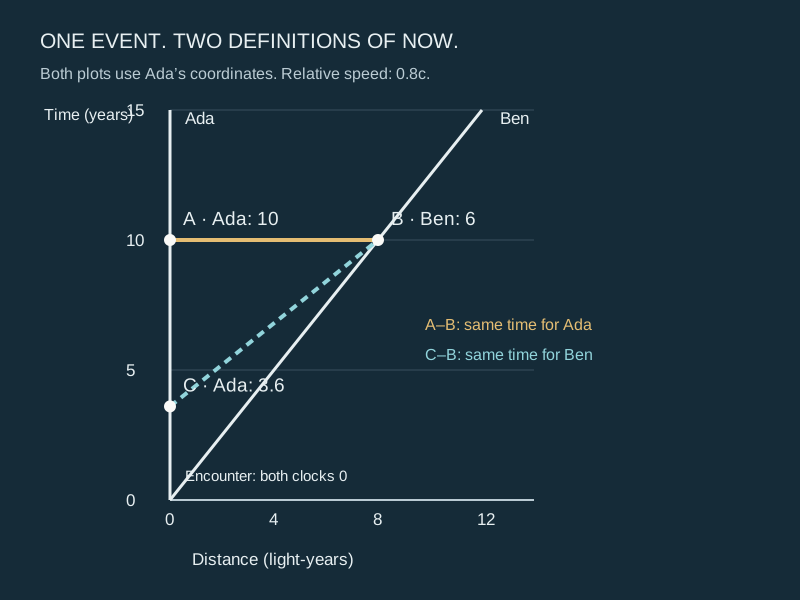
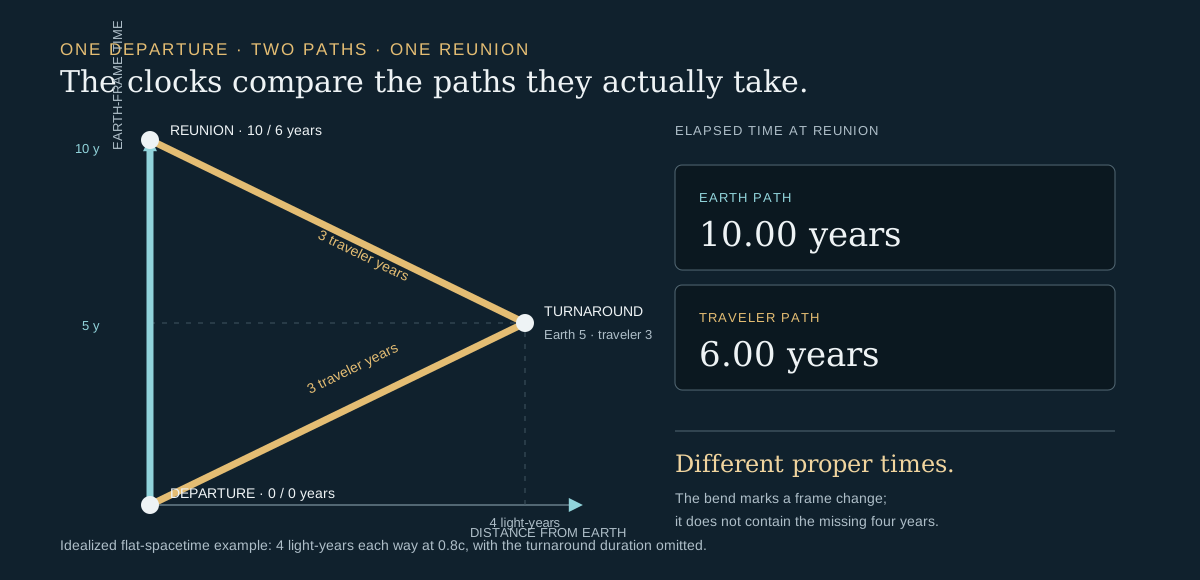
The lesson connects to the wider journal: clock statements need a measurement procedure. Compare the earlier explanation of why moving observers can both find the other clock slow.
The horizon is a global boundary
In the clean mathematical definition, an event horizon separates events that can send light to the indefinitely distant future from events that cannot. Determining that boundary can require knowing the spacetime’s future development. That makes an event horizon a global concept, especially in simulations of changing or merging black holes. [5]
Physicists also use more local ideas, such as apparent or dynamical horizons, when studying evolving situations. Those technical distinctions do not change the central public-facing idea: the event horizon marks the loss of every outward causal route.
A telescope image shows a shadow, not the horizon itself
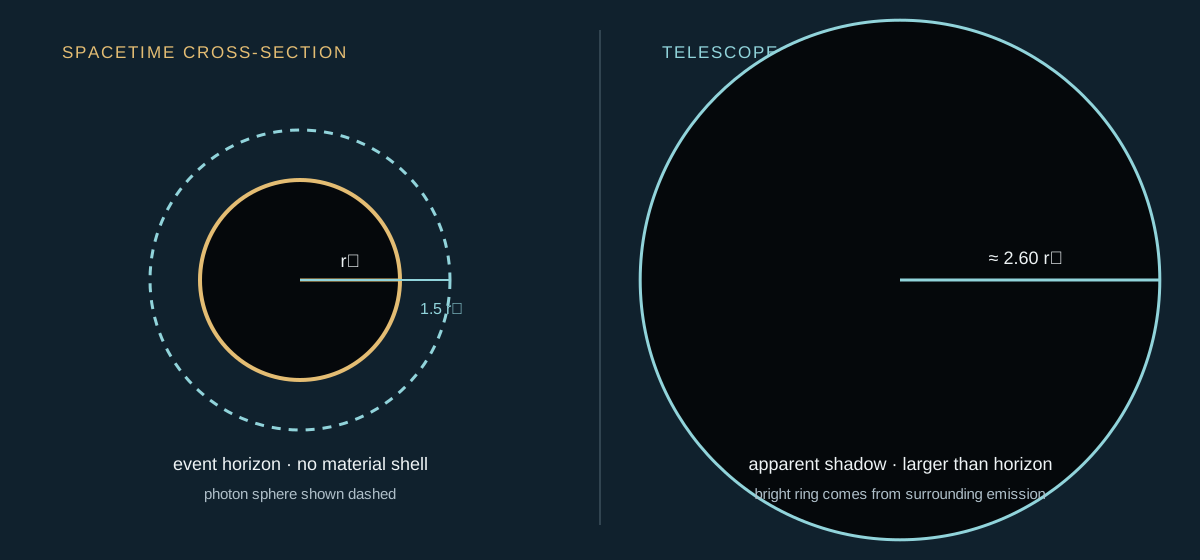
The dark center in an Event Horizon Telescope image is commonly called the black hole’s shadow. It is not a photograph of the horizon’s physical outline. Light rays passing near the black hole are bent or captured, producing a dark apparent region whose size is larger than the horizon. Hot plasma around the black hole supplies the bright ring. [6, 7]
For the ideal nonrotating model in the diagram, the photon sphere lies at 1.5 Schwarzschild radii. The critical shadow radius in the image plane is about 2.60 Schwarzschild radii. Accretion flow, rotation, viewing angle, and telescope response shape the observed ring, so the picture is not a simple ruler laid across a black sphere.
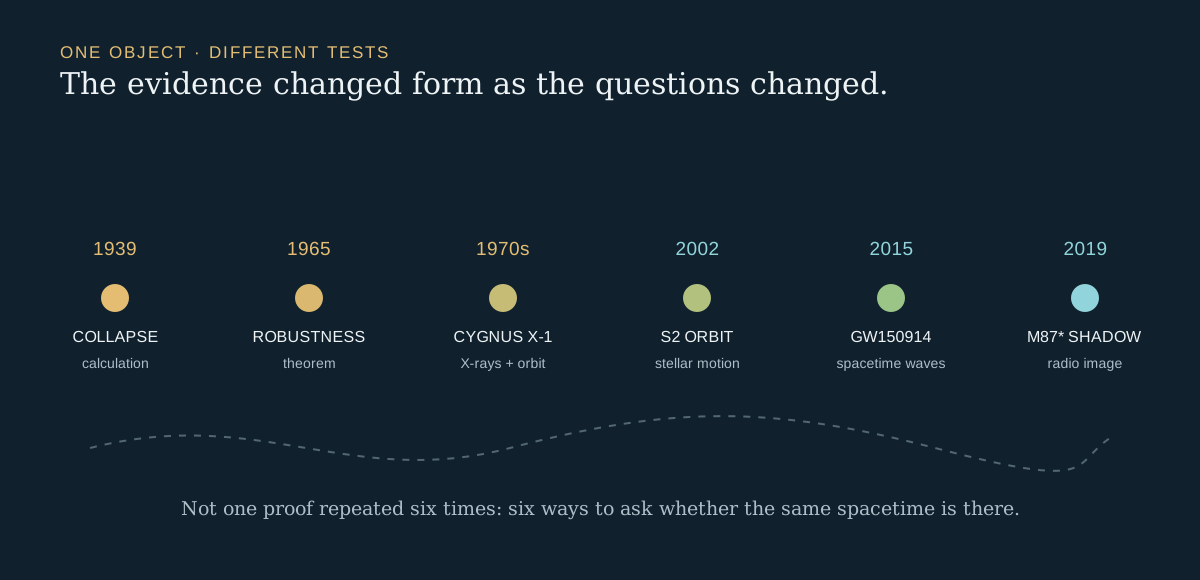
The EHT observations of Sagittarius A* and M87* are consistent with the shadow sizes expected for black holes of roughly four million and 6.5 billion solar masses. That is evidence about the spacetime and emitting material near the horizon—not a view from inside it. [7, 8]
What the boundary changes
Outside a horizon, an outward light beam can still increase its distance from the black hole. Inside, even an outward-pointing light beam cannot reach the external universe. The phrase “nothing can escape” is therefore not a statement that objects simply need stronger engines. The geometry has removed the outward destination from their possible futures.
It is where “out” stops being a possible future.
Next, return to special versus general relativity for the role of curved spacetime, or read how Einstein changed the meaning of gravity.
Sources & further reading
- NASA Science — Black Holes ↗
- NASA Science — Frequently Asked Questions on Black Holes ↗
- NASA Space Math — Black Hole Math ↗
- NASA Science — Black Hole Visualization Takes Viewers Beyond the Brink ↗
- Living Reviews in Relativity — Isolated and Dynamical Horizons and Their Applications ↗
- Einstein Online — How the Event Horizon Telescope observes black holes ↗
- Event Horizon Telescope — First Sagittarius A* Results: The Shadow ↗
- Event Horizon Telescope — Astronomers Capture First Image of a Black Hole ↗
Prepared with AI assistance. Sources are linked for verification. See our editorial approach.
Keep a little room for curiosity.
Save the journal for your next visit, or get new articles in a reading app.
Ways to stay updated ↗