OPEN THE CASEBOOK / 05
Where do the pictures part company?
Choose a case. Each answer separates the practical calculation from the deeper description.
01An apple falls near EarthOpen case
Newton: Use the gravitational force and the apple’s acceleration. For ordinary accuracy, this is the efficient answer.
Einstein: The apple follows a free-fall path through curved spacetime. Near Earth, the prediction is almost indistinguishable from Newton’s.
Verdict: different pictures, effectively the same everyday result.
02Mercury’s orbit slowly turnsOpen case
Newton: Explains nearly all the motion, including perturbations from other planets, but leaves a residual advance of about 43 arcseconds per century.
Einstein: The Sun’s spacetime geometry supplies the remaining advance.
Verdict: a tiny mismatch reveals the boundary of an excellent approximation.
03Starlight grazes the SunOpen case
Newtonian picture: Ordinary Newtonian gravitation was not a complete account of light propagation and did not yield general relativity’s full deflection.
Einstein: Light follows spacetime geometry; the solar-limb prediction is roughly 1.75 arcseconds.
Verdict: the 1919 eclipse offered a visible way to compare predictions.
04A spacecraft crosses the Solar SystemOpen case
Newton: Provides the workhorse trajectory for most mission planning.
Einstein: Adds corrections when timing, navigation, or proximity to a massive body demands them.
Verdict: use the simplest model accurate enough for the question.
Conceptual comparison, not a numerical calculator. Opening a case stores or submits nothing.
One universe, two ways of seeing it
An apple drops. The Moon keeps falling around Earth. Mercury circles the Sun. Newton and Einstein can both describe these motions—but they do not tell the same story about what gravity is.
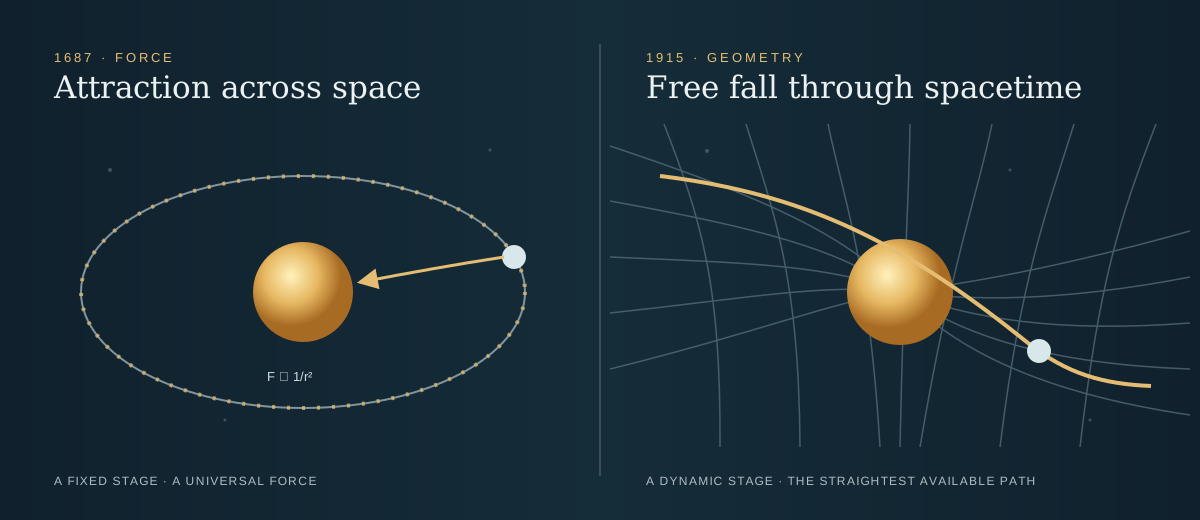
In Newtonian gravity, masses attract one another with a force whose strength falls with the square of their separation. In general relativity, freely falling bodies follow the straightest available paths through curved spacetime. The first picture is not useless because the second is deeper. For weak gravitational fields and ordinary speeds, Einstein’s theory recovers Newton’s as an excellent approximation. [1]
The history is therefore not a contest with one winner and one loser. It is a lesson in how science can preserve successful predictions while changing the concepts beneath them.
1687 / Newton joins Earth to the heavens
Before Newton, the motion of a falling object and the motion of a planet could look like different kinds of problem. The Principia, published in 1687, brought terrestrial and celestial motion into one mathematical framework. The same universal gravitation that pulls an object toward Earth also supplies the inward acceleration that keeps the Moon in orbit. [2, 3]
That unification was the revolution. An orbit was no longer a separate celestial rule: it could be understood as continual free fall combined with sideways motion. Together with the laws of motion, the inverse-square law explained Kepler’s planetary patterns and made precise predictions possible.
The familiar apple story is not needed to establish any of this. Whatever prompted Newton’s early thinking, the achievement was the mathematical system and its contact with observation.
A powerful law—and an open question
Newton’s theory told physicists how gravity varied with mass and distance, but it did not supply a mechanical cause for the attraction. In the 1713 General Scholium, Newton wrote that he had not derived the cause of gravity’s properties from phenomena and would not invent a hypothesis to fill the gap. [4]
That restraint is easy to misunderstand. It was not an admission that the law had failed. A theory can organize observations and predict motion without answering every question about its underlying mechanism.
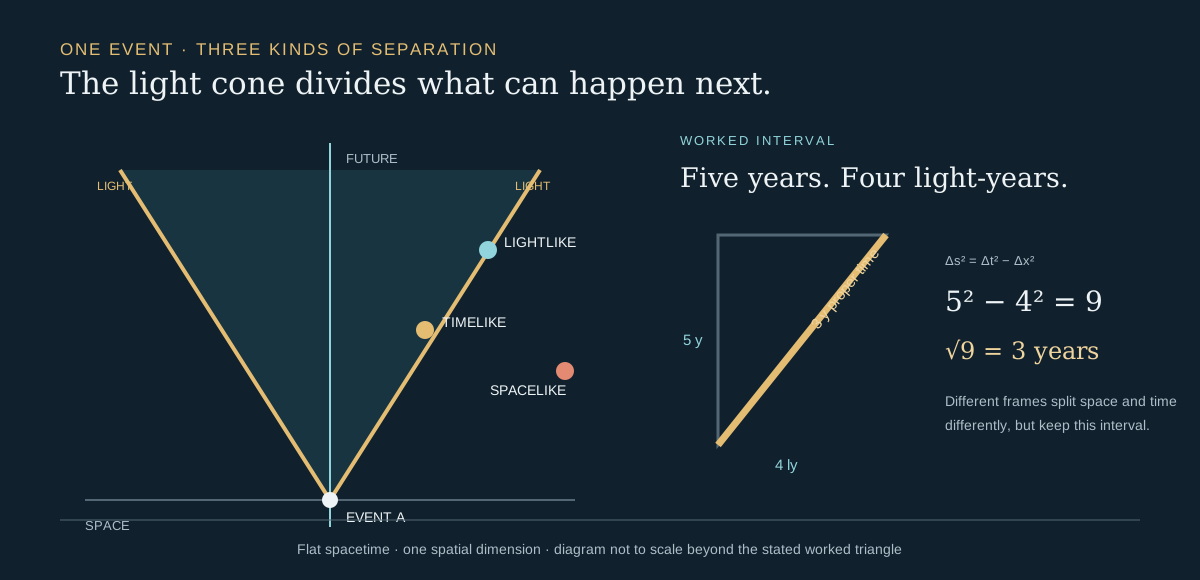
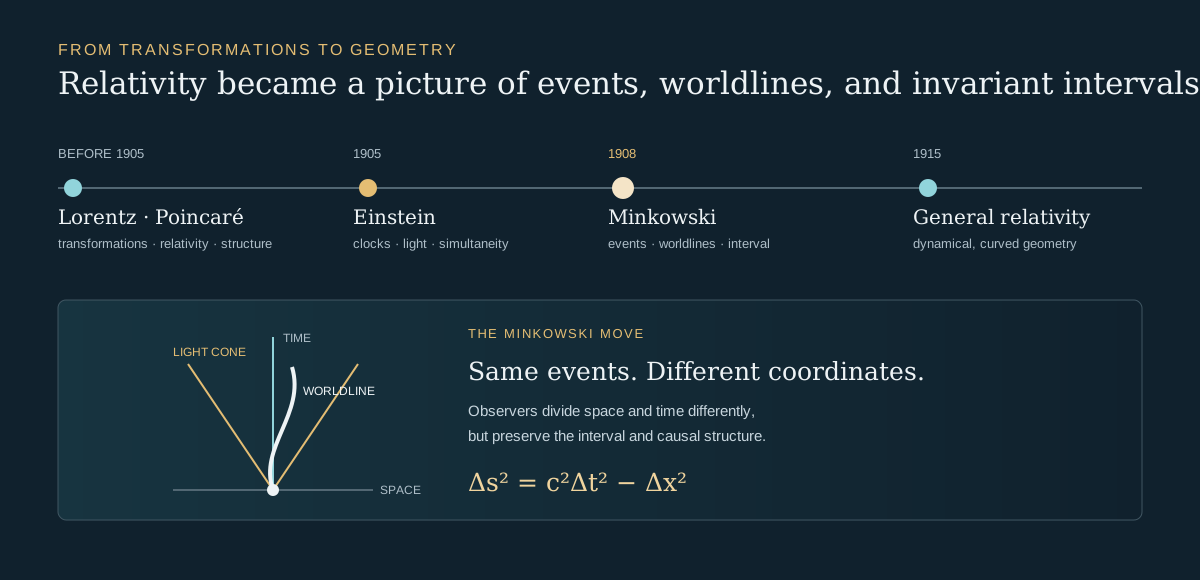
Still, the conceptual picture came with commitments: space and time provided a fixed stage, and gravitational influence entered as a force between bodies. Centuries later, special relativity made that stage difficult to keep. A theory in which no physical influence outruns light could not simply inherit instantaneous action across distance.
1915 / Gravity becomes geometry
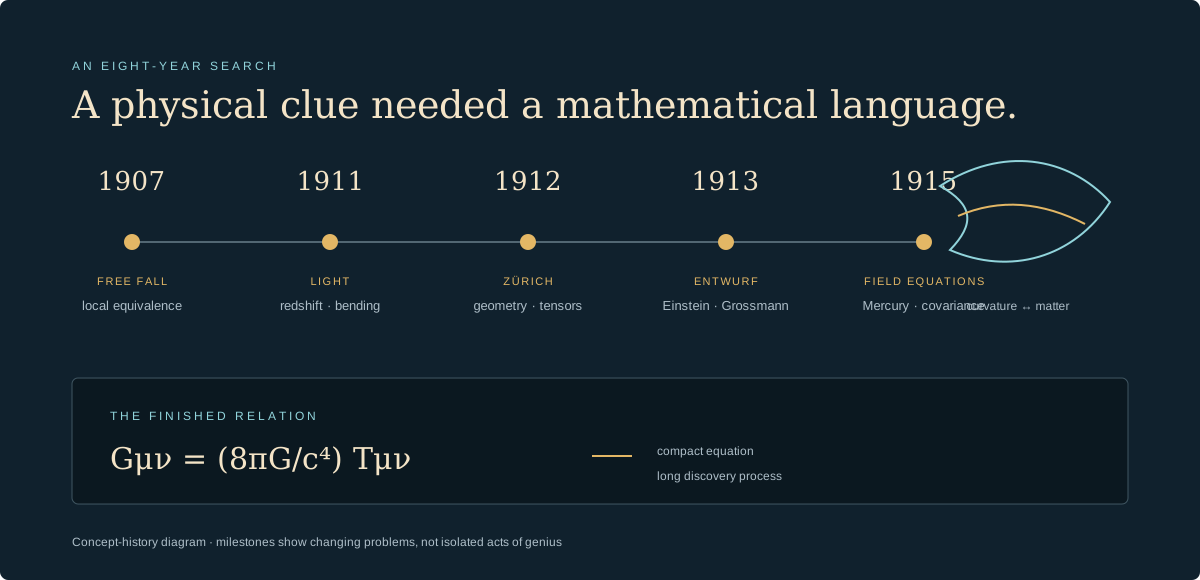
Einstein’s route from special relativity to a new theory of gravity took roughly a decade. One clue was the equivalence principle: inside a sufficiently small freely falling laboratory, gravity can disappear locally. But widen the laboratory and tidal effects remain—neighboring falling objects can converge or separate. General relativity describes that irreducible pattern through spacetime curvature. [5]
This changes the grammar of the explanation. Earth is not held in orbit by an invisible rope pulling through a passive arena. Matter and energy affect spacetime geometry, and that geometry shapes free motion. “Curved spacetime” is not merely a poetic synonym for force; it belongs to a different mathematical framework.
It is also easy to turn the rubber-sheet picture into a new myth. A dented sheet uses ordinary gravity to explain gravity and suppresses the time part of spacetime. It can suggest that geometry matters, but it is not a model from which the theory’s predictions follow.
Mercury supplies a stubborn remainder
Newtonian calculations account for almost all of the rotation of Mercury’s elliptical orbit, including the effects of the other planets. A small residual advance of the orbit’s closest point to the Sun remained: about 43 arcseconds per century. [1]
On November 18, 1915, Einstein presented a calculation showing that his developing theory produced that remaining advance. One week later he presented the field equations in their final form. Mercury mattered because the new framework recovered the old theory’s enormous success and also reached a measurable detail beyond it. [6]
This is how a replacement theory earns trust: not by declaring the past foolish, but by explaining why the older account worked so well—and where its boundary lay.
1919 / The Sun turns into a lens
General relativity also predicted that light passing near the Sun would be deflected. A total solar eclipse on May 29, 1919 made stars near the darkened Sun photographable. British expeditions observed from Sobral in Brazil and Príncipe off West Africa; the results were announced in London on November 6 and published by Frank Dyson, Arthur Eddington, and Charles Davidson in 1920. [7, 8]
The measurements supported the larger deflection predicted by general relativity and helped make Einstein famous. They were not the final word. Historians and scientists have repeatedly examined the instruments, plate selection, and uncertainties. Later analysis argues that familiar claims of improper data rejection do not fit the surviving evidence, while modern tests have long since become far more precise. [9]
Calling the eclipse a single experiment that “proved Einstein right” flattens a better story. It was important evidence inside an accumulating case.
What changed—and what did not
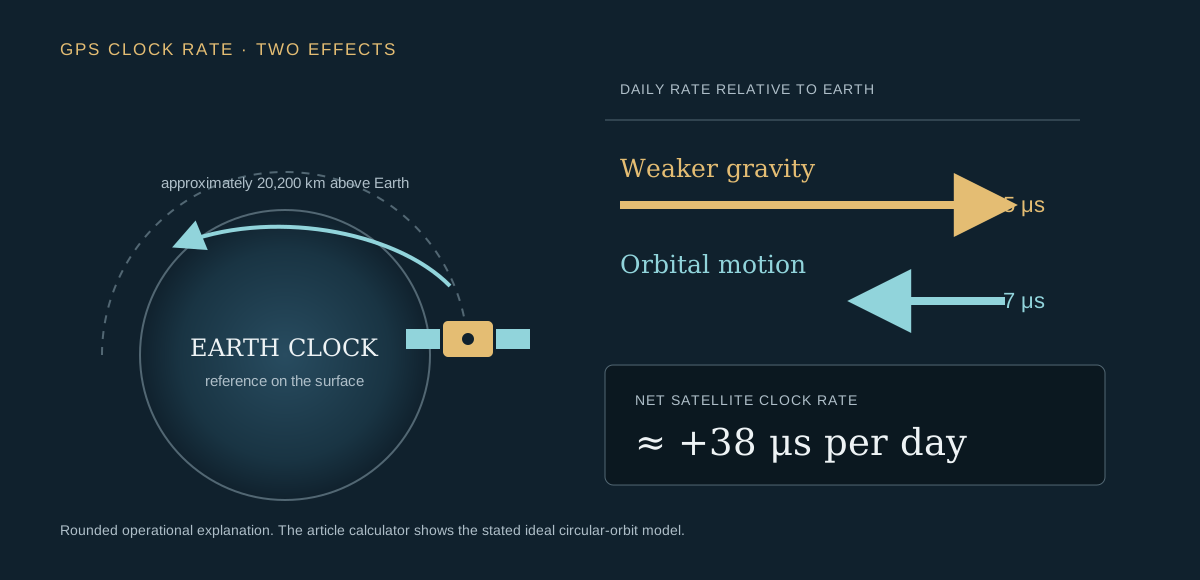
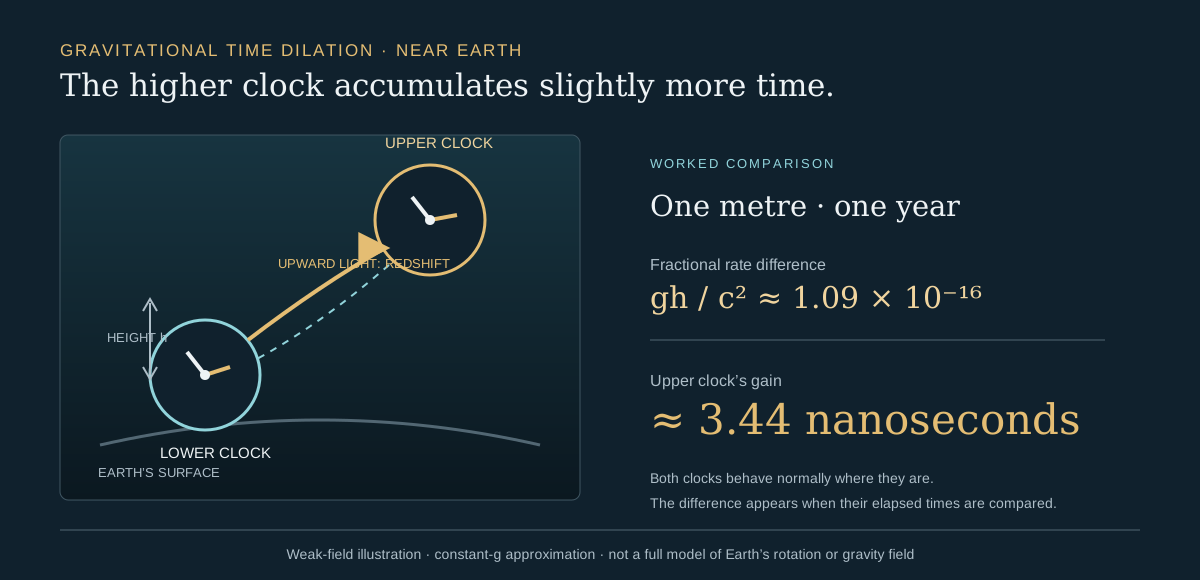
Newton’s equations still guide engineering, astronomy, and spacecraft calculations whenever relativistic corrections are too small to matter. General relativity is not used because Newton was careless; it is used when the question demands a more complete account—precision clocks, strong gravitational fields, light propagation, gravitational waves, or the slow precession hidden in Mercury’s orbit.
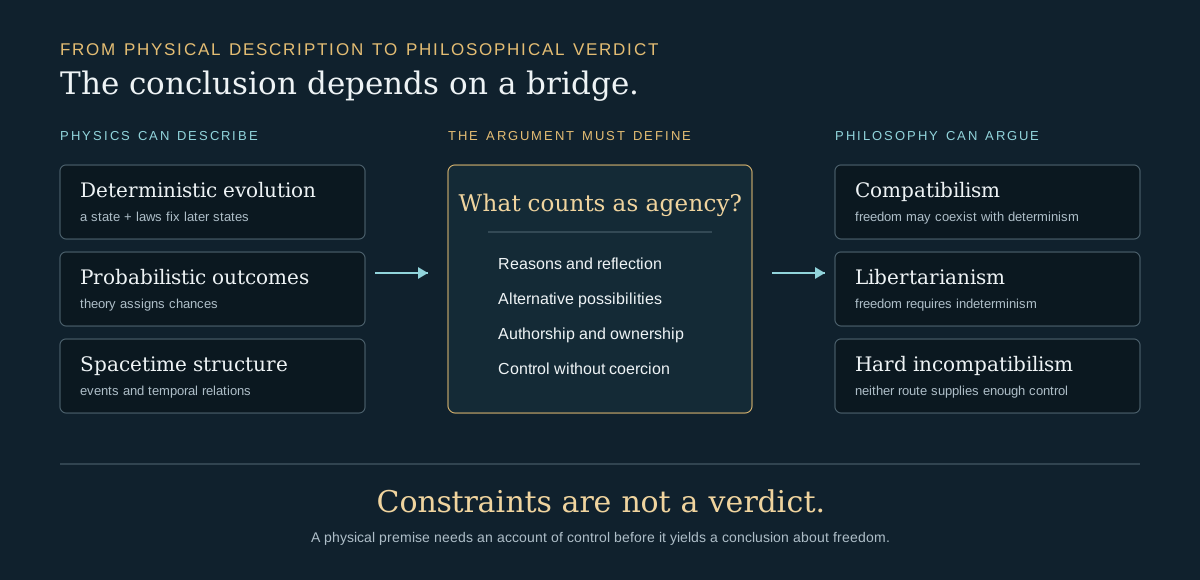
The philosophical change is real but should be stated carefully. The physics establishes a successful geometric theory of gravity. Further claims about whether spacetime is a substance, a network of relations, or something else are interpretations, not additional measurements. [10]
while changing what the question means.
Continue with the difference between special and general relativity, or step back to Einstein’s 1905 papers to see the earlier rethinking of light, atoms, time, and energy.
Sources & further reading
- Markus Pössel, Einstein Online — Step by step from Newton to Einstein ↗
- NASA Science — Gravity and mechanics ↗
- The Newton Project — Newton’s life and work at a glance ↗
- Isaac Newton, General Scholium (1729 English edition), The Newton Project ↗
- Markus Pössel, Einstein Online — Gravity: from weightlessness to curvature ↗
- Einstein Papers Project — One hundred years of the field equations and Mercury’s perihelion ↗
- F. W. Dyson, A. S. Eddington and C. Davidson (1920) — A determination of the deflection of light by the Sun’s gravitational field ↗
- The Royal Society — Observing general relativity ↗
- Gerard Gilmore and Gudrun Tausch-Pebody (2022) — The 1919 eclipse results and their later detractors ↗
- Stanford Encyclopedia of Philosophy — The Hole Argument ↗
Prepared with AI assistance. Sources are linked for verification. See our editorial approach.
Keep a little room for curiosity.
Save the journal for your next visit, or get new articles in a reading app.
Ways to stay updated ↗