EXPLORE THE IDEAS / 02
Four papers. Four doors.
The idea buttons are unavailable until they load. You can still read each explanation below: light, atoms, time, and energy.
Choose an idea to see the question Einstein was trying to answer.
What if light comes in packets?
Increasing brightness and increasing frequency are not the same change. The light-quantum idea helped explain how light transfers energy to electrons.
Think about it: why might brighter red light fail to do what dimmer violet light can?
Before the icon
In 1905, Albert Einstein was working at the Swiss patent office in Bern. That year he published four landmark papers addressing the photoelectric effect, Brownian motion, special relativity, and mass–energy equivalence. Together, they changed the questions physicists could ask about matter, light, and time. [1]
It is tempting to compress the year into an inspirational story about an overlooked genius. But the ideas become more interesting when we separate them. Each paper addressed a different problem; none was simply an early chapter of general relativity, which came later.
01 / Light arrives in packets
Light can eject electrons from a material. The relationship between the light’s frequency and the emitted electrons’ energy was a challenge for a purely classical wave account.
Einstein proposed that light could behave as discrete energy quanta, with energy proportional to frequency. A quantum could transfer energy to an electron; some energy was needed for the electron to escape the material, with the remainder available as kinetic energy.
This helps explain why changing frequency is different from simply increasing brightness. More low-energy quanta do not each become higher-energy quanta. Einstein’s work on the photoelectric law was specifically recognized in his 1921 Nobel Prize citation. [2]
02 / Invisible atoms leave visible traces
Brownian motion is the irregular motion of small particles suspended in a fluid. Einstein connected that observable wandering to the effects of molecules striking the particles.
The value of the explanation was quantitative: molecular ideas could make predictions about measurable motion. A particle viewed through a microscope could become evidence about a world far smaller than the microscope could directly resolve. This work helped make the reality of atoms experimentally testable. [3]
03 / Time becomes part of the problem
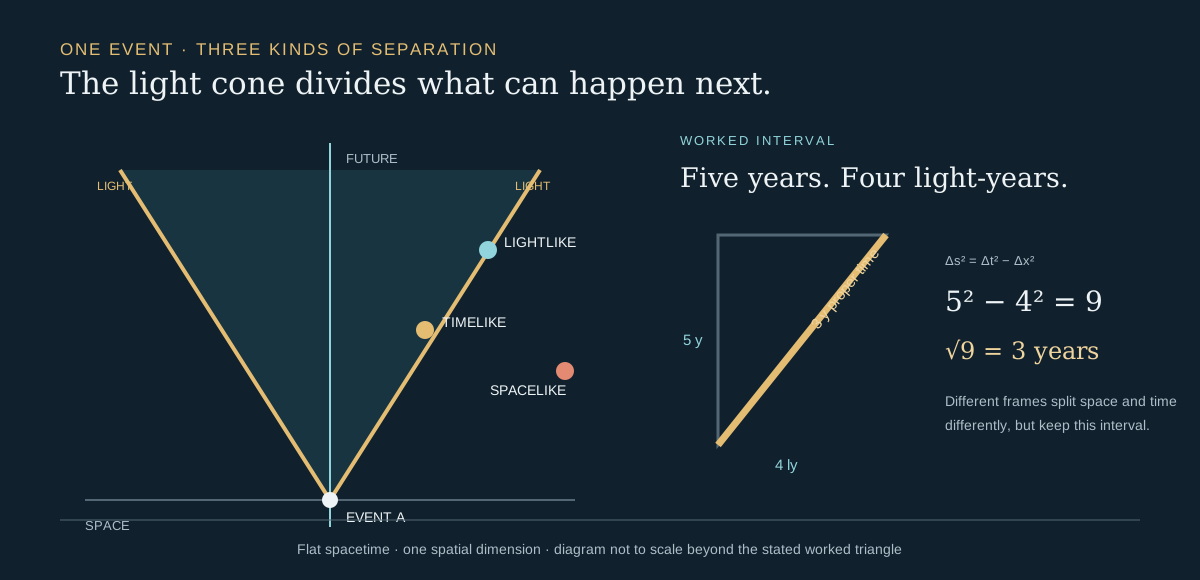
Special relativity reworked the relationship between space and time. Its starting points were the equivalence of inertial reference frames for the laws of physics and the same vacuum light speed for inertial observers.
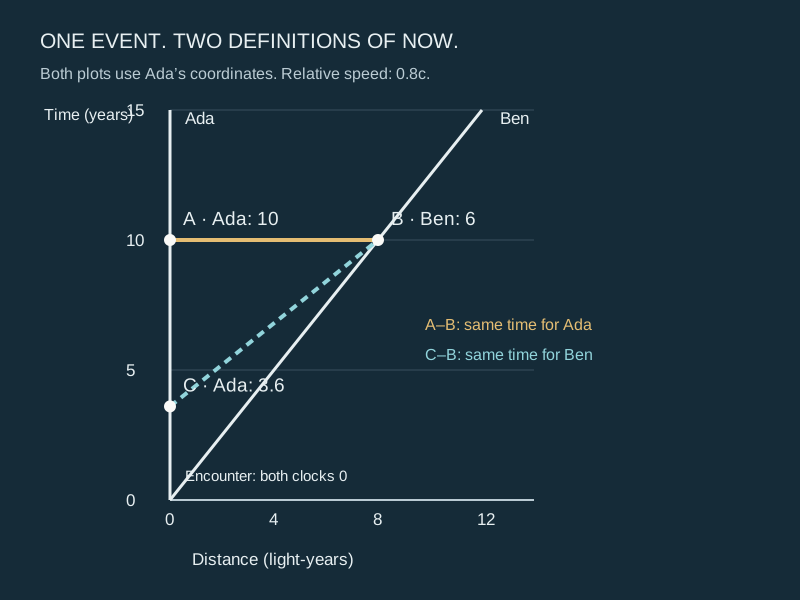
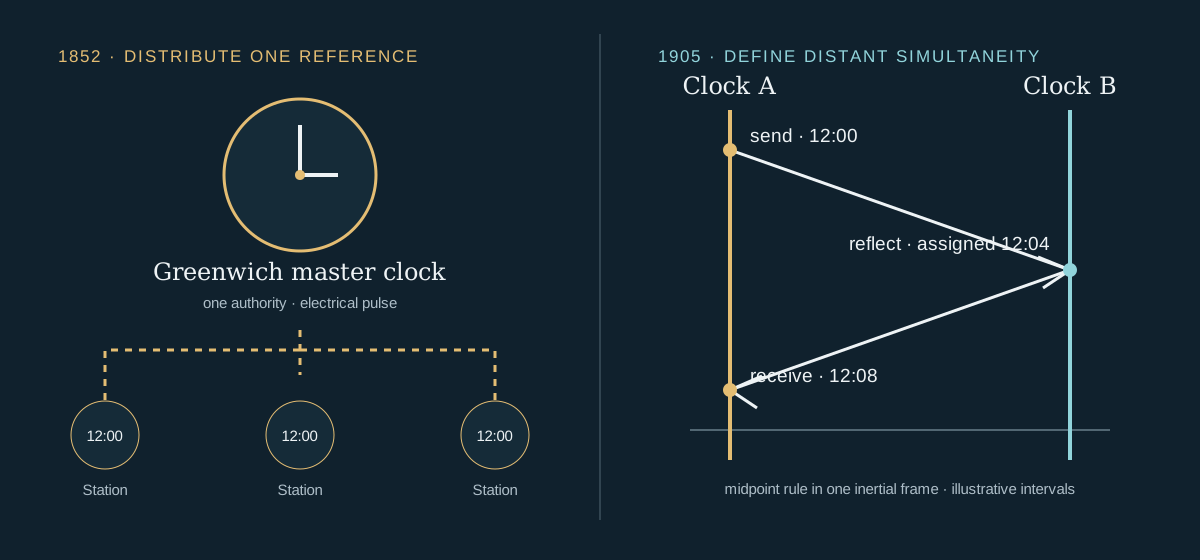
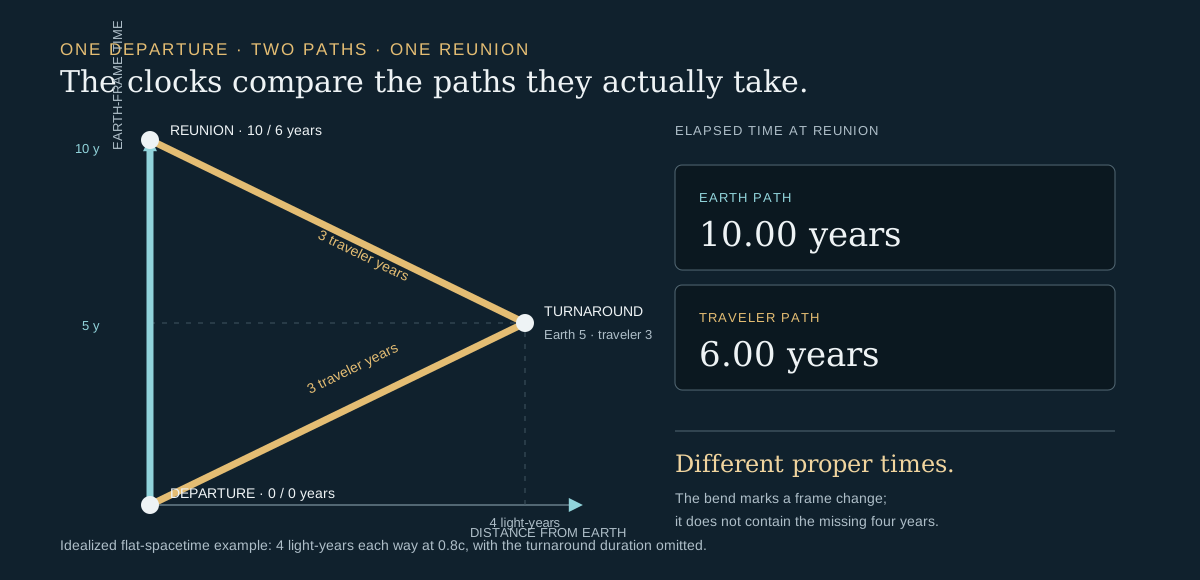
Clock comparisons could no longer assume one universal time shared by everyone. The consequences include time dilation and the relativity of simultaneity. To see why, begin with our light-clock explanation.
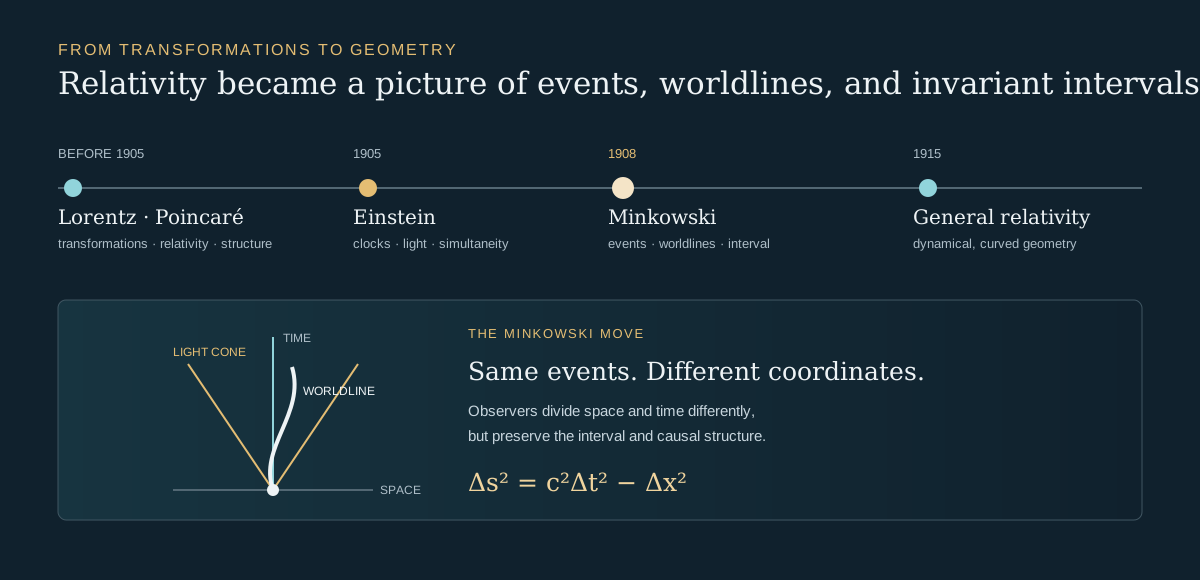
Einstein worked within an active scientific conversation. Lorentz and Poincaré were among the important contributors to the development of relativity. Treating the history as a single person’s isolated revelation hides the questions and mathematical work that helped make it possible. [4]
04 / Mass and energy meet
Another short 1905 paper connected a body’s energy content to its inertia. The relationship is now familiar as E = mc²: rest energy equals mass multiplied by the square of the speed of light. [1]
The equation does not say that every object releases that energy easily, or that mass simply disappears without accounting. It gives a relation that must be interpreted within energy conservation and the physical process being considered.
It was a new set of questions.
Read the four papers as four different moves: reconceiving light, connecting visible motion to molecules, rebuilding clock comparisons, and relating mass to energy. That is a richer introduction to Einstein than a list of quotations—and a better starting point for understanding what followed.
Sources & further reading
- Nobel Prize — Albert Einstein: questions and answers ↗
- Nobel Prize — The photoelectric effect ↗
- Nobel Prize — The Nobel Prizes in Physics 1901–2000 ↗
- Nobel Prize educational resource — A short history of relativity ↗
Prepared with AI assistance. Sources are linked for verification. See our editorial approach.
Keep a little room for curiosity.
Save the journal for your next visit, or get new articles in a reading app.
Ways to stay updated ↗