COMPARE THE EVENTS / 06
Keep Ben’s six-year event fixed.
Before opening either comparison, predict which reading of Ada’s clock it will pair with Ben’s. Open both to compare. The diagrams use the same Ada-frame axes.
Use Ada’s definition of simultaneous
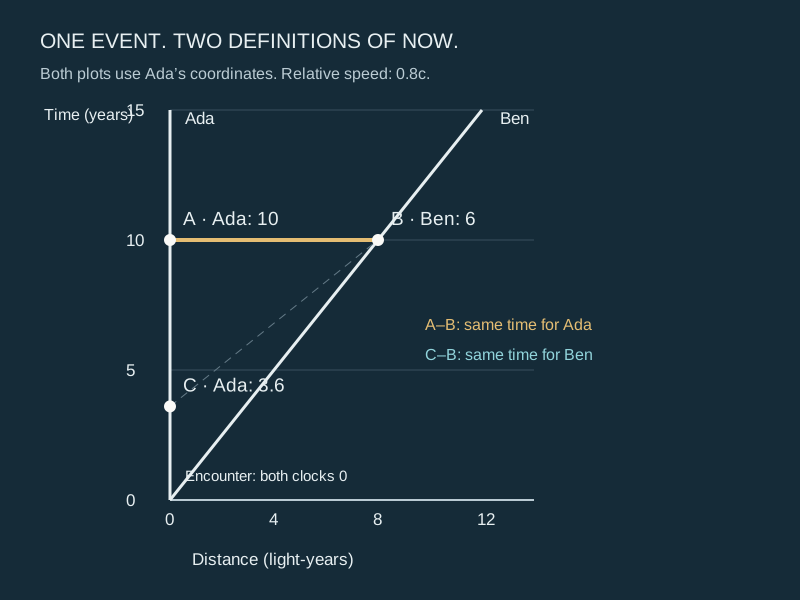
A and B: 6 ÷ 10 = 0.6. Ada calculates that Ben’s clock runs at 60% of her frame’s clock rate.
Use Ben’s definition of simultaneous
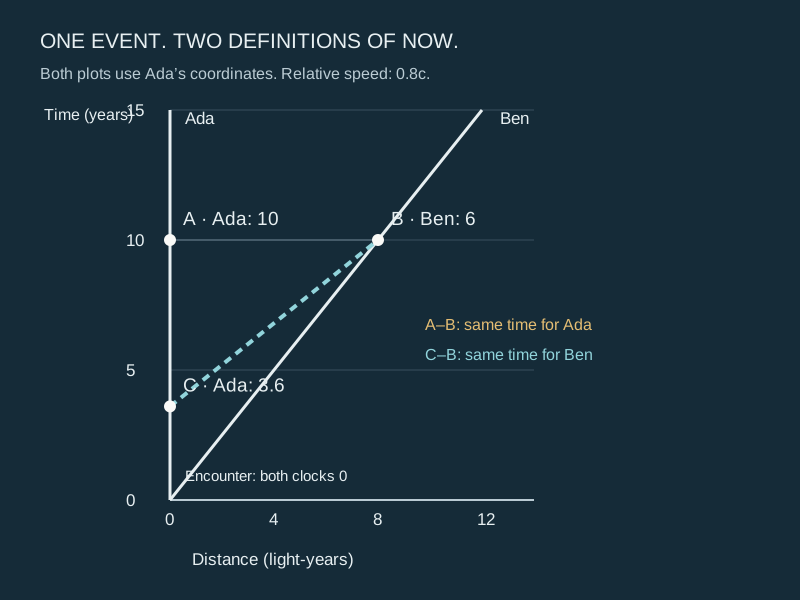
C and B: 3.6 ÷ 6 = 0.6. Ben calculates that Ada’s clock runs at 60% of his frame’s clock rate.
Exact idealized coordinates at 0.8c. No gravity, acceleration or light-signal delay is included. Opening a comparison sends no custom interaction event. Both disclosures work without JavaScript and require no animation.
The short answer: they compare different events
Both inertial observers can correctly calculate that the other’s clock runs slowly. Their comparisons use different pairs of distant events, because they disagree about which events happen simultaneously. Neither clock is broken. Neither observer has access to a preferred cosmic time. [1]
The apparent contradiction comes from silently assuming a shared meaning of “right now over there.” Special relativity does not supply that shared distant now. It supplies a consistent way to translate between frames.
Our time-dilation calculator gives six years on a moving clock for ten reference-frame years at 80% of light speed. This article answers the next question: what happens when the moving observer does the calculation?
First separate a clock reading from a photograph
When physicists say a moving clock runs slowly, they mean its rate compared with synchronized clocks in an inertial reference frame, after accounting for the travel time of light. A telescope image arrives late. It cannot, by itself, tell you what a distant clock reads at the time you receive the image.
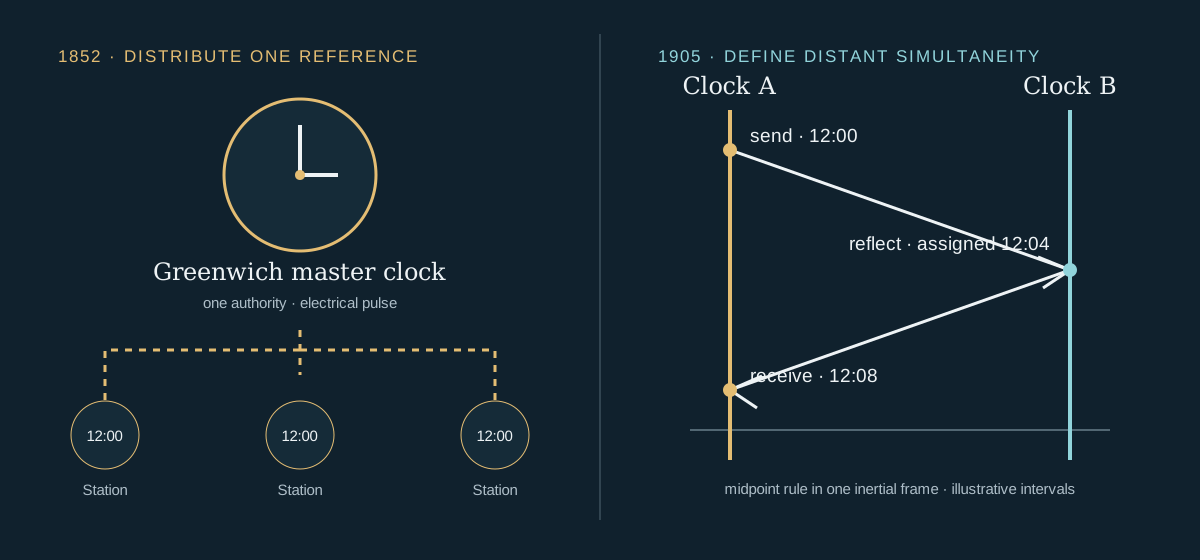
To assign times across a frame, imagine a network of stationary clocks synchronized using light signals and the usual Einstein synchronization procedure. Each moving observer can construct such a network in their own frame. Networks that agree internally need not agree with one another about distant simultaneity. [2]
Keep that distinction throughout the example: “assigns as simultaneous” is a statement about coordinates, not a claim that information arrives instantly.
One encounter, followed by three events
Ada and Ben coast past each other in otherwise empty, flat spacetime. They set their clocks to zero at that encounter. Ben moves at 0.8 times light speed relative to Ada. Both continue at constant velocity; there is no turnaround, gravity, or reunion.
Use Ada’s coordinates first. Ten years after the encounter, Ben is eight light-years away. His own clock reads six years. Call that event B. The event on Ada’s clock that is simultaneous with B in Ada’s frame is A: Ada reading ten years.
Now keep B fixed and ask what Ben assigns as simultaneous with it. Ben pairs B with a different event on Ada’s clock: C, where Ada reads 3.6 years. The two comparisons are therefore:
- Ada’s frame: Ben records 6 years during 10 Ada-frame years.
- Ben’s frame: Ada records 3.6 years during 6 Ben-frame years.
Both ratios are 0.6. The ten-year and 3.6-year readings refer to different events on Ada’s worldline, the path her clock traces through spacetime. No one says that Ada’s single clock shows both readings at the same event.
Where the 3.6 years comes from
The Lorentz transformation converts the time and position of an event between these frames. In units of years and light-years, where light travels one light-year per year, the time equation becomes:
At B, put in t = 10 and x = 8: t′ = (5/3)(10 − 6.4) = 6 years. Ada remains at x = 0. To find the event on her clock with that same Ben-frame time, solve 6 = (5/3)t. The answer is t = 3.6 years: event C. This is a worked application of the Lorentz transformation, not a separate experimental measurement. [3]
The subtraction involving position is the crucial part. Changing frames changes the time assigned to a distant event, not just the rate assigned to a clock.
What the diagram is telling you
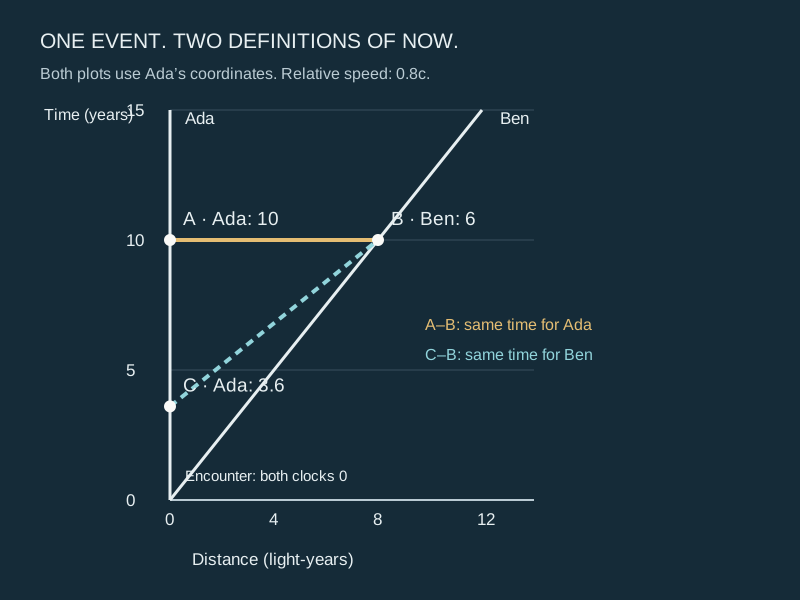
Read the plot upward as increasing Ada-frame time, and rightward as increasing Ada-frame distance. Ada’s worldline is vertical because she stays at x = 0 in these coordinates. Ben’s line slopes because his position changes.
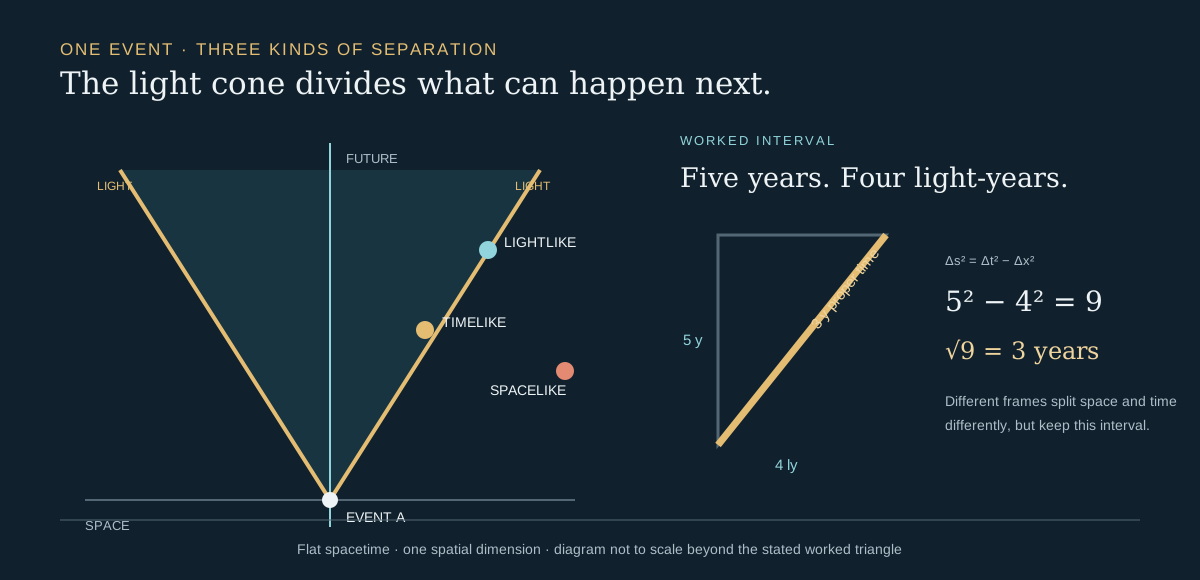
The horizontal A–B segment joins events simultaneous in Ada’s frame. The sloping C–B segment joins events simultaneous in Ben’s frame. These are comparison lines, not light signals or journeys. The plotted coordinates stay in Ada’s frame even when the highlighted comparison changes.
A helpful geometric analogy is two people using different directions to decide which landmarks are alongside one another. They can disagree about alignment without disagreeing that the landmarks exist. Spacetime uses its own geometry, so an ordinary landscape is only an analogy. [4]
Why a reunion asks a different question
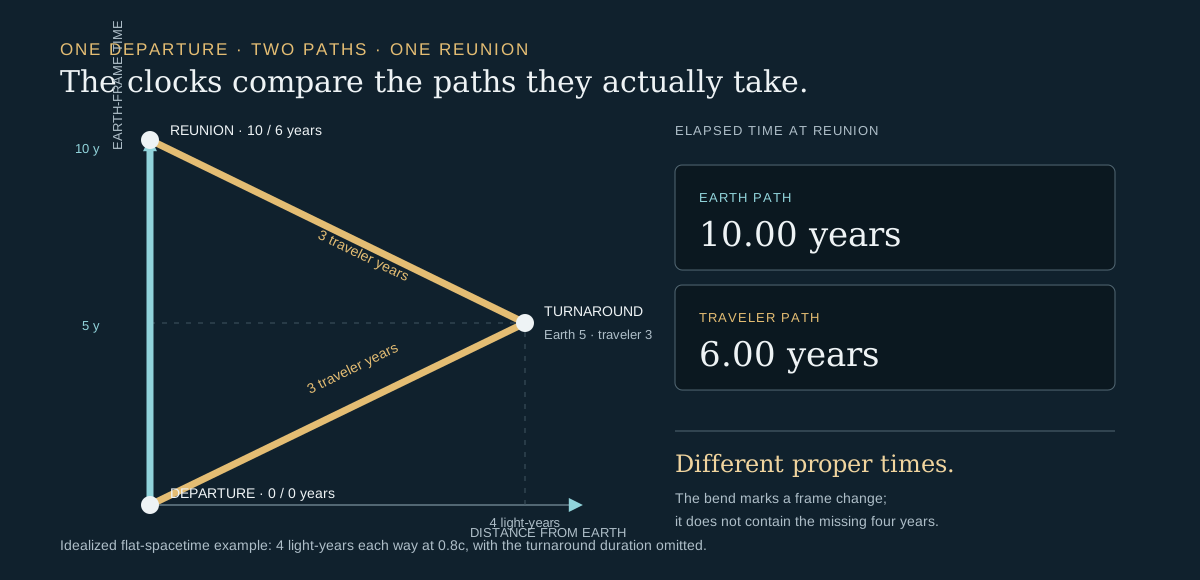
If Ada and Ben meet again, they can place their clocks side by side. They will agree on each clock’s elapsed time. But two straight, constant-velocity worldlines that cross once cannot cross a second time: someone must change motion.
In the standard twin example, the traveler switches between outbound and inbound inertial frames while the stay-at-home twin follows one inertial path. Applying one reciprocal, constant-speed comparison to the whole journey misses that asymmetry. The final ages depend on the complete paths between departure and reunion. [5]
Acceleration does not make distant clocks physically jump. A change of reference frame changes which distant events are assigned the same time. For the distinction between acceleration and gravity, see special versus general relativity.
Try the guided time-dilation activity next. For each answer, add one sentence: whose frame supplies the comparison, and which events does it compare?
Sources & further reading
- Markus Pössel, Einstein Online — The dialectic of relativity ↗
- Markus Pössel, Einstein Online — The definition of “now” ↗
- OpenStax, University Physics III, section 5.6 — The Lorentz Transformation (LibreTexts edition) ↗
- Markus Pössel, Einstein Online — Time dilation on the road ↗
- Markus Pössel, Einstein Online — The case of the travelling twins ↗
Prepared with AI assistance. Sources are linked for verification. See our editorial approach.
Keep a little room for curiosity.
Save the journal for your next visit, or get new articles in a reading app.
Ways to stay updated ↗