CONCEPT EVOLUTION DESK / 15
What changed—and who changed it?
Open the six files in order. Each contribution answers one problem while leaving another unfinished.
01Lorentz · transformation rulesWhat stayed the same?
Contribution: transformations that preserve the form of electromagnetic equations and connect measurements in moving systems.
Not yet: Einstein’s operational redefinition of simultaneity or Minkowski’s fully geometric synthesis.
02Poincaré · relativity and structureHow do the rules fit together?
Contribution: emphasis on the relativity principle, the group character of Lorentz transformations, and important four-dimensional mathematical steps.
Not yet: the same event-centered geometric program Minkowski presented in 1908.
03Einstein · clocks, light, simultaneityWhat do observers measure?
Contribution: a physical theory built from the relativity principle and invariant light speed, with distant time defined by light-signal synchronization.
Not yet: a theory initially written as four-dimensional spacetime geometry.
04Minkowski · events and worldlinesWhat is the shared geometry?
Contribution: a four-dimensional framework in which observers use different coordinates for the same events while preserving intervals and causal structure.
Gain: time dilation, length contraction, and relativity of simultaneity become related aspects of one geometry.
05Einstein and collaborators · curved geometryWhat about gravity?
Next step: general relativity made geometry dynamical and curved, using additional physical principles and tensor mathematics.
Limit: flat Minkowski spacetime is the local and gravity-free starting point, not the whole theory.
06Philosophers · what does the picture mean?Does every time exist?
Open question: spacetime geometry constrains accounts of time, especially any universal present.
Limit: the mathematical representation does not by itself prove eternalism, determinism, or fatalism.
A conceptual chronology, not a priority scoreboard. The categories overlap, and the history contains parallel work, revisions, and disagreements that no six-card sequence can fully represent.
Relativity did not arrive as a finished geometry
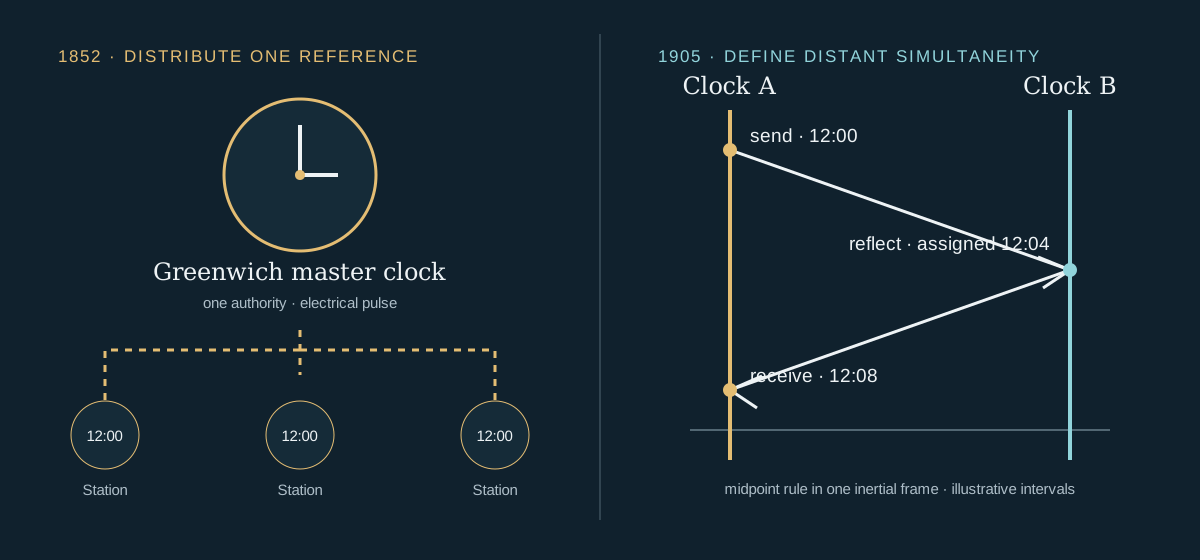
In 1905, Albert Einstein rebuilt the electrodynamics of moving bodies from two physical principles: the laws of physics take the same form in every inertial frame, and light in vacuum has the same speed for each such observer. His paper reworked the meaning of distant simultaneity and derived the transformations connecting measurements of space and time. [1]
Yet the theory was not immediately presented as the spacetime picture now found in textbooks. That synthesis came from Hermann Minkowski, a mathematician who had taught Einstein at the Zürich Polytechnic. In a lecture delivered in Cologne on 21 September 1908, Minkowski organized the theory around a four-dimensional geometry of events. [2, 3]
Calling this a change of notation would miss its force. Calling Minkowski the sole inventor of relativity would miss the history. Spacetime emerged from a chain of work by Lorentz, Poincaré, Einstein, Minkowski, and others—and each changed the problem in a different way.
Before Minkowski: transformations without a new world-picture
By the turn of the twentieth century, experiments and electromagnetic theory were putting pressure on older ideas of absolute space and time. Hendrik Lorentz developed coordinate transformations that preserved the form of Maxwell’s equations. Henri Poincaré clarified their group structure, emphasized the relativity principle, and explored a four-dimensional mathematical language. [4]
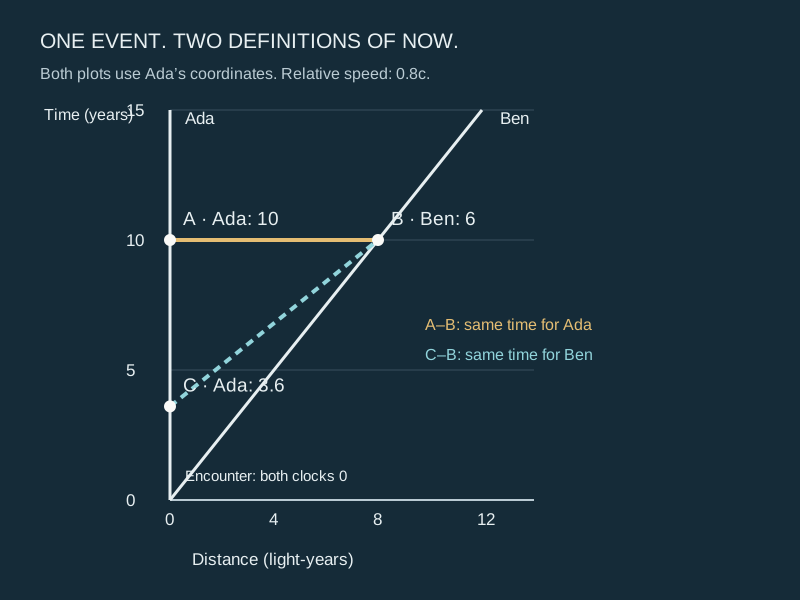
Einstein’s 1905 move was physical and operational. He asked how observers synchronize distant clocks using light signals, then treated the relativity principle and the invariant speed of light as foundations rather than as corrections hiding motion through an ether. The familiar effects—relativity of simultaneity, time dilation, and length contraction—followed from that reorganization. Our guide to Einstein’s 1905 papers tells that part of the story.
The important point is not to award a single trophy. Mathematical structures, physical interpretation, and experimental motivation advanced together, but not always in the same hands or at the same moment.
Minkowski’s decisive object was the event
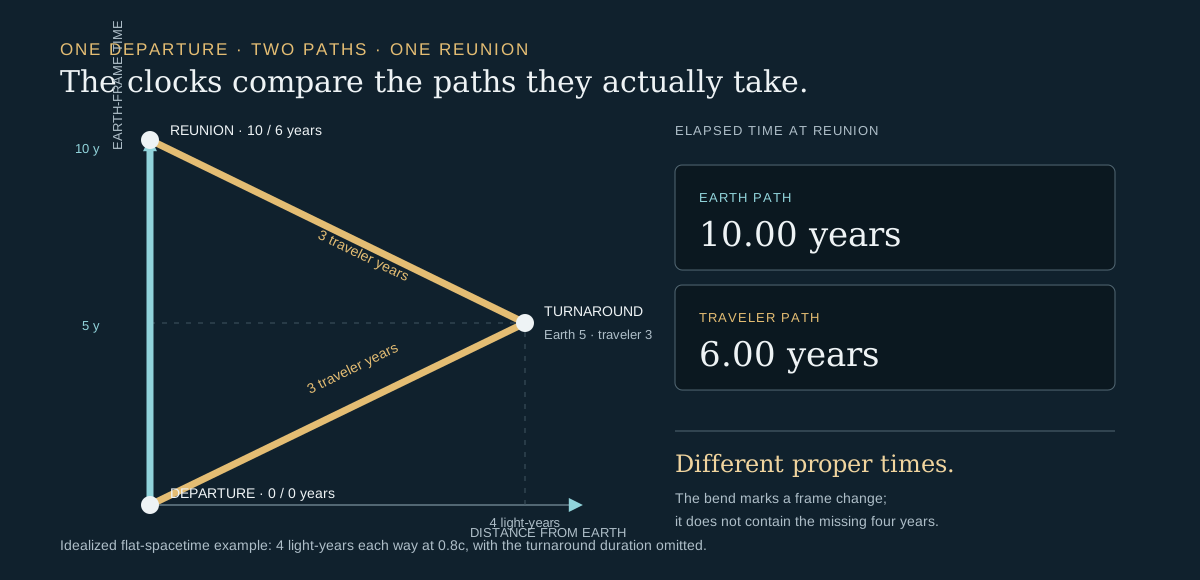
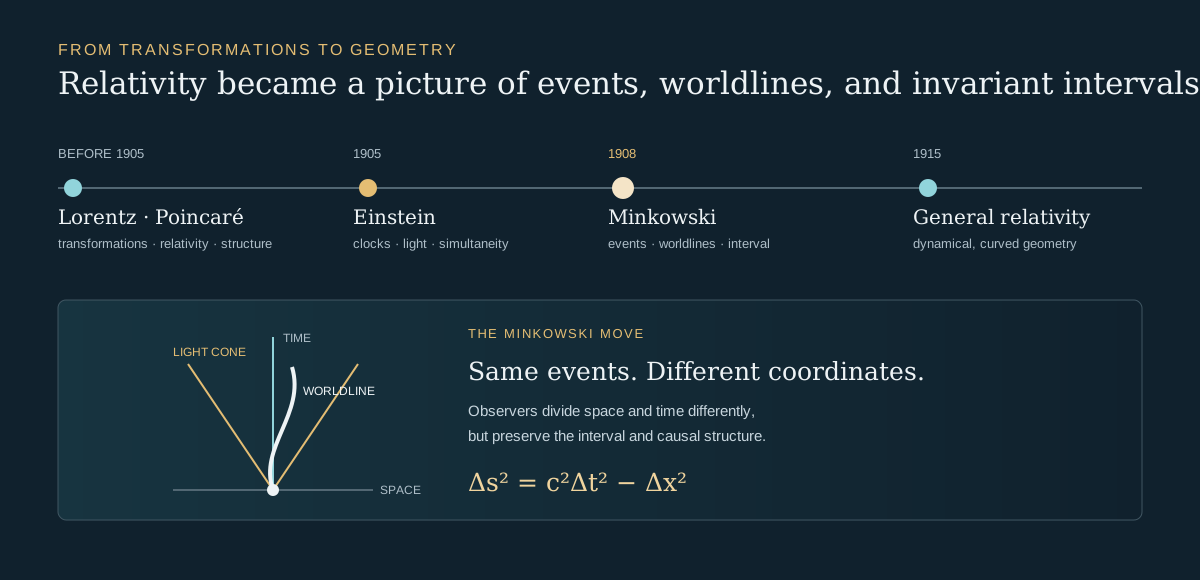
Minkowski treated a physical occurrence as an event with four coordinates: three for position and one for time. A particle’s history became a curve through this four-dimensional arena—a worldline. Different inertial observers could assign different space and time coordinates to the same event while agreeing on the underlying geometric relations. [2, 5]
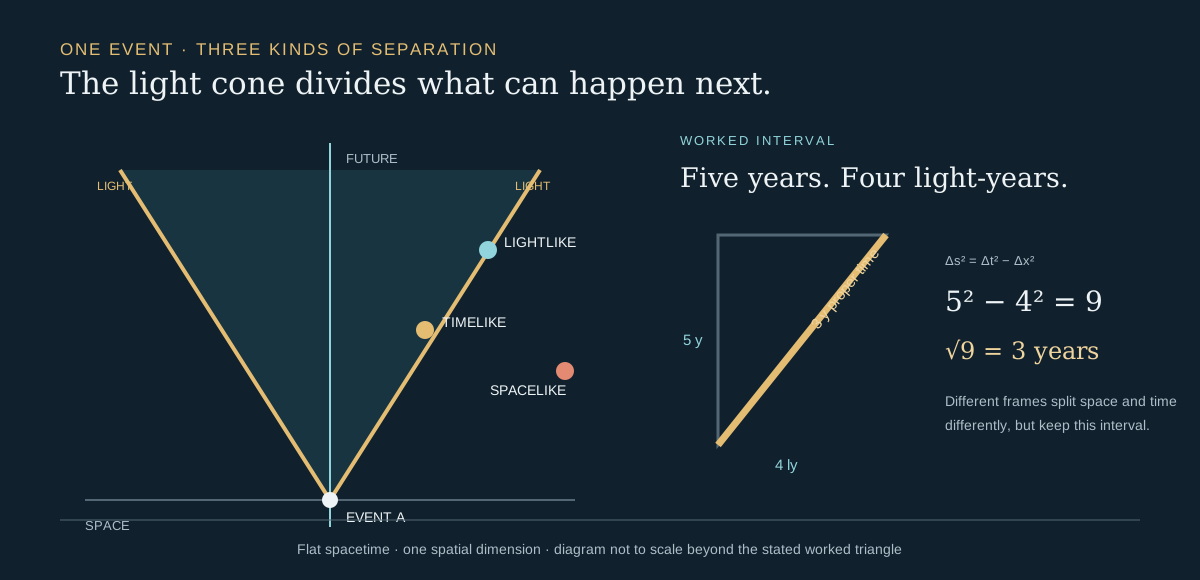
That shift made the Lorentz transformations resemble rotations, though in a geometry with a different sign for the time part. In one spatial dimension, a modern convention writes the invariant interval as:
Our light-cone and interval explorer develops the physics. The historical change was that effects which looked like separate adjustments to rods and clocks could now be read as projections of one geometry.
A diagram became a tool for causal reasoning
On a spacetime diagram, light rays mark the boundary between events that can be causally connected and events too far apart for any light-speed-or-slower influence. Timelike worldlines lie inside the light cone; ideal light paths lie on it. This structure is shared by all inertial observers even though their coordinate grids differ. [5]
The diagram did not merely decorate the equations. It made questions about possible influence, proper time, and simultaneity easier to organize. Max Born, Arnold Sommerfeld, and other physicists helped spread and extend the four-dimensional methods after Minkowski’s sudden death in January 1909. Historical research shows that acceptance was a process, not an instantaneous conversion to one formalism. [4]
Open the concept desk above to see what each contributor added—and what the next step still required.
Flat spacetime was not yet Einstein’s theory of gravity
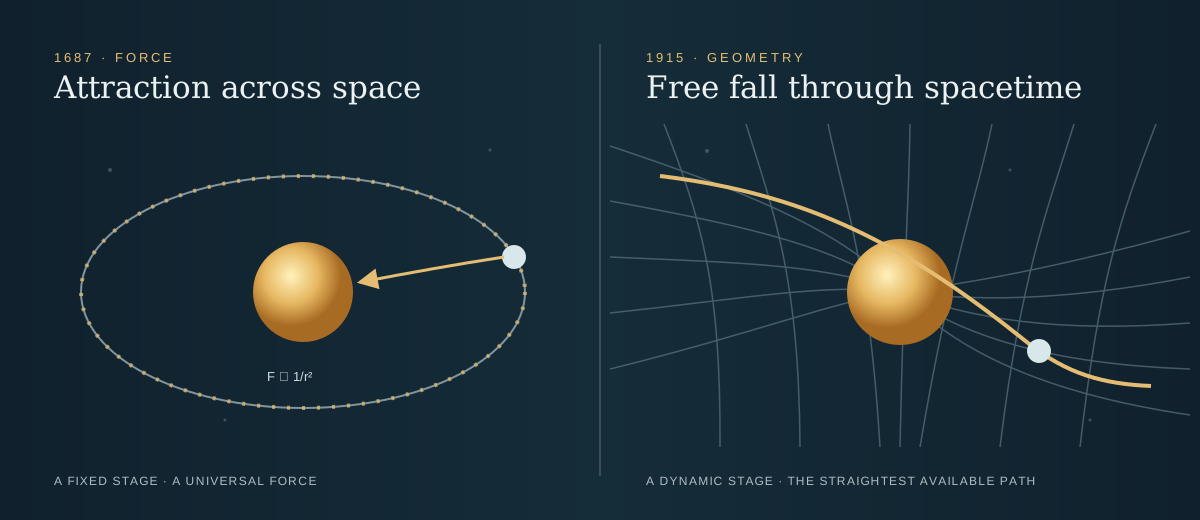
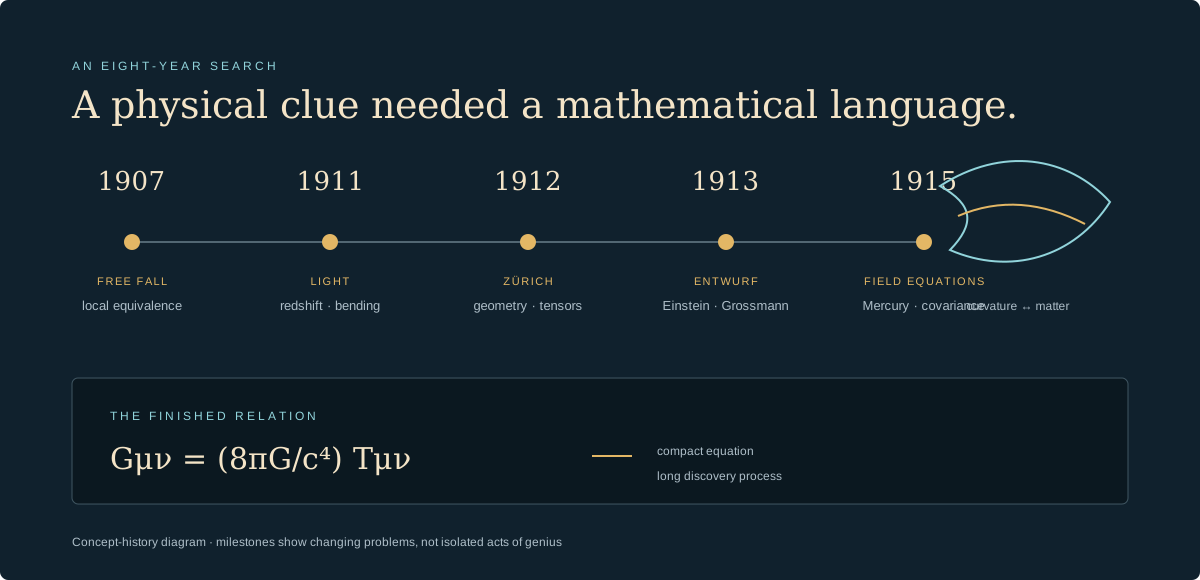
Minkowski spacetime is the flat geometry of special relativity. It describes inertial motion without gravity as curvature. General relativity went further: spacetime geometry became dynamical, responding to matter and energy, and freely falling bodies followed paths in curved spacetime.
Minkowski’s synthesis supplied concepts and mathematical habits that became essential to that later project, but it did not contain Einstein’s field equations or a complete geometric theory of gravitation. Einstein reached general relativity through additional ideas—including the equivalence principle—and through tensor methods developed by mathematicians such as Gregorio Ricci-Curbastro and Tullio Levi-Civita, with crucial collaboration from Marcel Grossmann. [6]
That is why “Minkowski invented general relativity” is false, while “Minkowski changed the language in which relativity could grow” is fair. Compare the two frameworks in our special versus general relativity guide.
Geometry does not settle the philosophy of time by itself
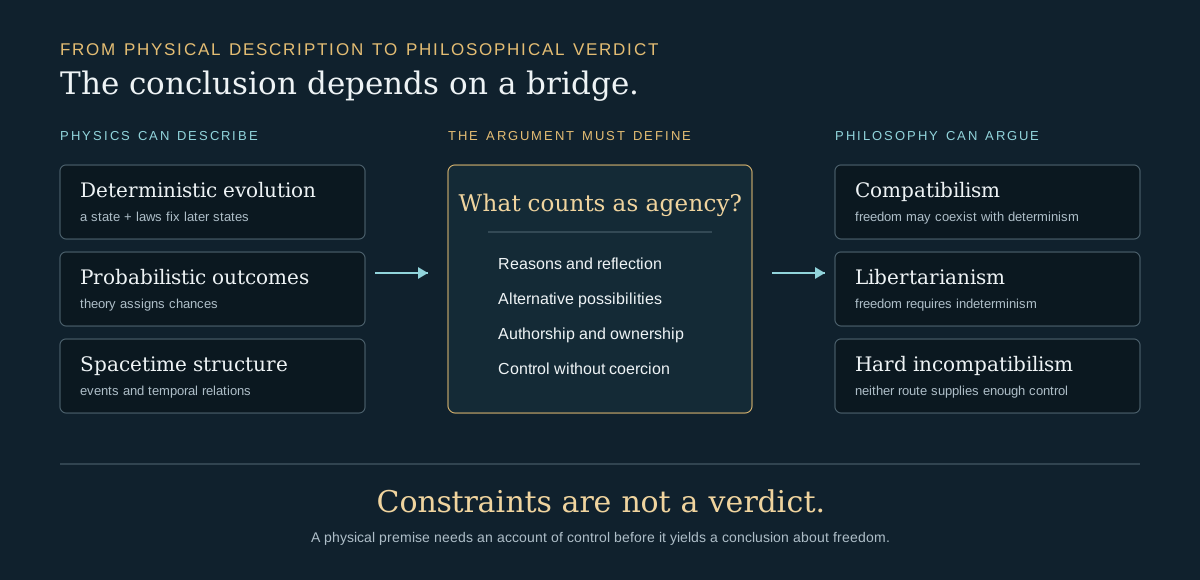
A four-dimensional representation places events from different times within one mathematical structure. That makes the spacetime picture hospitable to eternalism—the view that past, present, and future events all belong to reality. But usefulness in physics is not, by itself, a proof of that metaphysical conclusion. [7]
One must still ask what the formalism represents, whether an objective present can be added consistently, and what “existence” across time means. Those are philosophical questions constrained by relativity, not measurements read directly from a diagram.
This distinction protects both subjects. Physics tells us that inertial observers can divide spacetime into space and time differently while preserving causal structure. Philosophy asks what ontology best fits those facts. Our block-universe article compares the main positions without pretending the diagram has already voted.
The achievement was a synthesis, not a solo origin story
Minkowski’s achievement was to see that the transformations of relativity expressed a geometry—and to make that geometry a productive way of thinking. His 1908 lecture did not erase Lorentz’s transformations, Poincaré’s mathematical insights, or Einstein’s physical reconstruction. It revealed how their results could fit into a more unified structure. [2, 4]
The result is now so familiar that it can look inevitable. It was not. Turning equations into a world-picture required a mathematician willing to treat space and time together, physicists willing to adopt unfamiliar tools, and later researchers willing to distinguish what the geometry established from what it merely suggested.
Minkowski showed the geometry those rules had been describing.
Sources & further reading
- Albert Einstein, “On the Electrodynamics of Moving Bodies” (1905), Collected Papers of Albert Einstein ↗
- Hermann Minkowski, “Space and Time” (1908 lecture; 1909 publication), English translation ↗
- MacTutor History of Mathematics — Hermann Minkowski ↗
- Scott A. Walter — “Minkowski, Mathematicians, and the Mathematical Theory of Relativity” ↗
- Einstein Online — Special Relativity: Spacetime ↗
- Einstein Online — General Relativity ↗
- Stanford Encyclopedia of Philosophy — Being and Becoming in Modern Physics ↗
Prepared with AI assistance. Sources are linked for verification. See our editorial approach.
Keep a little room for curiosity.
Save the journal for your next visit, or get new articles in a reading app.
Ways to stay updated ↗