SORT THE QUESTIONS / 07
Which kind of time problem is this?
Open each case after choosing your answer. The same word—“synchronize”—can hide three different jobs.
A town sets noon when the Sun is highest there.
Local solar time. The clock follows an astronomical event at that location. A town farther east reaches its solar noon earlier.
Every station prints departures using the same zone time.
Standard civil time. A network adopts one reference so schedules remain coherent across many locations.
Two distant clocks exchange a light signal and assign the reflection to the round-trip midpoint.
Relativistic synchronization. This is the operational rule used to define distant simultaneity within one inertial frame.
These categories can coexist. A railway clock can display civil time while physicists use its location as part of an idealized reference-frame clock network. Opening a case stores or submits nothing.
When every town could keep its own noon
For most of history, clock time could remain local. Noon was tied to the Sun reaching its highest point in a particular place. Move east or west and solar noon moves with you, so neighboring towns could keep slightly different times without much trouble.
Railways changed the cost of that difference. A printed timetable joins many places into one system. If every station interprets 12:00 locally, a departure time is no longer a single instruction. Telegraphy made it possible to send a time signal faster than a train—and to distribute one reference time over a network. [1, 2]
This was an administrative and engineering transformation, not yet Einstein’s relativity. The first problem was practical: which clock should a network follow?
Greenwich time travels by wire
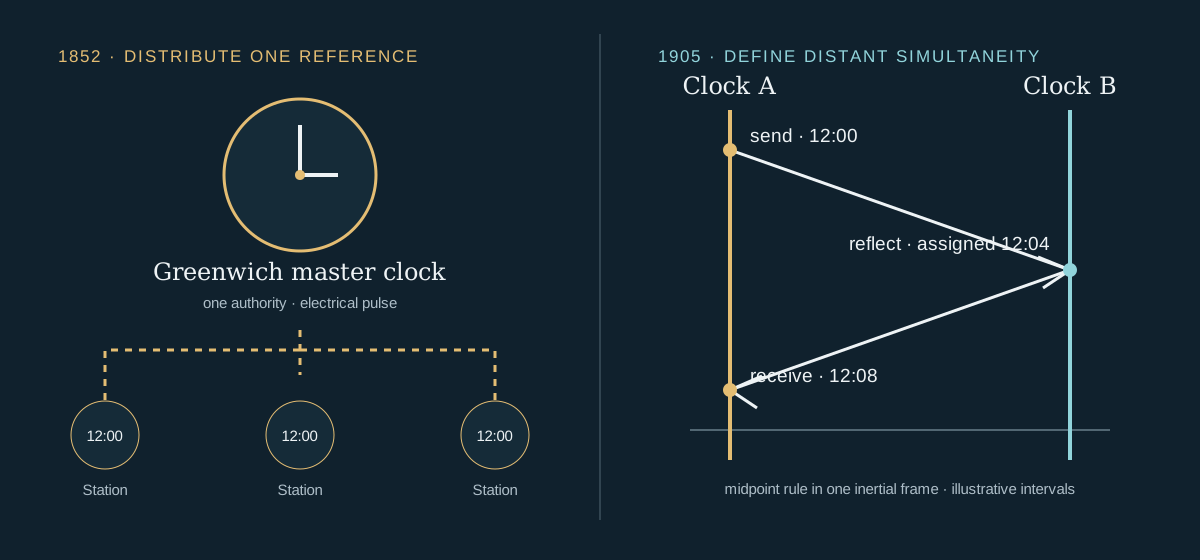
By the 1840s, most British railway companies had adopted Greenwich Mean Time rather than each town’s local solar time. In 1852, the Royal Observatory installed the Shepherd master-clock system. Electrical signals could travel from Greenwich along telegraph lines to railway stations and public clocks. [1]
That system did not abolish geography. It replaced many local answers with an agreed reference. A clock in Bristol could display Greenwich time even though the Sun crossed Bristol’s meridian later than Greenwich’s.
The distinction matters: standard time coordinates activity. It tells a network what reading to use. It does not claim that the Sun reaches the same position everywhere, or that all observers in motion must agree about distant simultaneity.
North America changes its clocks in 1883
North American railroads faced a larger patchwork. The Smithsonian reports that by the early 1880s railroads were using roughly fifty regional times. Railroad managers asked William Frederick Allen to develop a simpler plan. On November 18, 1883, most railroads adopted Standard Railway Time based on zones. Many large cities quickly followed, although resistance continued in some places. [2, 3]
The change was coordinated by the railroads, not initially imposed as one national law. United States federal legislation establishing standard-time-zone authority came later, in 1918. The 1884 International Meridian Conference then selected the Greenwich meridian as the international reference for longitude. [3]
Time zones are conventions in a plain and powerful sense: societies choose boundaries and reference offsets so that clocks can coordinate life. Their usefulness does not make them arbitrary in practice. Miss the convention and you may miss the train.
Einstein asks a different question
Einstein’s 1905 special-relativity paper begins by refusing to treat distant time as self-explanatory. A clock beside an event can label that event locally. But to speak of the time of distant events, clocks at different places need a synchronization rule.
Einstein’s procedure uses light. Send a signal from clock A to clock B and reflect it back. If the return reaches A eight minutes after departure, standard synchronization assigns the reflection at B to the midpoint, four minutes after departure. The rule assumes equal one-way light travel times in opposite directions within that inertial frame. [4, 5]
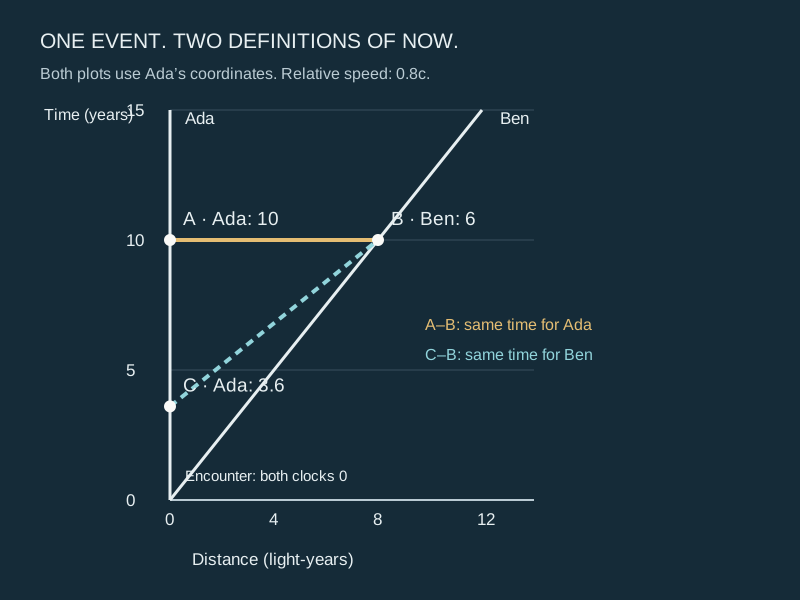
The move is deeper than choosing a time zone. Once two relatively moving inertial frames each synchronize their own clock networks, they need not agree about which distant events are simultaneous. The reciprocal-clock example shows the calculation.
Did trains and telegraphs cause relativity?
No historical source can turn technical context into a simple cause. Einstein’s theory addressed electrodynamics, the principle of relativity, and the behavior of light—not merely railway scheduling. Lorentz, Poincaré, and others were already developing ideas essential to the new physics.
Historian Peter Galison argues that clock networks, patent work, railway coordination, and longitude mapping formed an important material background for Einstein and Poincaré. The key insight is not that a timetable secretly contains special relativity. It is that “What time is it over there?” had become a procedure involving signals, instruments, and agreements rather than a question answered by intuition alone. [6]
That is a historical interpretation supported by archival work, not an experimentally testable law of physics. It helps explain why a seemingly abstract question about simultaneity also belonged to the technological world around 1905.
Three meanings of shared time
The story becomes clearer if we keep three achievements separate:
- Local solar time connects a clock to astronomical conditions at one place.
- Standard civil time coordinates many places by choosing a common reference and zone rules.
- Relativistic synchronization defines how an inertial frame assigns times to distant events using signals and clocks.
The first is local astronomy. The second is social and technical infrastructure. The third is part of a physical theory. They overlap historically, but they answer different questions.
engineers had to make distant clocks agree in practice.
Continue with Einstein’s four papers of 1905, then use the time-dilation calculator to see what changes when clocks move relative to one another.
Sources & further reading
- Royal Museums Greenwich — History of the Royal Observatory and Greenwich time ↗
- Smithsonian National Museum of American History — Synchronizing Time ↗
- NIST — A Walk Through Time: World Time Scales ↗
- Albert Einstein, 1905 — On the Electrodynamics of Moving Bodies, scholarly edition hosted by the University of Pittsburgh ↗
- Stanford Encyclopedia of Philosophy — Conventionality of Simultaneity ↗
- Peter Galison, Harvard University — Einstein’s Clocks, Poincaré’s Maps ↗
Prepared with AI assistance. Sources are linked for verification. See our editorial approach.
Keep a little room for curiosity.
Save the journal for your next visit, or get new articles in a reading app.
Ways to stay updated ↗