THE AGENCY TEST / 13
Which fact would make a choice free?
Open each case. There is no score: the point is to test whether determinism, unpredictability, randomness or reasons are doing the work in your view.
01A determined but reasons-responsive choiceOpen case
A person considers the evidence, recognizes reasons on both sides and chooses according to their settled values. Assume every step has sufficient prior causes.
What it tests: a compatibilist may call this free because the action expresses the person’s deliberative capacities. An incompatibilist may object that the person could not have selected a genuinely open alternative.
02A random event flips the outcomeOpen case
The deliberation is evenly balanced. An undetermined microscopic event tips the final response one way rather than the other.
What it tests: indeterminism creates an alternative outcome, but the mere presence of chance does not show that the person authored which outcome occurred.
03A deterministic choice nobody can predictOpen case
The decision arises from a highly complex, chaotic process. Tiny unknown differences make accurate long-range prediction impossible, even though the dynamics are deterministic.
What it tests: surprise and unpredictability are facts about prediction. They do not decide whether the agent has the kind of control freedom requires.
04A decision represented in a spacetime blockOpen case
A complete spacetime description includes the deliberation, choice and later consequence as events at their respective times.
What it tests: being represented as part of reality does not make the decision causally idle. Whether the block threatens freedom depends on a further view about alternatives and agency.
05An action produced by covert manipulationOpen case
A person acts from a desire that another agent secretly implanted in a way that bypassed ordinary reflection. The action feels voluntary from the inside.
What it tests: both compatibilists and incompatibilists need an account of ownership or control, not only a label for the universe’s laws.
These cases map philosophical positions; they are not psychological diagnoses or experimental evidence. Your selections are not recorded because there is nothing to submit.
The short answer: physics has not settled it
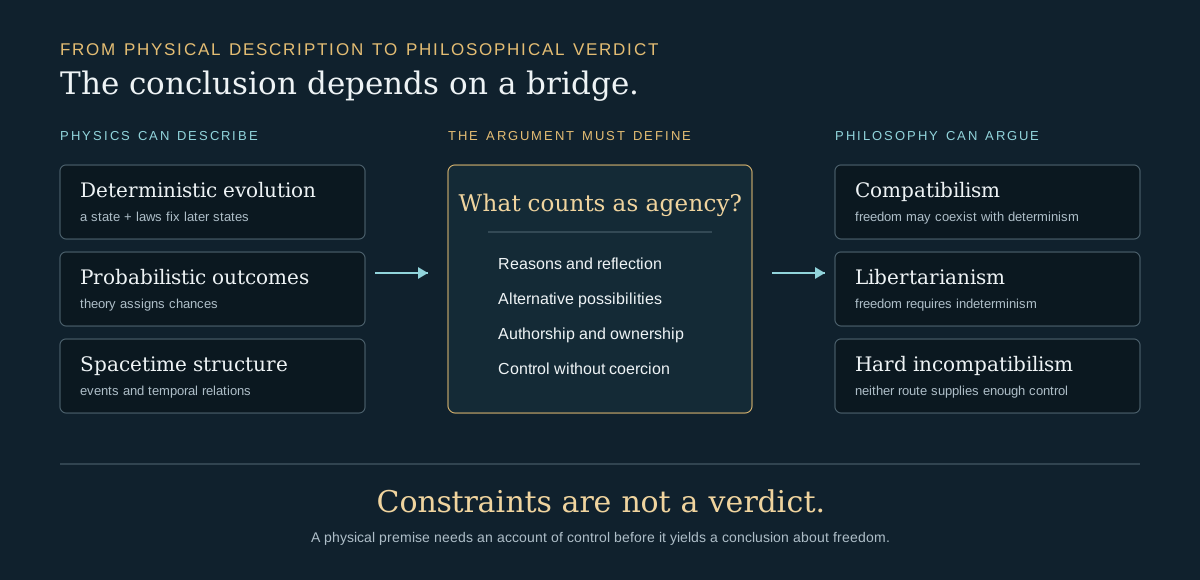
Physics tells us how physical systems evolve and what observations a theory predicts. The free-will debate asks a further question: when does an action count as genuinely ours? Those subjects meet, but they are not identical.
A deterministic universe would matter to the debate. So would irreducible quantum chance, if nature contains it. Relativity may matter to how we understand time and an “open” future. Yet no experiment has selected one agreed definition of freedom and then measured whether people possess it.
The careful answer is therefore neither “physics disproves free will” nor “quantum mechanics saves it.” Physics constrains the possibilities. Philosophy supplies competing accounts of agency, control, alternatives and responsibility. [1, 2]
Four ideas that should not be collapsed
Determinism is roughly the thesis that the state of the world at a time, together with the laws of nature, fixes what happens at other times. Predictability concerns what an observer can calculate or forecast. The two are not equivalent.
Fatalism is the different claim that an outcome is unavoidable regardless of what anyone does. Determinism does not make deliberation causally irrelevant: under a deterministic description, a person’s reasons, decision and action can be part of the process that produces the outcome.
Randomness is different again. An event may be unpredictable because information is limited, because a deterministic system is chaotic, or because a theory assigns fundamental probabilities. Those possibilities do not automatically amount to agency. [2, 3, 4]
Classical laws do not make the universe easy to predict
Classical mechanics inspired the image of a universe whose future could, in principle, be calculated from a complete present. But even a deterministic rule need not give finite observers practical foresight.
Chaotic systems are deterministic while being highly sensitive to initial conditions. Tiny uncertainties can grow until long-range prediction becomes unreliable. That is a limit on prediction, not a gap in causation and not evidence of freedom.
This distinction blocks one quick argument: “If behavior is unpredictable, it must be free.” Unpredictability can reflect the observer’s limitations or the system’s dynamics. Whether an action is free still depends on what kind of control a theory of freedom requires. [3]
Quantum chance is not the same as authorship
Quantum theory complicates the classical picture, but it does not supply a simple escape hatch. Some formulations use probabilities for measurement outcomes. Interpretations disagree about what those probabilities mean: for example, many-worlds approaches keep deterministic universal evolution, while other approaches introduce stochastic events. The observed predictions alone do not make every interpretive question disappear. [4, 5]
Suppose, for the sake of argument, that an undetermined quantum event changes a decision. That would make the outcome less fixed, but not obviously more controlled by the person. A random interruption is not automatically an act of authorship.
It does not, by itself, create control.
An incompatibilist account therefore needs more than indeterminism. It needs an explanation of how an agent—not mere noise—settles among possibilities. [6]
Relativity and the “already existing” future
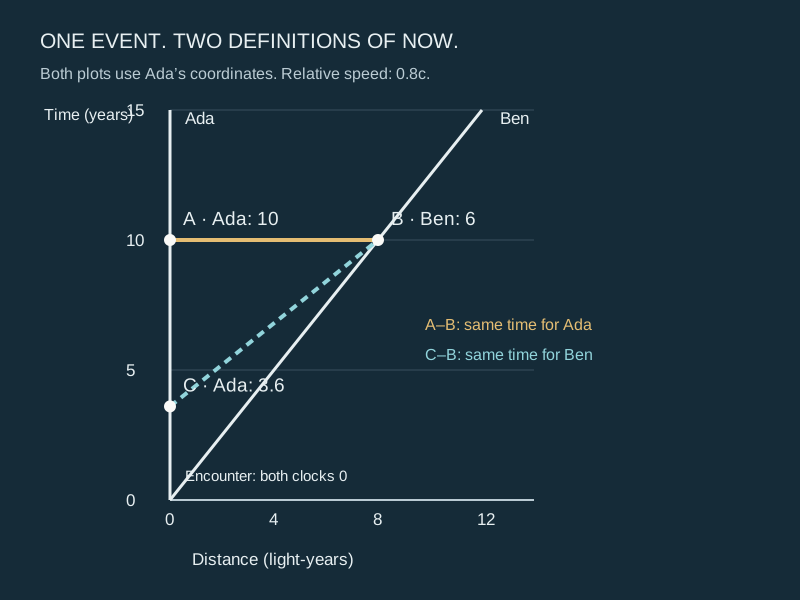
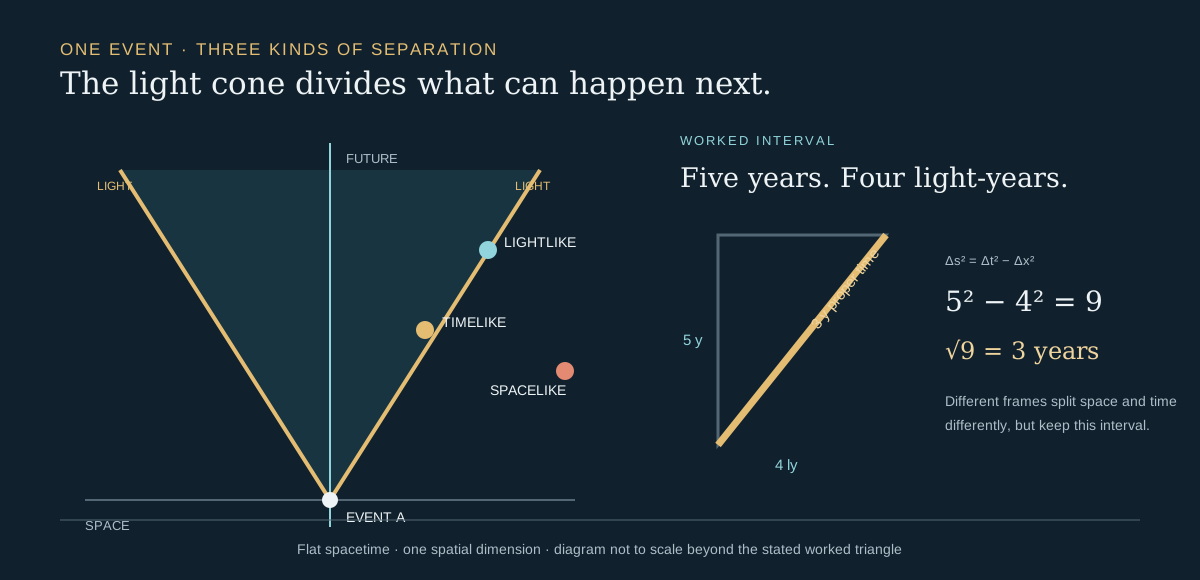
Special relativity denies a single, frame-independent way to divide all distant events into one universal present. This has encouraged block-universe or eternalist interpretations in which events at different times belong to one four-dimensional reality.
That interpretation is philosophically important, but it is not the same claim as determinism. A spacetime can represent events governed by deterministic laws or by probabilistic laws. Nor does “the decision is part of spacetime” imply “the decision does no work.” A choice can be among the events through which a later outcome occurs.
Our block-universe guide separates eternalism, determinism and fatalism. Relativity puts pressure on a universal “now”; it does not by itself announce a verdict about responsibility. [7]
Three philosophical families
Compatibilists hold that free will can coexist with determinism. Many focus on whether an action flows from the person’s values, reasoning or desires in the right way—without coercion or the kind of manipulation that bypasses ordinary control.
Libertarians about free will are incompatibilists who hold that people sometimes act freely and that the relevant kind of freedom requires determinism to be false. Their challenge is to explain how indeterminism contributes to authorship rather than luck.
Hard determinists and other hard incompatibilists reject the kind of free will they regard as necessary for basic-desert moral responsibility. Some ground the rejection in determinism; others argue that neither deterministic nor indeterministic causation provides the required control. These positions still leave room for debates about social practices, reasons and forward-looking responsibility. [1, 6, 8]
What could evidence actually establish?
Evidence could support or undermine a physical theory. It could reveal regularities in decision-making, limits on prediction, or causal influences that a person does not notice. Such results may challenge a particular theory of agency.
They cannot, without additional premises, decide whether “could have done otherwise,” “acts for reasons,” “originates the action,” or some other condition is the correct standard of freedom. That choice is partly conceptual and partly normative.
A strong argument should therefore show its bridge: the physical premise, the proposed account of control, and the conclusion about freedom. If the bridge remains hidden, a scientific result can appear to settle a philosophical question that it has only reframed.
A better question to carry forward
Ask not only whether an action was determined or random. Ask whether it issued from the person’s capacities for understanding, reflection and response to reasons; whether coercion or manipulation was present; whether genuine alternatives are required; and why that standard matters.
Physics can rule out incoherent pictures of the world and discipline speculation about causation and time. It cannot make the philosophical work optional.
A theory of freedom must say what makes one of those events an action.
For the time side of the argument, continue with eternalism and the problem of “now”. For the physics beneath that discussion, read why simultaneity depends on a reference frame.
Sources & further reading
- Stanford Encyclopedia of Philosophy — Free Will ↗
- Stanford Encyclopedia of Philosophy — Causal Determinism ↗
- Stanford Encyclopedia of Philosophy — Chaos ↗
- Stanford Encyclopedia of Philosophy — Chance versus Randomness ↗
- Stanford Encyclopedia of Philosophy — Many-Worlds Interpretation of Quantum Mechanics ↗
- Stanford Encyclopedia of Philosophy — Incompatibilist (Nondeterministic) Theories of Free Will ↗
- Stanford Encyclopedia of Philosophy — Being and Becoming in Modern Physics ↗
- Stanford Encyclopedia of Philosophy — Compatibilism ↗
Prepared with AI assistance. Sources are linked for verification. See our editorial approach.
Keep a little room for curiosity.
Save the journal for your next visit, or get new articles in a reading app.
Ways to stay updated ↗