OPEN THE WORKING NOTEBOOK / 17
What did each step solve—and leave unsolved?
Open the six stages. The path is a chain of problems, not a straight march toward an inevitable answer.
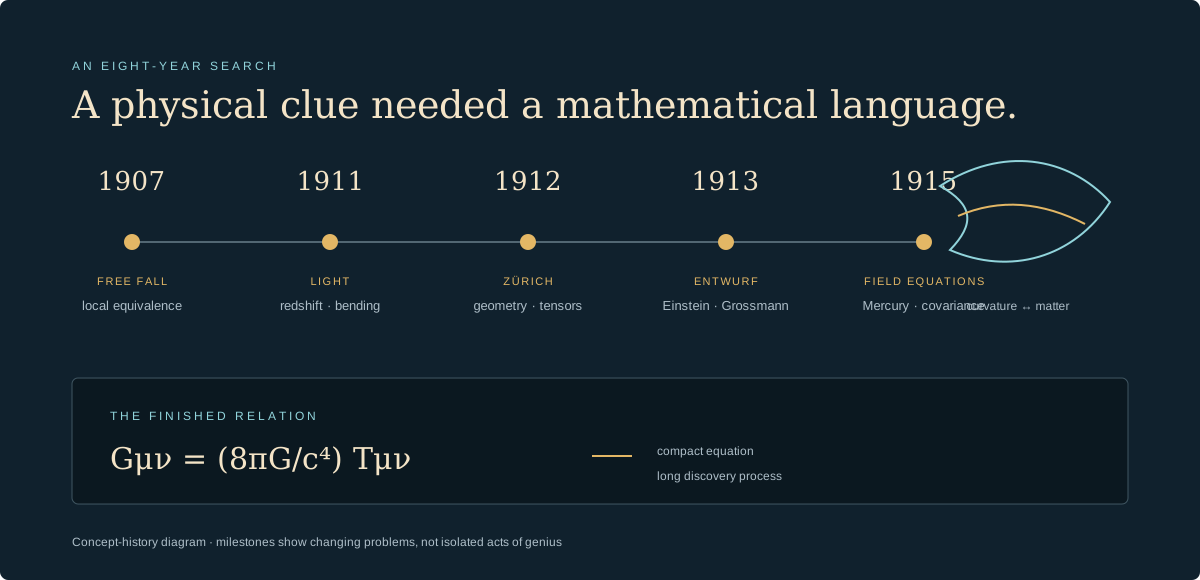
1907Free fall removes gravity locallyOpen note
Added: the equivalence principle connects acceleration, weight, and local free fall.
Still missing: a description of tidal effects and a field equation for varying gravity.
1911Gravity acts on light and clocksOpen note
Added: testable consequences including gravitational redshift and light deflection.
Still missing: the complete spacetime geometry; the early light-bending value was incomplete.
1912Geometry becomes the candidate languageOpen note
Added: metric tensors and curvature can express gravity without a preferred coordinate grid.
Still missing: field equations satisfying the physical limits Einstein required.
1913The Einstein–Grossmann outlineOpen note
Added: a metric theory with much of the later formal structure.
Still missing: the final generally covariant equations; the Entwurf theory had a restricted covariance.
1915Mercury tests the reconstructionOpen note
Added: the new equations account for the unexplained 43 arcseconds per century.
Still missing: one successful anomaly did not by itself test every consequence of the theory.
25 NOVThe field equations reach final formOpen note
Added: generally covariant equations relating spacetime curvature to matter and energy.
Still open: solutions, observations, interpretation, and later extensions would occupy generations.
Historical problem map, not a claim that discovery followed six clean or isolated steps. Opening a note stores or submits nothing.
The finished theory hides the search
General relativity is often introduced as one elegant idea: matter and energy shape spacetime, and free bodies follow its geometry. The historical route was less tidy. Between 1907 and 1915, Albert Einstein moved from a physical clue about falling bodies to a mathematical theory, rejected equations close to the ones he later adopted, defended an incomplete alternative, and then rebuilt the theory during an intense month of work. [1, 2]
That uneven path matters. It shows that the theory did not fall out of one elevator thought experiment, and it was not produced by intuition alone. Einstein needed mathematical tools developed by Bernhard Riemann, Elwin Christoffel, Gregorio Ricci-Curbastro, Tullio Levi-Civita, and others. His friend Marcel Grossmann helped him enter that literature. David Hilbert became an important interlocutor near the finish. [3, 4]
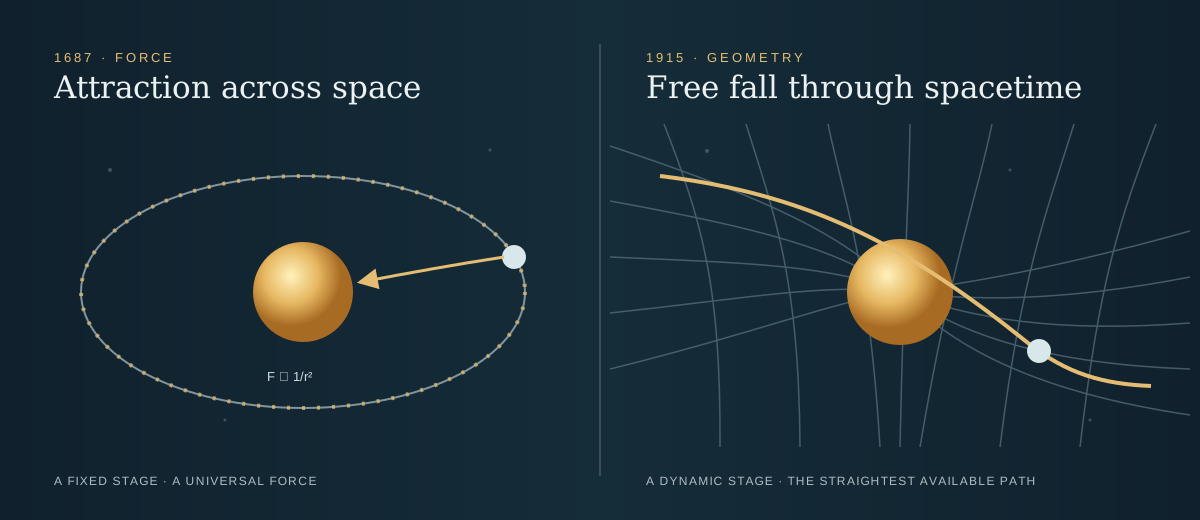
This is therefore not another comparison of Newtonian force with Einsteinian geometry. It is a reconstruction of how the newer picture became possible.
1907 / Free fall supplies the physical clue
Special relativity had reorganized space and time for observers moving uniformly, but Newtonian gravity still appeared to act instantaneously across distance. Einstein’s opening move was to focus on a fact hidden in ordinary falling motion: in a sufficiently small freely falling laboratory, unsupported objects accelerate together. Locally, the occupants can treat themselves as weightless. [1]
Reverse the thought experiment. Inside a sealed rocket accelerating through otherwise gravity-free space, released objects fall toward the floor. Over a small region, the effects resemble those attributed to a uniform gravitational field. This local relationship between free fall, acceleration, and gravity became the equivalence principle.
The word local does real work. A large laboratory can detect tidal effects: nearby falling paths may converge or separate. The equivalence principle does not erase gravity everywhere. It identifies frames in which gravity can be transformed away only over a sufficiently small region, leaving the variation from place to place as the deeper problem.
1911 / The clue begins to make predictions
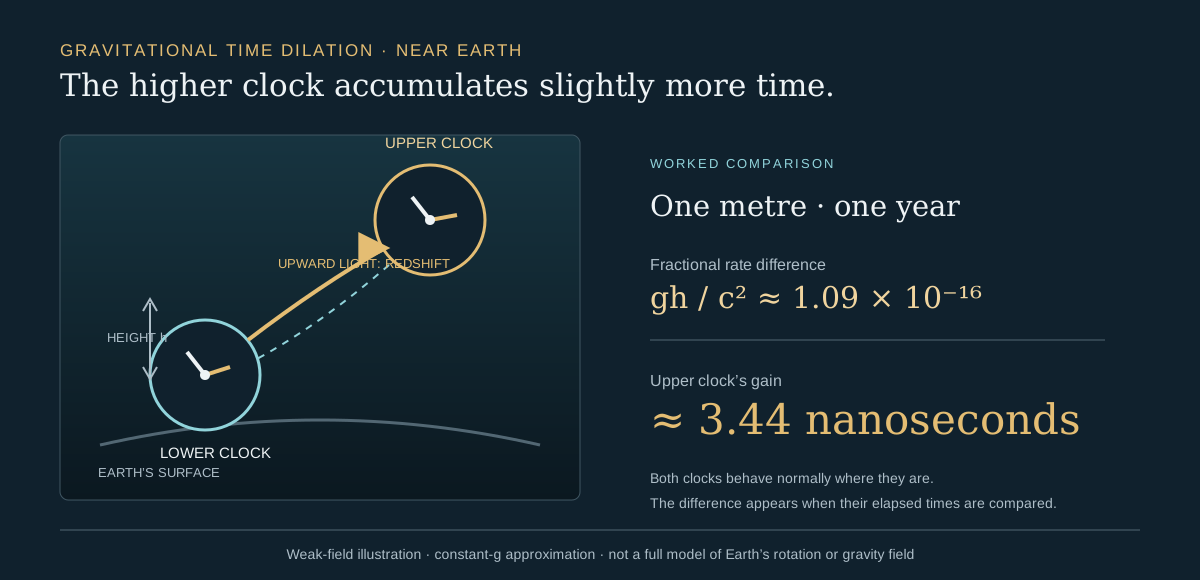
Einstein used the equivalence idea to reason that gravity should affect both light and clocks. A light signal moving through a gravitational field should change frequency when compared by observers at different heights; a light ray passing the Sun should bend. In 1911 he calculated a solar deflection, although the result was only half the value predicted by the completed theory. [5]
The partial result is historically useful. The equivalence principle pointed in the right direction, but it was not yet a full theory of curved spacetime. A uniformly accelerated frame could reveal local consequences; it could not by itself provide field equations for realistic, varying gravitational systems.
The search now needed an object that could represent geometry from point to point and equations that reduced to Newton’s theory when gravity was weak and motion slow.
1912–1913 / Grossmann opens the mathematical door
Back in Zürich in 1912, Einstein turned to Marcel Grossmann, a mathematician and former classmate at the Swiss Federal Polytechnic. Grossmann directed him toward the differential geometry and tensor calculus associated with Riemann, Christoffel, Ricci, and Levi-Civita. These tools could describe quantities independently of a particular coordinate grid and could express curvature mathematically. [3, 4]
Einstein’s surviving Zürich Notebook records the search. Its pages show him testing candidate equations, including forms close to the final 1915 theory, while trying to satisfy several physical demands at once: energy-momentum conservation, the Newtonian limit, and a broad relativity of coordinate systems. The notebook is valuable precisely because it preserves uncertainty rather than a polished discovery story. [2, 6]
In 1913 Einstein and Grossmann published the Entwurf, or “outline,” theory. Einstein wrote the physical part; Grossmann wrote the mathematical part. It already treated gravity through a spacetime metric, but its field equations did not have the general covariance of the final theory. It was a major step and a wrong turn at the same time.
Why the near miss lasted two years
Einstein had reasons for distrusting more generally covariant candidates. He believed some failed to recover familiar Newtonian physics or conflicted with conservation laws. He also developed the “hole argument,” which he took to show that generally covariant equations could not uniquely determine the gravitational field inside an empty region. [2, 7]
The later resolution changed what counts as a distinct physical solution. If two mathematical descriptions differ only by a smooth reassignment of coordinates while preserving observable relations, they need not describe two different worlds. General covariance could be retained without treating coordinate labels as independently physical.
This is a philosophical lesson constrained by physics, not an experiment proving one complete metaphysics of spacetime. The episode shows how assumptions about representation can guide—and misguide—the equations a physicist accepts.
November 1915 / Four papers, one rapid reconstruction
By 1915, difficulties with the Entwurf theory had accumulated. It did not handle rotating coordinate systems as Einstein expected, and it failed to produce the observed residual advance of Mercury’s perihelion. After discussions with David Hilbert in Göttingen and renewed work in Berlin, Einstein presented four communications to the Prussian Academy on successive Thursdays in November. [4, 8]
On 18 November he obtained Mercury’s unexplained advance of about 43 arcseconds per century using equations close to the final form. On 25 November he submitted the generally covariant field equations now associated with general relativity. Hilbert was pursuing a related variational approach at almost the same time; the priority history is more complicated than a simple race with a single decisive date. [8, 9]
The equation’s compactness conceals the work needed to identify the correct geometric quantity, connect it to matter, preserve conservation, and recover Newtonian gravity in the appropriate limit.
What the discovery story should preserve
Einstein supplied the sustained physical program: the equivalence principle, the demand for a relativistic gravity theory, the interpretation of the metric, and the final synthesis. Grossmann’s mathematical guidance and joint work were indispensable to the 1912–1913 transition. Earlier mathematicians supplied the geometric language. Hilbert’s parallel work helped sharpen the final stage. Observations such as Mercury’s orbit then connected the new formalism back to nature.
None of that reduces Einstein’s achievement. It makes the achievement legible. General relativity emerged through a repeated negotiation between physical principles, mathematical possibilities, and empirical constraints—not from a diagram, a quotation, or a flash of insight alone.
The theory required a language, collaborators, wrong turns, and tests.
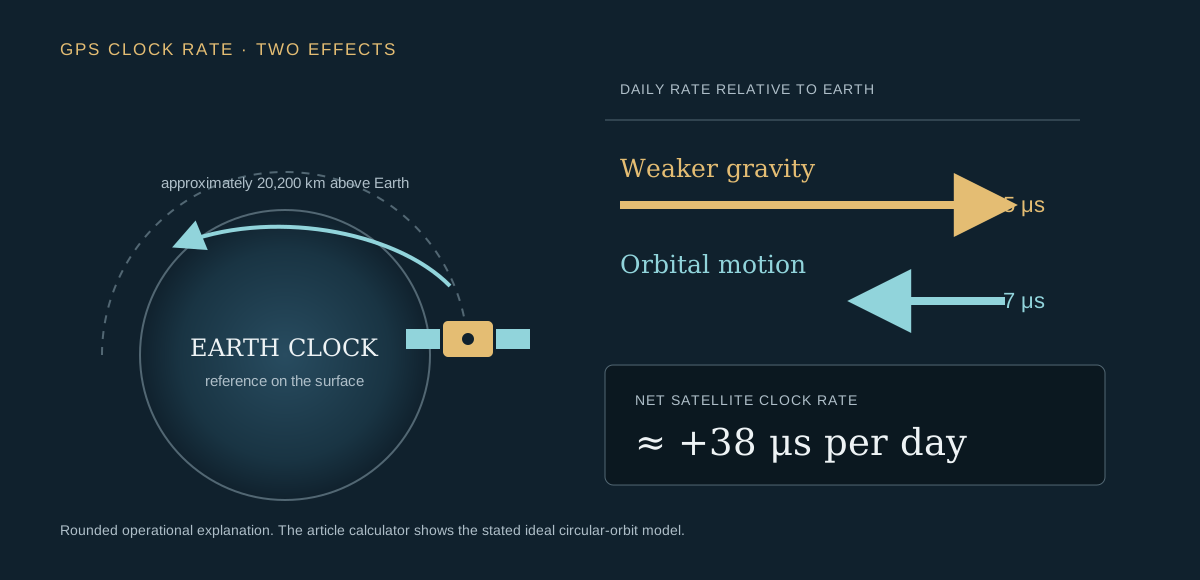
For the physics behind the opening clue, explore why gravity changes clock comparisons. To see what changed conceptually, continue with Newton versus Einstein on gravity or Minkowski’s spacetime synthesis.
Sources & further reading
- Einstein Online — The elevator, the rocket, and gravity: the equivalence principle ↗
- Renn, Sauer, Stachel, Janssen & Norton — The Relativity Crisis and the Reorganization of Classical Knowledge on Gravitation ↗
- Tilman Sauer — Marcel Grossmann and his contribution to the general theory of relativity ↗
- Einstein Papers Project — Volume 4: The Swiss Years, Writings 1912–1914 ↗
- Einstein Papers Project — Volume 3: The Swiss Years, Writings 1909–1911 ↗
- Max Planck Institute for the History of Science — Einstein’s Zürich Notebook ↗
- Stanford Encyclopedia of Philosophy — The Hole Argument ↗
- Einstein Papers Project — One Hundred Years of Einstein’s Field Equations and Mercury’s Perihelion ↗
- Princeton University Press — Was Einstein the First to Discover General Relativity? ↗
Prepared with AI assistance. Sources are linked for verification. See our editorial approach.
Keep a little room for curiosity.
Save the journal for your next visit, or get new articles in a reading app.
Ways to stay updated ↗