BUILD THE DISTANCE LADDER / 11
What does each rung actually tell you?
Open the five cards in order. Each observation answers one question—and leaves the next one for another rung.
01Watch one star brighten and dimWhat can you measure?
You get its period: the time between repeating points in the brightness cycle. A period alone is not a distance.
02Compare many stars in the same cloudWhat becomes comparable?
You can compare luminosities relatively. Because the stars are at approximately the same distance, brighter-looking members are generally more luminous. Real analyses still account for scatter, dust and crowding.
03Plot brightness against periodWhat pattern appears?
Longer-period Cepheids are brighter. This is the period–luminosity relation Leavitt established from the Small Magellanic Cloud variables.
04Calibrate a Cepheid with a known distanceWhat is added?
The relation gains an absolute scale. A calibration fixes the zero point, turning relative luminosities into estimated intrinsic luminosities.
05Find a Cepheid in another galaxyWhat can you infer?
You can estimate its distance. Measure the period, infer intrinsic luminosity from the calibrated relation, and compare it with apparent brightness. The result inherits uncertainties from every rung.
Conceptual sequence, not a numerical fit. Modern Cepheid work distinguishes stellar populations and observing bands and corrects for effects such as dust, composition and crowding.
Astronomy needed a longer ruler
At the start of the twentieth century, astronomers could measure nearby stellar distances with parallax: watch a star from opposite sides of Earth’s orbit and use its tiny apparent shift. But the angle becomes too small for the methods of the time as distance grows. The scale of the Milky Way—and whether the fuzzy spiral nebulae lay inside it—remained uncertain.
The missing tool was a light source whose true luminosity could be inferred from something observable. If you know how luminous an object really is, then its apparent faintness tells you how far its light has travelled. Henrietta Swan Leavitt uncovered just such a clue in a class of pulsating stars. [1, 2]
A discovery made by comparison
Leavitt worked at the Harvard College Observatory, where women employed as “computers” measured and classified astronomical photographs. Her assignment was variable stars: points of light whose brightness changed between glass plates exposed on different nights. The work demanded repeated, careful comparison across plates containing thousands of stars. [2, 3]
She catalogued variables in the Magellanic Clouds, two nearby satellite galaxies of the Milky Way. In a 1908 report, she drew attention to a possible pattern among a small group of variables. Her 1912 study presented periods and brightness ranges for 25 variables in the Small Magellanic Cloud and made the relationship unmistakable. The observatory circular was signed by director Edward Pickering but opened by stating that the analysis had been prepared by Leavitt. [1, 3]
Why one distant cloud made the pattern visible
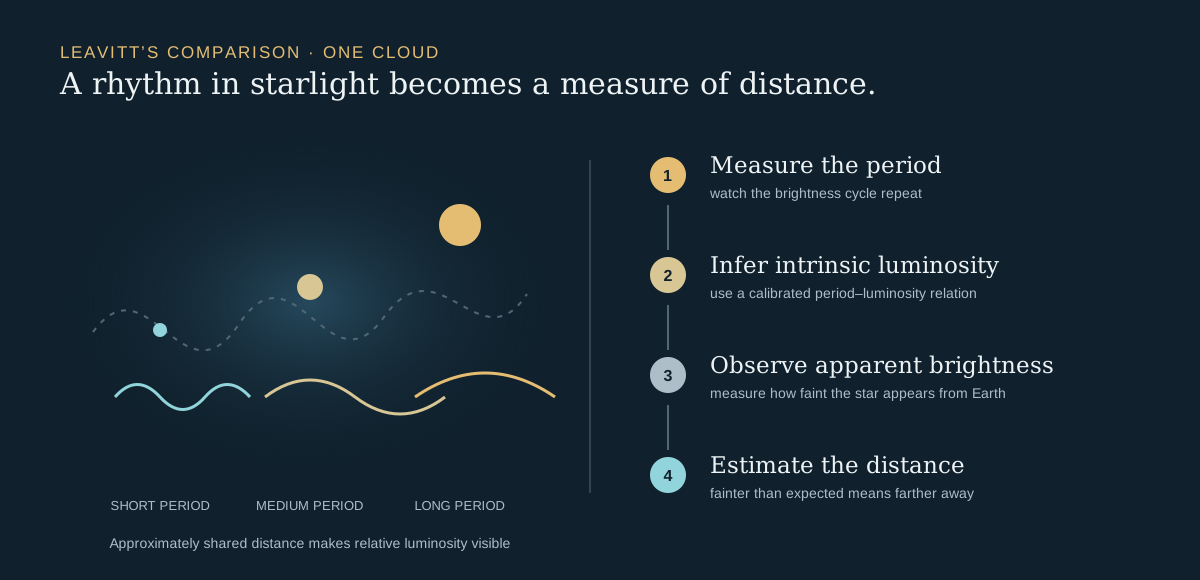
Stars that look equally bright may not be equally luminous: a modest nearby star can outshine a powerful distant one in our sky. Leavitt’s sample offered a way around that ambiguity. The stars belonged to the same remote cloud, so their distance differences were small compared with the cloud’s distance from Earth.
That did not make every star literally equidistant, nor did it remove dust, crowding or measurement error. It did make a powerful first approximation: within the sample, differences in apparent brightness mostly tracked differences in intrinsic luminosity. That shared-distance logic is the hinge of the discovery. [1, 4]
The pattern in 25 pulsing stars
A Cepheid variable repeatedly brightens and dims as the star pulsates. Its period is the time required to complete one cycle. Leavitt found that the variables with longer periods were brighter; plotted against the logarithm of period, their brightnesses followed a near-straight trend. Today this is called the Cepheid period–luminosity relation, or the Leavitt Law. [1, 4]
The period is especially useful because it can be measured by watching the brightness cycle repeat. Once the relation is calibrated, the period predicts luminosity. Comparing that predicted luminosity with the star’s apparent brightness then yields distance.
A relation is not yet a complete measuring tape
Leavitt established the slope and tightness of the relation from stars at approximately the same distance. She did not, from those observations alone, know the Small Magellanic Cloud’s absolute distance. The relation still needed a zero point: a calibration from Cepheids whose distances were known by another method.
This distinction keeps the history and the physics honest. Leavitt discovered the repeatable relation that made a new ruler possible; later astronomers calibrated and applied it. The cosmic distance ladder works because one method anchors the next, not because any single rung measures every scale directly. [1, 4]
From a pulsing star to another galaxy
In 1923, Edwin Hubble identified a Cepheid variable called V1 in the Andromeda nebula. Using the period–luminosity method, he found Andromeda far beyond the scale then assigned to the Milky Way. The observation helped establish that Andromeda is another galaxy, dramatically enlarging the known universe. [5]
That achievement rested on a chain: photographic observations, Leavitt’s relation, subsequent calibration and Hubble’s telescope data. Later distance ladders linked Cepheids to still more distant markers and to measurements of cosmic expansion. Modern astronomers continue to refine the Cepheid rung rather than treating it as a finished antique. [4, 6]
Credit the work without inventing a lone genius
Leavitt’s achievement is sometimes told as a neglected-genius correction to a history centered on famous men. The correction is necessary, but a new lone-genius myth would still hide how science works. Her insight depended on observatory plates, telescope crews, earlier variable-star research, colleagues who organized and measured data, and later astronomers who calibrated and extended the result.
It also emerged from an unequal institution. Harvard’s women computers did skilled scientific work while facing restricted roles and opportunities. Leavitt’s careful comparisons became foundational, even though she had limited control over which questions she could pursue. [2, 3]
because a pattern became comparable.
Continue with how independent evidence changed the case for black holes, or see how gravity changed from force to geometry.
Sources & further reading
- Henrietta S. Leavitt & Edward C. Pickering (1912) — Periods of 25 Variable Stars in the Small Magellanic Cloud ↗
- Center for Astrophysics | Harvard & Smithsonian — Remembering Astronomer Henrietta Swan Leavitt ↗
- Harvard Plate Stacks — Henrietta Swan Leavitt ↗
- Center for Astrophysics | Harvard & Smithsonian — Cepheids ↗
- NASA Science — Edwin Hubble’s Discovery of a New Universe ↗
- Breuval, Huang & Riess (2025) — Re-analysis of the First Cepheid Period–Luminosity Relation ↗
Prepared with AI assistance. Sources are linked for verification. See our editorial approach.
Keep a little room for curiosity.
Save the journal for your next visit, or get new articles in a reading app.
Ways to stay updated ↗