ROUND-TRIP CLOCK LAB / 12
How old are the twins at reunion?
Set a one-way distance in Earth’s frame and a cruise speed. The model uses equal outbound and inbound speeds with an instantaneous turnaround.
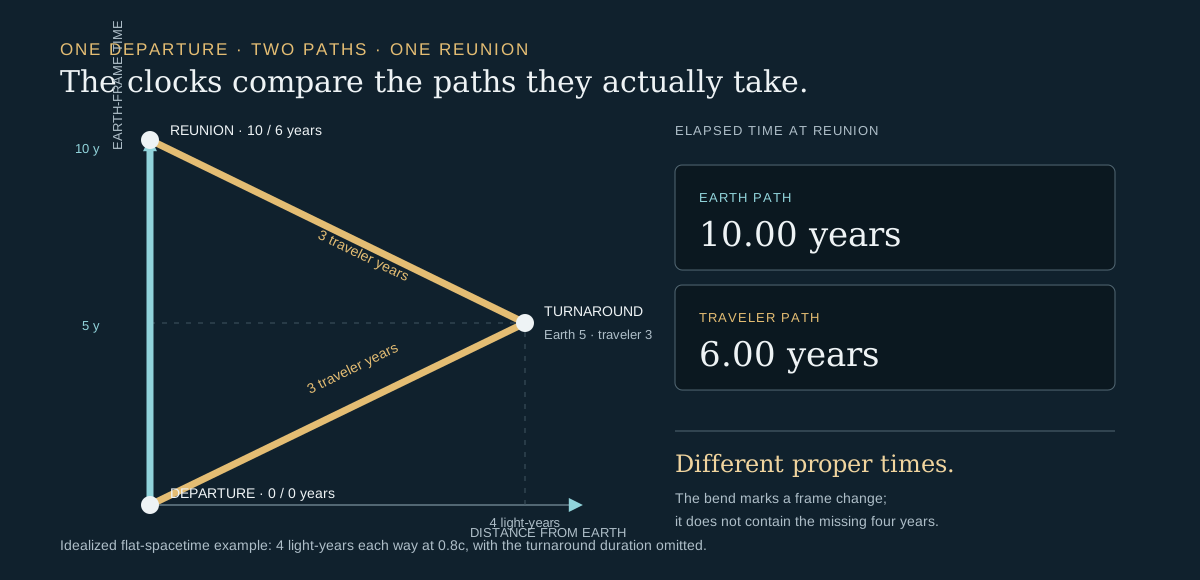
At 80% of light speed, each four-light-year leg takes 5.00 Earth years and 3.00 traveler years.
Idealized special-relativity model: flat spacetime, destination at rest in Earth’s frame, constant cruise speed on each leg, instantaneous turnaround, no gravity.
The adjustable calculator is unavailable until it loads. The worked example remains valid: Earth ages 10.00 years, the traveler ages 6.00 years, and they differ by 4.00 years at reunion.
What the paradox seems to say
One twin remains on Earth while the other travels to a distant star at high speed and returns. Special relativity says a moving clock accumulates less time. From Earth, the traveler’s clock runs slow, so the traveler should come home younger.
But motion is relative. During a constant-speed encounter, the traveler can also describe Earth as moving and calculate that Earth’s clocks run slow. Why, then, do the reunited twins not each expect the other to be younger?
The missing fact is that the traveler cannot make a round trip while remaining in one inertial frame. Outbound and inbound motion require different frames. The two twins follow different complete paths between the same departure and reunion events, and those paths contain different amounts of proper time. [1, 2]
The clocks measure paths, not a universal time
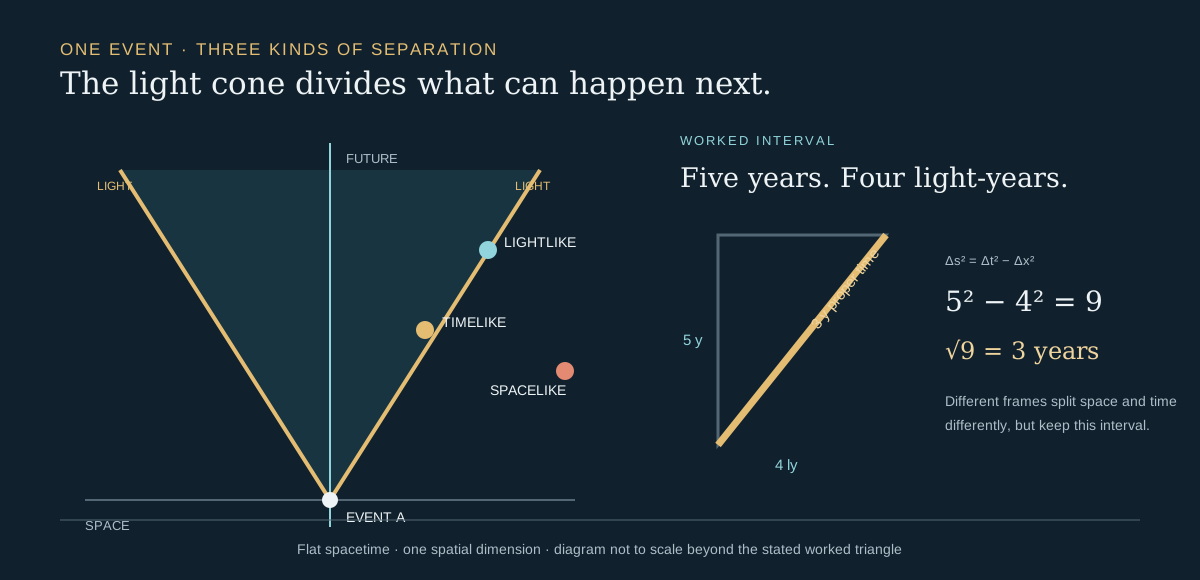
Proper time is the elapsed time recorded by a clock along its own path through spacetime. At departure, both clocks are together. At reunion, they are together again. They can compare readings directly, without correcting for light-travel delay or arguing about distant simultaneity.
Between those meetings, the stay-at-home twin follows one approximately inertial path in the idealized problem. The traveler follows an outbound path, changes velocity, and follows an inbound path. Relativity does not assign one master duration to the trip; it assigns proper time to each path.
This is a different question from two observers who only coast past once. Our reciprocal-clock explanation shows how both inertial observers can call the other clock slow. A second meeting changes the geometry.
A worked trip: four light-years away at 0.8c
Use a deliberately simple itinerary. In Earth’s frame, the destination is four light-years away. The traveler coasts at 0.8 times the speed of light, reverses direction instantly in the mathematical model, and returns at the same speed. Acceleration time and gravity are excluded.
Each leg takes 4 ÷ 0.8 = 5 Earth years, so Earth records ten years for the round trip. The time-dilation factor for the traveler is √(1 − 0.8²) = 0.6. Each five-year Earth-frame leg therefore corresponds to three traveler years:
Traveler: (5 × 0.6) + (5 × 0.6) = 6 yearsIdealized flat spacetime, constant 0.8c cruise speed, instantaneous turnaround.
At reunion, both agree: ten years elapsed on Earth’s clock and six on the traveler’s. The four-year age gap is not a disagreement about whose units to use. It is what the two clocks record along different paths. [2, 3]
The traveler gets the same answer
During the outbound leg, the traveler can use one inertial frame. In that frame, the Earth–destination distance is length-contracted from four light-years to 2.4. At 0.8c, the destination arrives after 2.4 ÷ 0.8 = 3 traveler years.
After turning around, the traveler uses a different inbound inertial frame. The return distance is again 2.4 light-years in that frame, so the return takes another three traveler years. The traveler’s total is six.
The subtle part is Earth’s aging. The traveler may say Earth’s clock runs slowly during each coasting leg, but the definition of “right now on Earth” changes when the traveler switches frames. The traveler cannot combine the two slow-rate statements while pretending that one unchanging inertial frame covers the whole journey.
What changes at the turnaround
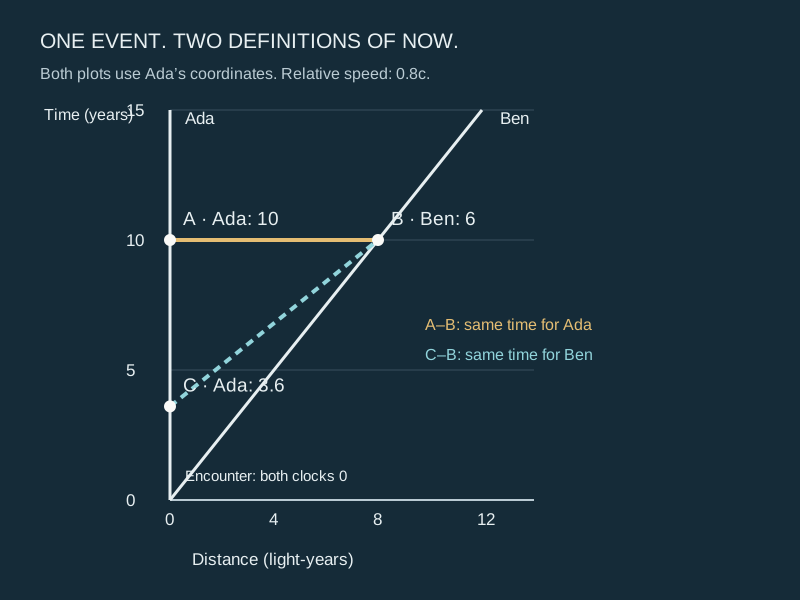
In the worked example, just before the idealized turnaround, the outbound frame assigns an Earth time of 1.8 years as simultaneous with the turnaround event. Just after switching to the inbound frame, the new frame assigns an Earth time of 8.2 years as simultaneous with that same event.
Earth’s clock does not physically jump forward. No signal travels instantly. What changes is the traveler’s coordinate assignment to a distant event—the same relativity of simultaneity that resolves reciprocal clock comparisons. Earth’s total can be organized as 1.8 years, then a 6.4-year change in the assigned distant “now,” then 1.8 more years: ten years altogether.
The sharp 1.8-to-8.2 change belongs to the instantaneous-turnaround idealization. A finite acceleration produces a continuous change instead. Either treatment yields the same coasting-limit result when the full path is handled consistently. [3, 4]
Acceleration marks the asymmetry; it is not an aging force
It is common to say the traveler is younger “because they accelerated.” That identifies who changed frames, but it can suggest the wrong mechanism. The age difference is not stored in a split-second turn as though acceleration temporarily froze the clock.
Acceleration is the joint that connects the outbound and inbound segments. The elapsed time comes from integrating along the entire path. Einstein Online compares this to two routes joined at a corner: the corner is necessary to build the bent route, but the route’s length is not concentrated at the corner. [1, 4]
Different smooth turnarounds can add different amounts of proper time, so a real itinerary requires its actual acceleration history. But no separate “acceleration penalty” can replace the path calculation.
Does this require general relativity?
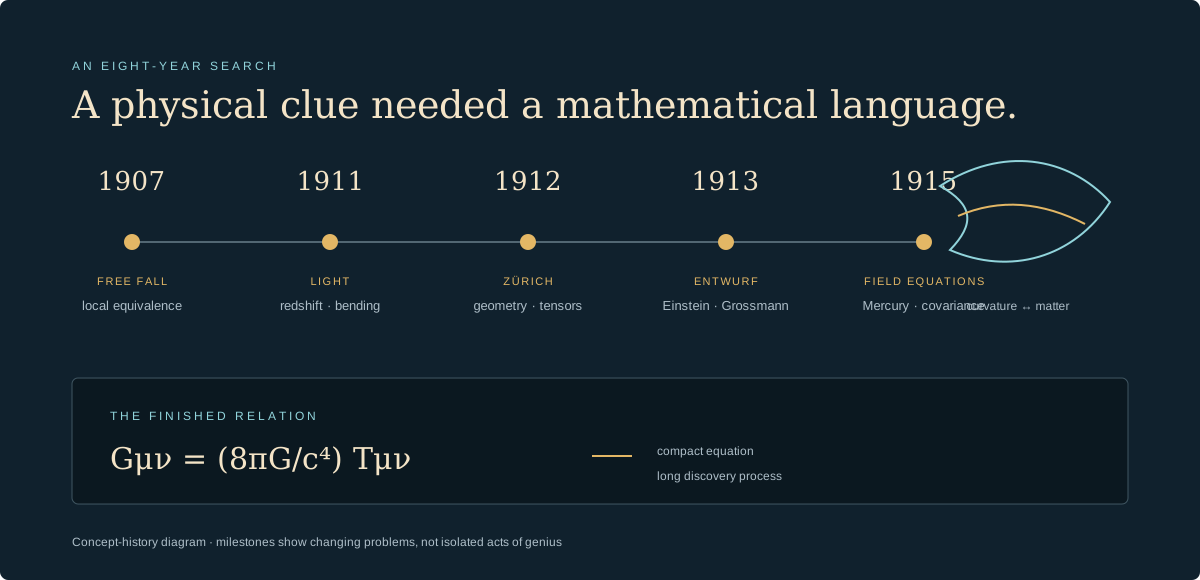
No gravity is needed for the standard flat-spacetime twin problem. Special relativity can calculate proper time along an accelerated path, even though one global inertial frame cannot stay attached to the traveler for the whole trip. General relativity provides a broader framework for arbitrary coordinates and gravity, but it is not required for the idealized result above.
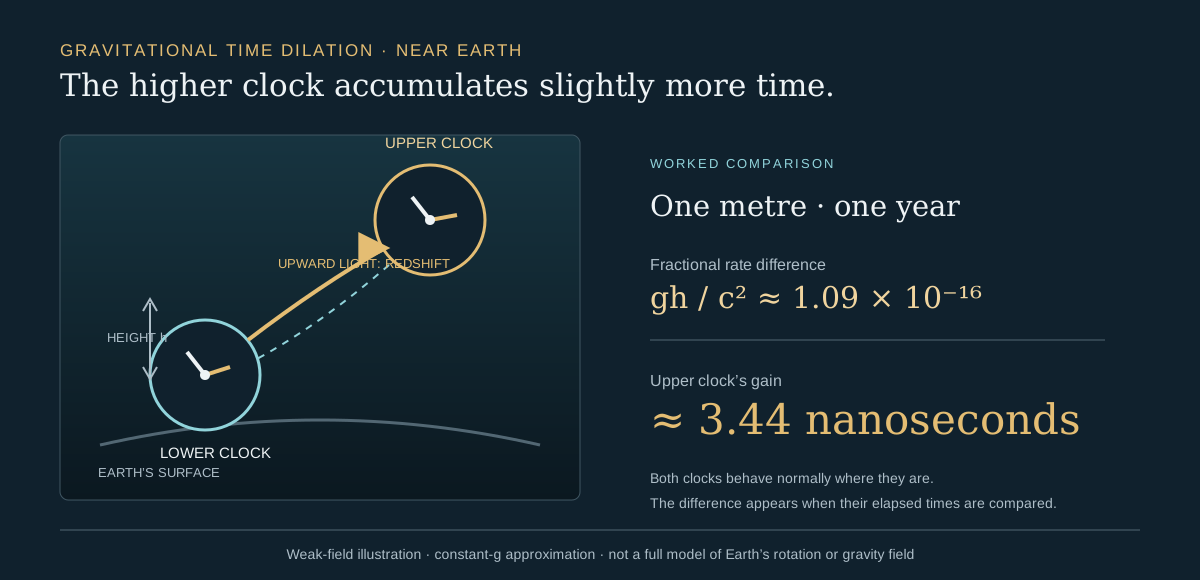
Real clocks have shown motion-dependent elapsed-time differences. In the 1971 Hafele–Keating experiment, atomic clocks flown around Earth disagreed with clocks left on the ground in the way relativity predicted within experimental uncertainty. That experiment also required gravitational and rotational effects, so it was not a clean copy of the gravity-free twin story. [5]
What the thought experiment does—and does not—show
The calculator above assumes flat spacetime, a destination at rest in Earth’s frame, equal outbound and inbound cruise speeds, and an instantaneous turnaround whose duration is ignored. It predicts clock readings, not fuel use, survivable acceleration, propulsion, communication delays, or an achievable spacecraft.
The lesson is narrower and stranger: elapsed time between two meetings depends on the path connecting them. Reciprocity during one inertial leg does not make a round trip symmetric.
Their paths carried different amounts of time.
Begin with the basic time-dilation explanation, then use the reciprocal-clock article to see exactly why two coasting observers can both be right.
Sources & further reading
- Markus Pössel, Einstein Online — The case of the travelling twins ↗
- OpenStax University Physics Volume 3 — Time Dilation ↗
- OpenStax University Physics Volume 3 — The Lorentz Transformation: the twin paradox in spacetime ↗
- Markus Pössel, Einstein Online — Twins on the road ↗
- NIST — Putting Einstein to the Test With the World’s Most Accurate Clocks ↗
Prepared with AI assistance. Sources are linked for verification. See our editorial approach.
Keep a little room for curiosity.
Save the journal for your next visit, or get new articles in a reading app.
Ways to stay updated ↗