SPACETIME INTERVAL EXPLORER / 14
Can one event influence the other?
Event A is the origin. Place event B by setting its time and distance from A in one inertial frame. The explorer classifies their separation.
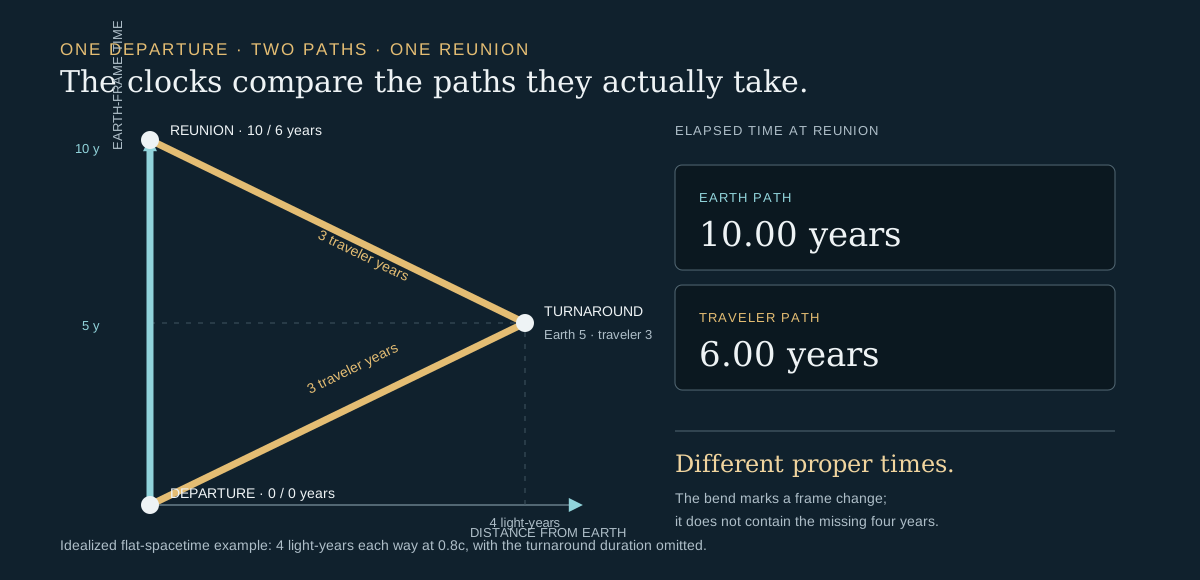
A traveler at 80.00% of light speed can connect A to B. A clock traveling inertially between them records 3.00 years.
Flat-spacetime model with one spatial direction. Distance is in light-years, time is in years, and c = 1 light-year per year. Gravity is excluded.
The adjustable explorer is unavailable until it loads. The default remains valid: five years and four light-years gives a timelike interval of +9 year² and three years of proper time.
Spacetime is a map of events
An event is something that happens at a particular place and time: a flash leaves a lamp, a spacecraft fires an engine, two clocks meet. Describing an event requires both where and when. Spacetime is the structure that organizes those combined addresses.
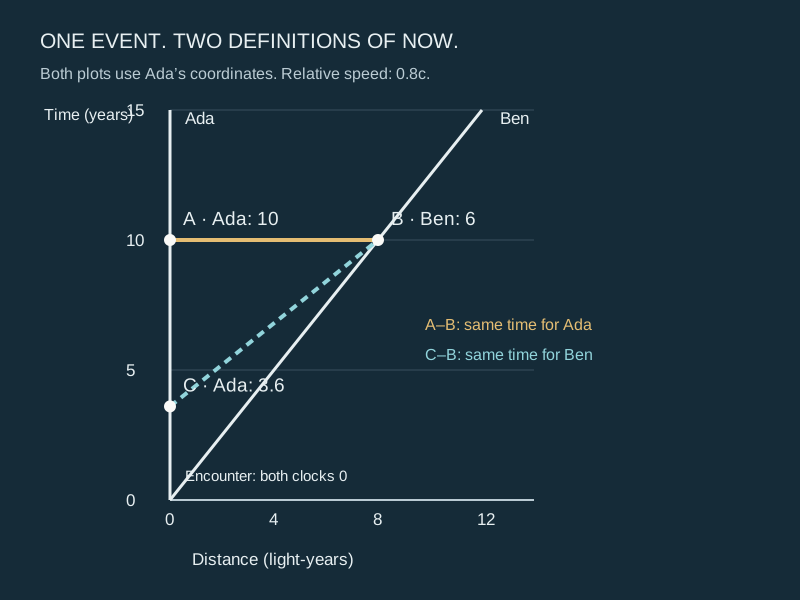
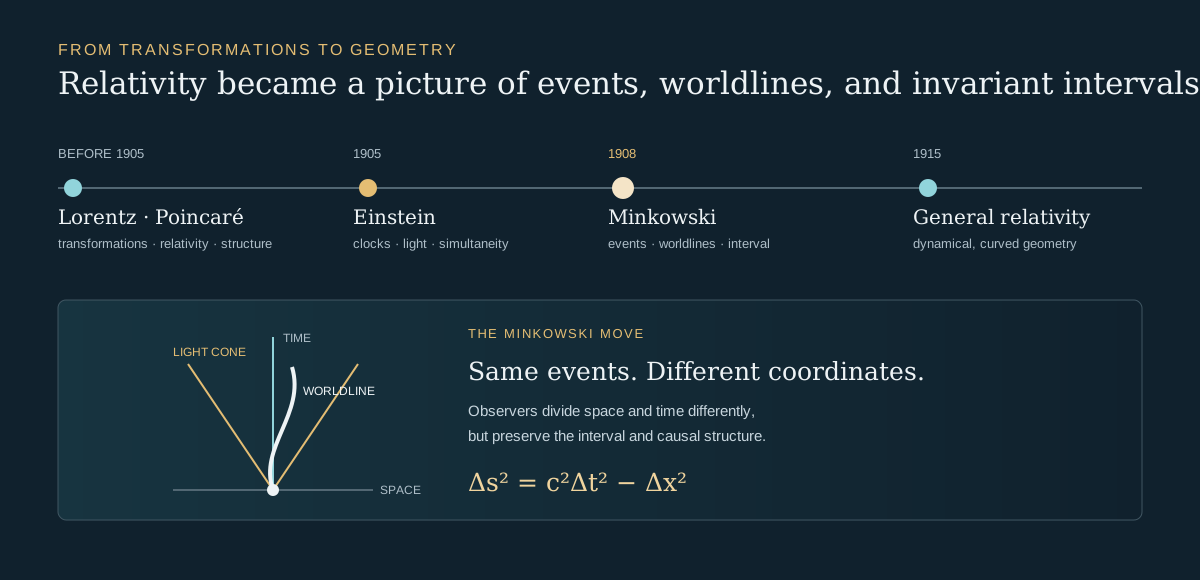
This does not say that space and time are interchangeable in every respect. Time has a different role in the geometry, and physical objects move from earlier events toward later ones. The useful claim is that observers in relative motion mix spatial and temporal coordinates when they describe the same events. What one observer calls mostly a separation in time, another can divide differently between space and time. [1, 2]
Why ordinary distance is not enough
Imagine two flashes. One observer records them two years apart and six light-years apart. Another observer moving relative to the first assigns different values to both the time separation and the spatial separation. Neither has made a measurement error; their coordinates belong to different inertial frames.
A purely spatial distance between the events is therefore not something all inertial observers must share. Nor is a coordinate-time difference. Special relativity replaces those separate invariants with a combined quantity: the spacetime interval.
For motion along one spatial direction, and using years for time and light-years for distance, the squared interval is:
Different inertial observers can disagree about Δt and Δx while obtaining the same Δs². The sign of that interval divides event pairs into three physically different classes. [2, 3]
A light cone is a boundary of possible influence
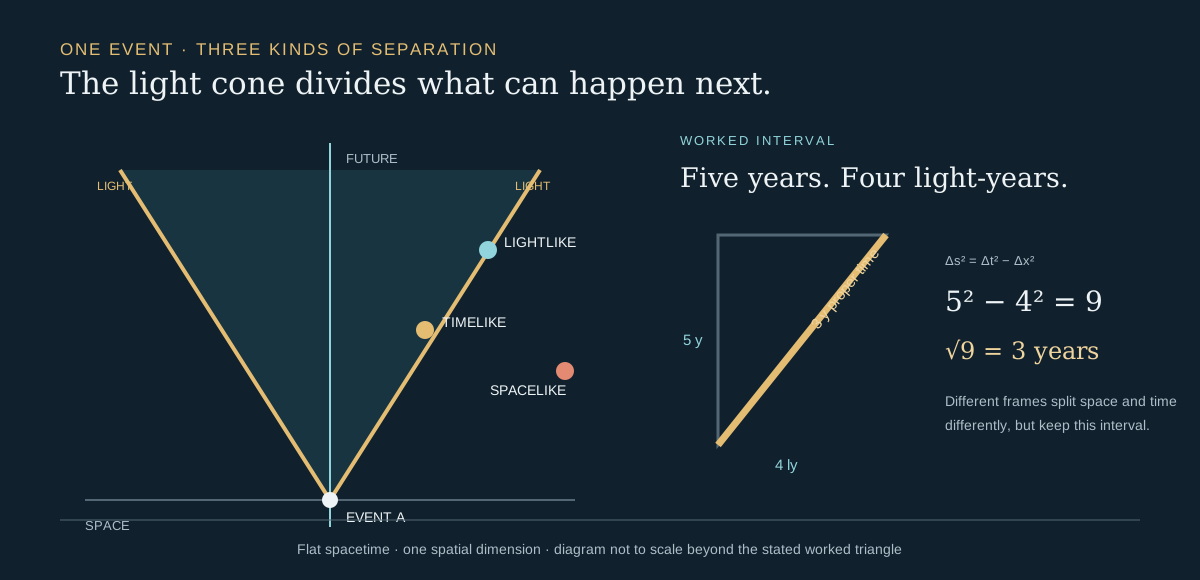
Place one event at the center of a spacetime diagram: here and now. Light sent from it spreads through space at the vacuum speed of light. The paths of those rays form the edge of the event’s future light cone. Incoming light traces the past light cone.
Events inside the future cone can, in principle, be reached by a slower-than-light signal or traveler. Events on its surface can be joined only by light in vacuum. Events outside it are too far away for even light to cover the distance in the available time.
The cone is not a glowing object in space. It is a diagram of causal relationships centered on an event. Each event has its own cone. [1, 4]
Timelike: a clock or traveler can connect the events
If Δt² is greater than Δx², the interval is positive in the sign convention used here. The separation is timelike. A physical traveler moving slower than light can be present at both events.
For a straight, constant-speed path in flat spacetime, the traveler’s proper time is √(Δt² − Δx²). Take two events separated by five years and four light-years in one frame. A traveler connecting them moves at 0.8c, while a clock traveling with them records three years:
That is the one-leg geometry used in our twin-paradox explanation. Other inertial observers assign different coordinate separations, but all calculate the same three-year proper time between those two events.
Lightlike: only light can connect the events
If Δt² equals Δx², the interval is zero and the separation is lightlike or null. A light ray can leave the first event and arrive at the second.
A zero interval does not mean the two events are identical or have no separation. It means the time and distance terms balance exactly. In the units used by the explorer above, a flash crossing four light-years in four years lies on the cone.
No inertial frame exists in which light is at rest. That is why the usual idea of attaching a clock to the light ray does not work; proper time along an ideal light path is zero, not a reading from a valid “photon reference frame.” [2, 3]
Spacelike: no signal can arrive in time
If Δx² is greater than Δt², the interval is negative and the separation is spacelike. Connecting the events would require a speed greater than light.
That has a striking consequence. Because no causal signal can travel between the two events, inertial observers can disagree about which happened first. There is even an inertial frame in which the spacelike-separated events are simultaneous. This reversal does not let an observer change the order of cause and effect: events that can be causally connected are timelike or lightlike, and all inertial observers preserve their order. [3, 4]
Our article on reciprocal moving clocks shows how differing planes of simultaneity resolve an apparent contradiction.
The diagram is not a view from outside the universe
A spacetime diagram compresses a physical history into a picture. One axis represents a spatial coordinate, another represents time, and a worldline traces the events occupied by an object. The page is not a place outside spacetime from which someone watches the universe.
The picture also depends on coordinates. Tilted axes or differently spaced grid lines can describe the same events from another inertial frame. What survives that redescription—the light-cone structure, interval class and causal order—is the deeper content.
This distinction matters when diagrams are recruited into philosophical arguments. A four-dimensional diagram is useful in physics; whether all represented times “equally exist” is a further metaphysical question explored in our block-universe guide.
Flat spacetime is the starting point, not the whole theory
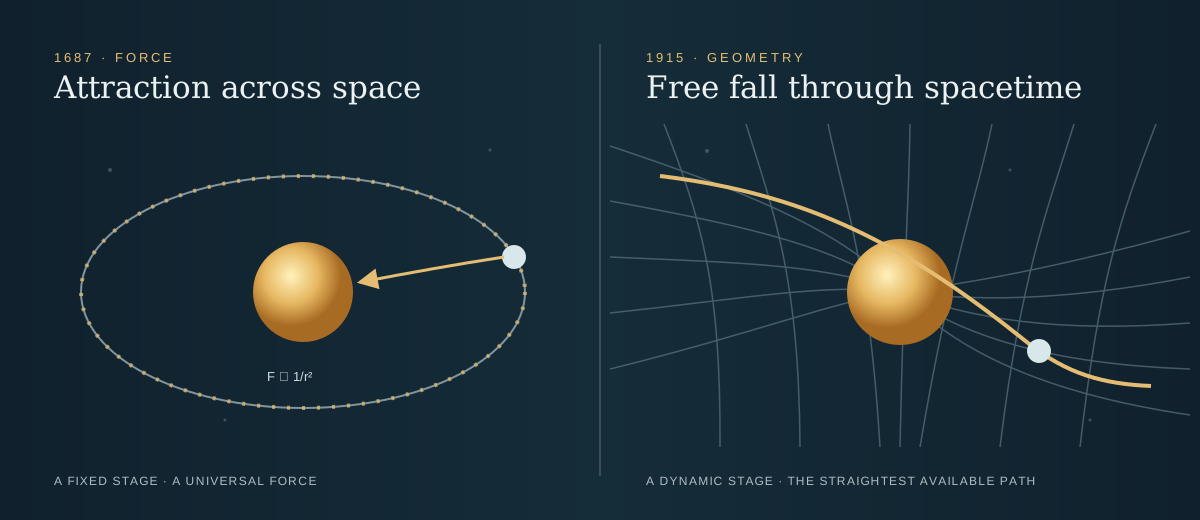
The explorer uses special relativity: flat spacetime, one spatial direction and inertial coordinates. General relativity goes further. Matter and energy affect spacetime geometry, freely falling paths need not look like straight lines globally, and a single flat-spacetime interval formula cannot cover an extended curved region.
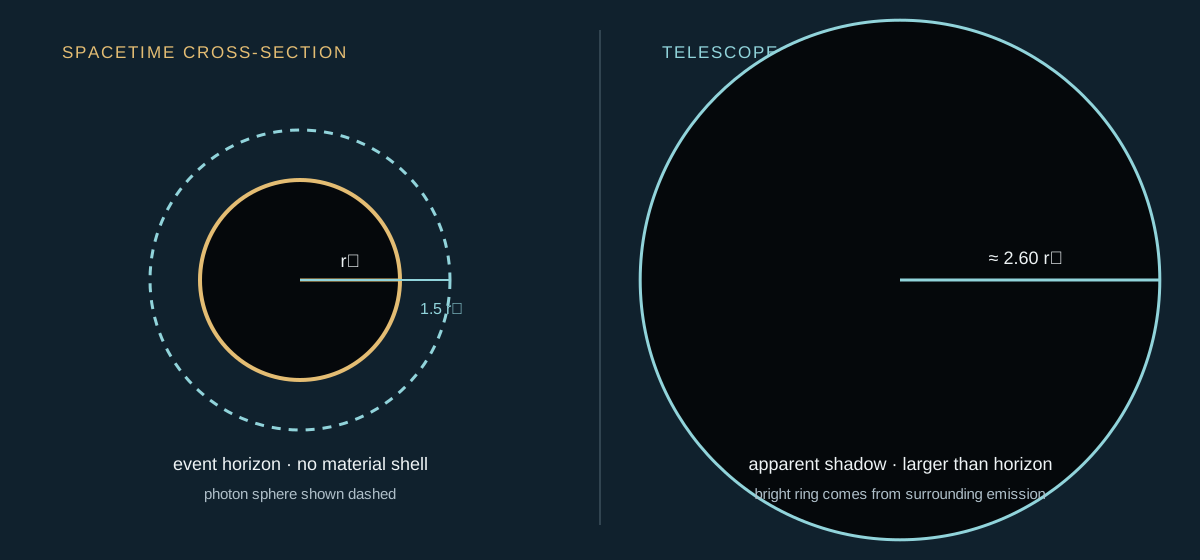
Locally—within a sufficiently small freely falling laboratory—the rules approach those of special relativity. That local connection is one bridge between Einstein’s two theories. Our special-versus-general relativity guide develops the distinction, while the event-horizon article shows how causal structure behaves in strong gravity.
Its geometry decides which events can be connected.
Sources & further reading
- Einstein Online — Spacetime ↗
- David Tong, University of Cambridge — Dynamics and Relativity lecture notes ↗
- OpenStax University Physics Volume 3 — The Lorentz Transformation ↗
- OpenStax University Physics Volume 3 — Relativity of Simultaneity ↗
Prepared with AI assistance. Sources are linked for verification. See our editorial approach.
Keep a little room for curiosity.
Save the journal for your next visit, or get new articles in a reading app.
Ways to stay updated ↗