THE EVIDENCE DESK / 09
What did each result actually establish?
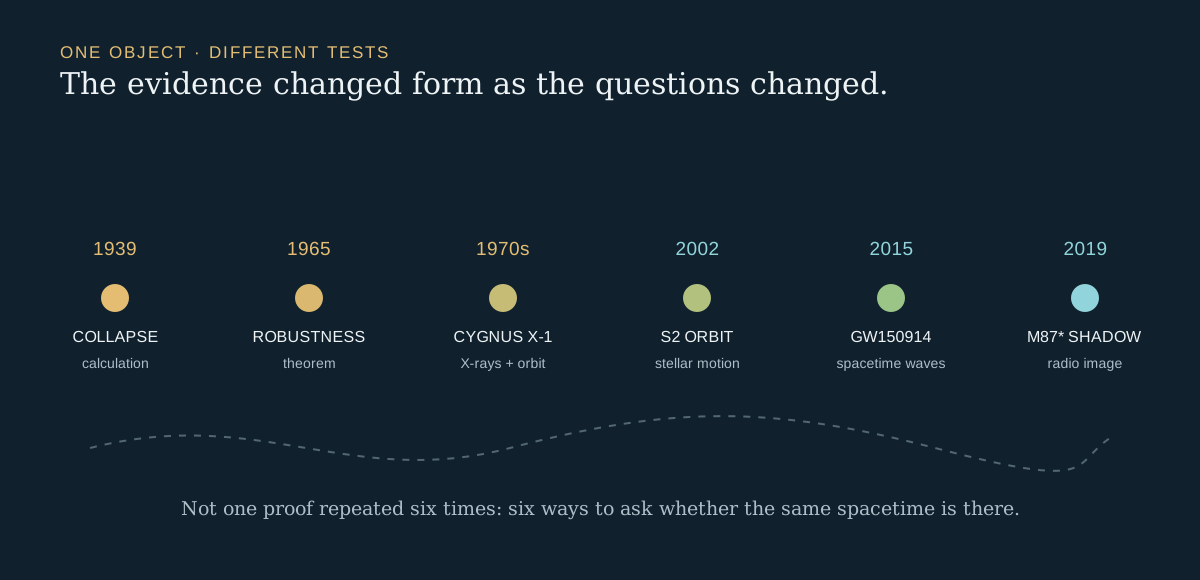
Open each case before reading the verdict. Scientific confidence grows when different tests remove different alternatives—not when one dramatic image replaces everything before it.
1939A star collapses in the equationsWhat changed? ↓
Added: a worked relativistic model in which collapse continues past the critical radius in finite proper time.
Still missing: robustness beyond ideal spherical matter and an astronomical object known to follow the model.
1965Collapse survives imperfect symmetryWhat changed? ↓
Added: Penrose’s theorem showed that singularity formation is a broad consequence of general relativity once a trapped surface forms.
Still missing: direct evidence that nature makes such objects.
1970sCygnus X-1 reveals a compact, dark companionWhat changed? ↓
Added: rapid X-rays plus orbital mass estimates gave astronomy a strong stellar-mass candidate.
Still missing: a clean signal from the spacetime itself; accreting matter supplied the light.
2002A star traces a tight Galactic-center orbitWhat changed? ↓
Added: a large mass was confined to a very small region through direct orbital tracking.
Still missing: horizon-scale resolution of that central object.
2015Two black holes merge in a waveformWhat changed? ↓
Added: the inspiral, merger, and ringdown pattern provided direct evidence that binary black holes exist and collide.
Still open: precision tests continue; one signal does not answer quantum or interior questions.
2019M87* casts the predicted shadowWhat changed? ↓
Added: horizon-scale emission and light bending agreed with a supermassive black hole’s expected shadow.
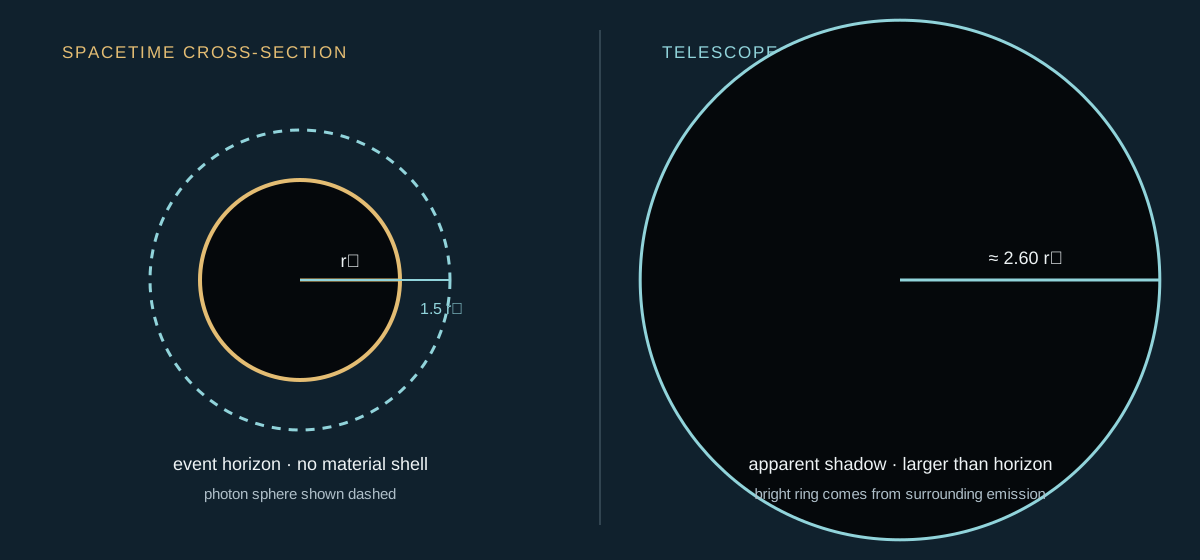
Important limit: the image shows surrounding radiation and a shadow, not the horizon as a material surface.
Acceptance was not a single discovery
There was no morning when physicists collectively decided that black holes were real. The case accumulated unevenly. First came equations describing extreme collapse. Then astronomers found invisible, massive objects through their effects on nearby matter. Later observations followed stellar orbits, recorded colliding black holes through gravitational waves, and resolved light bent near horizon-scale regions.
Those are different kinds of evidence. A mathematical solution can reveal what a theory permits; an X-ray binary can identify a compact candidate; a gravitational-wave signal can test the dynamics of two merging objects. Agreement across independent methods is what made the case compelling.
The word accept also needs care. Scientists can accept that astrophysical black holes exist while still investigating how horizons behave, how accretion flows produce images, or what ultimately happens to information. The object became mainstream before every question about it was settled.
A dark-star idea was not yet a black hole
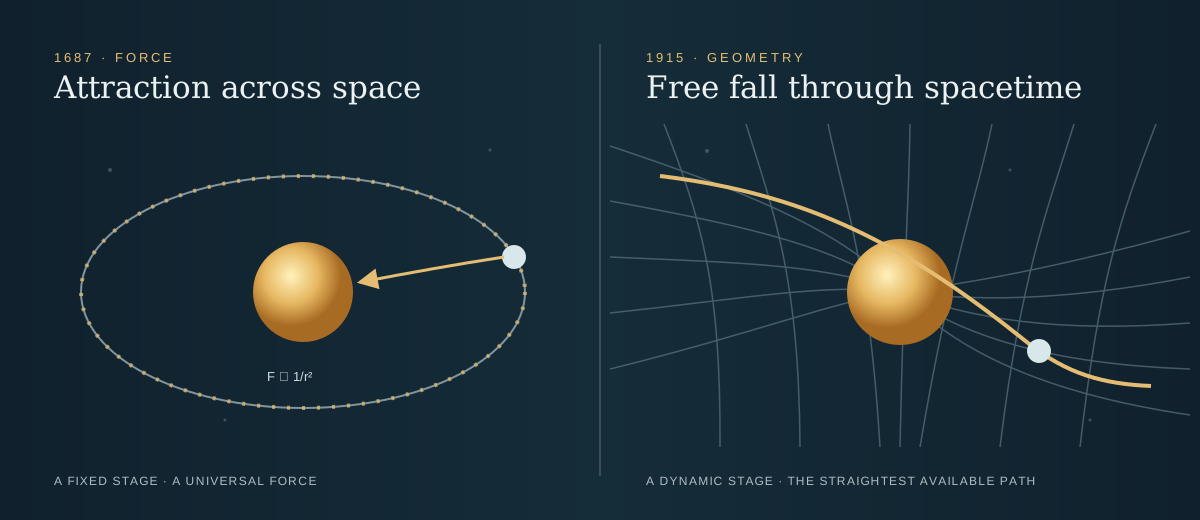
In 1783, John Michell considered a star so compact that its escape speed would exceed the speed of light. His “dark star” used Newtonian gravity and a particle theory of light. It is an important precursor, but it was not the modern black hole: general relativity later changed gravity from a force acting in fixed space into the geometry of spacetime. [1]
Karl Schwarzschild found an exact solution to Einstein’s field equations in 1916. The mathematics contained what is now called the Schwarzschild radius. Yet early interpretations were tangled by coordinates that made the horizon look singular. A solution on paper did not by itself show that a real star could collapse through that boundary.
This distinction matters. The history is not a straight line from Michell to a photograph. The central question became physical: could ordinary stellar evolution actually produce the spacetime described by the equations?
1930s: collapse became difficult to avoid
Subrahmanyan Chandrasekhar showed that electron degeneracy pressure cannot support an ideal white dwarf above a limiting mass. His early numerical value was later refined, but the conceptual result survived: not every exhausted star can remain a white dwarf. [2]
In 1939, J. Robert Oppenheimer and Hartland Snyder calculated the collapse of an idealized spherical star made of pressureless matter. To a distant observer its surface becomes increasingly redshifted; in the infalling matter’s own time, collapse continues. The model was deliberately simple, but it demonstrated that general relativity did not necessarily provide a last-minute halt. [2, 3]
The paper appeared as World War II began, and black-hole physics did not immediately become a central research program. Historical circumstance mattered, but so did physics: the calculation was idealized, horizons were poorly understood, and there was no convincing astronomical example.
1960s: the mathematics became robust
A revival of general relativity changed the problem. Better coordinate systems clarified that the Schwarzschild horizon is not a physical rupture in spacetime. Roy Kerr’s 1963 solution described rotating black holes, a necessary step because real stars carry angular momentum.
Roger Penrose then showed in 1965 that singularity formation did not depend on Oppenheimer and Snyder’s perfect spherical symmetry. Under broad physical conditions, once a trapped surface forms, general relativity implies incomplete paths in spacetime. The result made collapse a robust prediction of the theory rather than a fragile artifact of one tidy model. [4]
John Wheeler helped turn the subject into an active field and popularized the name “black hole” near the end of the decade. A memorable name did not prove the objects existed, but it gave researchers a shared object to calculate, debate, and search for.
1970s: an invisible object announced itself in X-rays
A black hole alone emits no ordinary light, so astronomers looked for its influence on visible matter. In a close binary system, gas pulled from a companion star can become extremely hot before crossing the horizon and radiate strongly in X-rays. [5]
Cygnus X-1 became the landmark case. Astronomers combined rapid X-ray variability, which implied a compact emitting region, with measurements of the visible companion’s motion, which implied an unseen massive partner. By 1974, Physics Today reported that many observers had become convinced, while explicitly noting that holdouts remained. That contemporary snapshot is useful: confidence was rising, not magically complete. [6]
A massive, dark companion could be identified as a black-hole candidate only after alternatives were tested. The reasoning was indirect but powerful: measure the orbit, constrain the unseen mass and size, then ask what known object can satisfy both.
Orbits, waves, and a shadow closed different gaps
Beginning in the 1990s, teams led by Reinhard Genzel and Andrea Ghez tracked stars racing around the center of the Milky Way. The compact mass inferred from those orbits—about four million Suns—left a supermassive black hole as the best explanation. The work was recognized in the 2020 Nobel Prize alongside Penrose’s theoretical result. [4, 7]
On September 14, 2015, the two LIGO detectors recorded GW150914. The waveform matched the inspiral, merger, and ringdown of two black holes. This was not light from hot gas near a candidate; it was a changing gravitational field carrying the signature of a binary black-hole collision. [8]
In 2019, the Event Horizon Telescope resolved a bright ring and central shadow around M87*. The image was not a photograph of the horizon itself. It showed emission and light bending on the scale predicted for a supermassive black hole. That distinction connects directly to our explanation of why the shadow is larger than the event horizon. [9]
What scientists accepted—and what remains open
Today, black holes are not supported by one iconic picture. They are supported by a network of mutually reinforcing observations: stellar and gas dynamics, X-ray binaries, gravitational waves, and horizon-scale radio interferometry, all interpreted through general relativity.
None of that means every black-hole question is finished. The detailed physics of accretion and jets remains active. Classical general relativity predicts singular behavior where its own description becomes incomplete, and a quantum theory of gravity is still missing. The information problem concerns the relationship between black holes and quantum mechanics; it is not evidence that the astronomical objects disappear.
It arrived when independent tests kept pointing to the same object.
For the conceptual foundation, read how Einstein changed gravity from force to geometry. For the boundary itself, continue with the event-horizon explainer and calculator.
Sources & further reading
- American Physical Society — John Michell anticipates black holes ↗
- Physics Today — Chandrasekhar’s role in 20th-century science ↗
- Oppenheimer & Snyder (1939), Physical Review — On Continued Gravitational Contraction ↗
- Nobel Prize in Physics 2020 — Press release ↗
- Ruffini & Wheeler (1971), Physics Today — Introducing the black hole ↗
- Physics Today (1974) — Evidence accumulates for a black hole in Cygnus X-1 ↗
- European Southern Observatory — 2020 Nobel Prize and the Galactic-center observations ↗
- LIGO Scientific Collaboration — GW150914 ↗
- Event Horizon Telescope — Astronomers capture the first image of a black hole ↗
Prepared with AI assistance. Sources are linked for verification. See our editorial approach.
Keep a little room for curiosity.
Save the journal for your next visit, or get new articles in a reading app.
Ways to stay updated ↗