ENERGY-TO-SPEED EXPLORER / 18
How expensive is the next nine?
Choose a speed below light speed. The model calculates the Lorentz factor and kinetic energy per kilogram of rest mass.
At 80% of c, relativity requires about 2.08 times the Newtonian kinetic-energy estimate.
Ideal special-relativity calculation for a single object with invariant rest mass. It excludes propulsion efficiency, fuel, radiation, collisions and gravity. The c value is exact in vacuum.
The adjustable explorer is unavailable until it loads. The default remains valid: at 80% of c, γ = 1.667 and K = 0.667 mc².
The limit is built into spacetime
In vacuum, light travels at exactly 299,792,458 metres per second. Every inertial observer measures the same value, even when the source and observer are moving relative to one another. In special relativity, that invariant speed is usually written c. [1, 2]
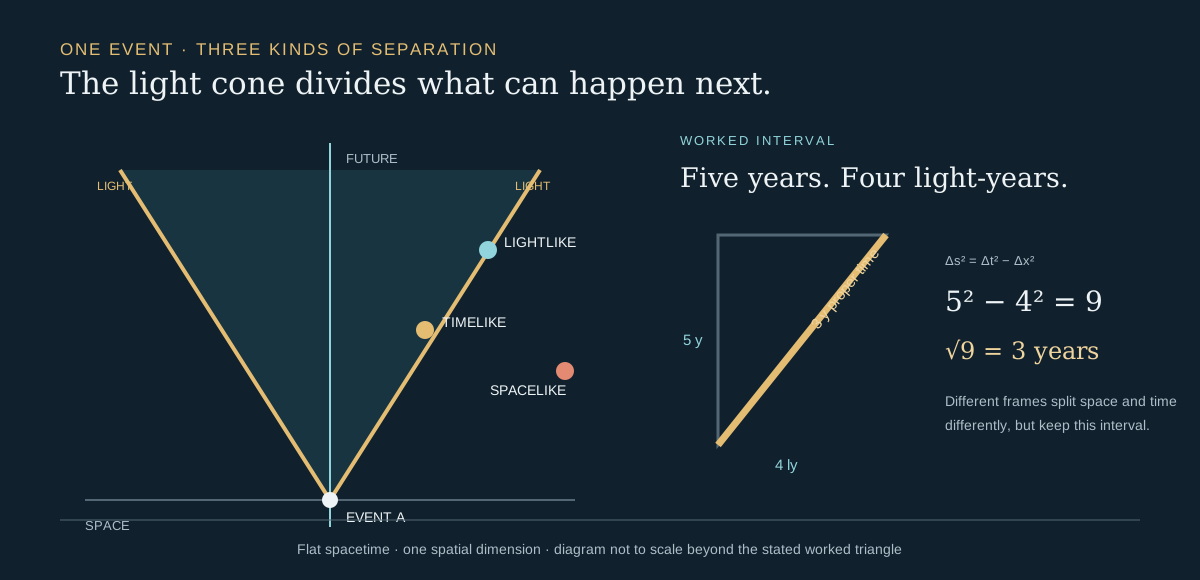
The surprising part is not simply that light happens to be fast. The same constant organizes the geometry of spacetime: it separates events that can influence one another from events that no signal could connect. Matter, energy and information cannot locally outrun a light signal. [3]
An object with mass may approach c as closely as available energy permits, but it cannot be accelerated from below c to c. The reason is visible in the relationship among speed, energy and momentum.
The Lorentz factor marks the rising cost
For an object with rest mass m moving at speed v, special relativity uses the Lorentz factor:
The object’s relativistic kinetic energy is:
At ordinary speeds, this reduces closely to the familiar Newtonian expression ½mv². Near light speed, the two predictions separate dramatically. Open the explorer above to compare them. [4, 5]
Why “add more energy” stops meaning “add the same speed”
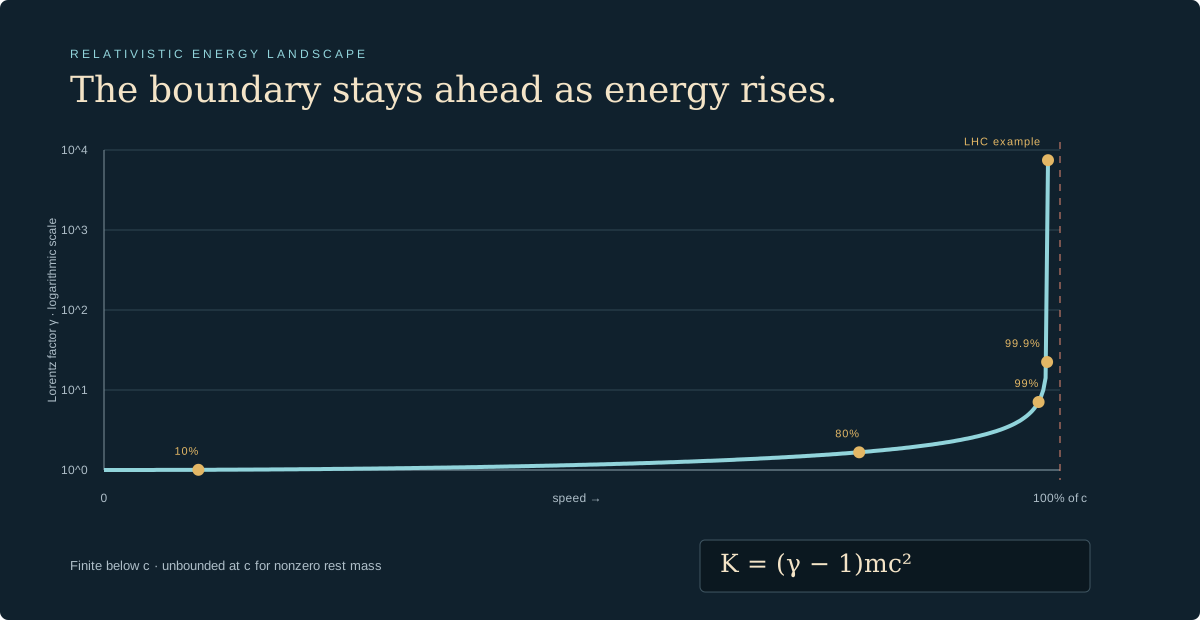
At 80% of light speed, γ is 1.667 and the kinetic energy is about 0.667 times the object’s rest energy, mc². At 99%, γ is about 7.09 and the kinetic energy is about 6.09 mc². At 99.9%, γ is about 22.37 and the kinetic energy is about 21.37 mc².
The energy can keep increasing; the speed increments become smaller. There is no final finite push that crosses the boundary. At exactly v = c, the formula for γ would require division by zero, and the energy needed for an object with nonzero rest mass would be unbounded.
This is why physicists describe high-energy particle beams by energy rather than by a long string of nines in their speed. The distinction between 99.99% and 99.999999% of c looks small on a speedometer while representing a major change in energy.
Particle accelerators make the asymptote practical
CERN’s Large Hadron Collider gives protons repeated electromagnetic pushes. At its documented 7 TeV top-energy example, a proton travels at about 0.999999991 times c. Increasing the beam energy mainly raises each proton’s energy and momentum; its speed moves only slightly closer to c. [6]
This is not a failure of the accelerator. High collision energy is the point. When beams collide, their energy can appear in the masses and motion of new particles, subject to conservation laws. Accelerator magnets and radio-frequency cavities are designed around relativistic momentum, not a Newtonian expectation that equal energy additions always yield comparable speed additions. [7]
The speed-limit claim is therefore not philosophical decoration. Modern accelerators would be misdesigned if relativistic energy and momentum did not describe their beams.
Why light can travel at the limit
A photon is not a massive object that started below c and was pushed until it reached the boundary. In vacuum, light follows lightlike paths. Photons have zero rest mass and obey the energy–momentum relation with m = 0, giving E = pc. [5]
There is no inertial rest frame in which a photon is stationary. Asking what the universe looks like “from a photon’s point of view” tries to use a reference frame that special relativity does not provide. The Lorentz transformations between inertial frames require relative speeds below c.
Light can have more or less energy through its frequency, but a higher-energy photon in vacuum does not travel faster than a lower-energy photon. Both travel at c.
Two common loopholes that are not loopholes
Velocity addition: suppose a spacecraft moves at 0.8c and launches a probe forward at 0.8c relative to the ship. Newtonian addition suggests 1.6c. Relativistic addition gives:
Cosmic expansion: in general relativity, distances between sufficiently remote galaxies can increase at a rate greater than c. That statement concerns the evolution of spacetime geometry across large distances, not a local object overtaking a neighboring light beam or carrying information past it. The local causal limit remains intact. [3, 8]
What the speed limit actually says
The careful statement is local and causal: no object with nonzero rest mass can be accelerated to c, and no matter, energy or usable signal can locally pass a light ray in vacuum. It is not a claim that every distance divided by every coordinate time in cosmology must be smaller than c.
Nor does the limit require saying that an object’s rest mass grows with speed. That older language packages γ into a “relativistic mass.” Modern treatments usually keep mass invariant and describe the frame-dependent growth of energy and momentum directly. [4]
It is the boundary built into spacetime’s causal geometry.
Continue with light cones and spacetime intervals, see how the same γ appears in time dilation, or calculate a complete journey in the twin paradox explorer.
Sources & further reading
- NIST CODATA — Speed of light in vacuum ↗
- Einstein Online — Special relativity: the speed of light ↗
- Einstein Online — Causality ↗
- OpenStax University Physics — Relativistic momentum ↗
- OpenStax University Physics — Relativistic energy ↗
- CERN — LHC: the guide ↗
- CERN — Accelerators ↗
- NASA Imagine the Universe — Expansion and the speed of light ↗
Prepared with AI assistance. Sources are linked for verification. See our editorial approach.
Keep a little room for curiosity.
Save the journal for your next visit, or get new articles in a reading app.
Ways to stay updated ↗