EXPLORE THE ASSUMPTIONS / 04
Same universe. Different questions.
Open a scenario to see which description is useful. The assumptions are part of the answer.
A rocket turns around in empty space
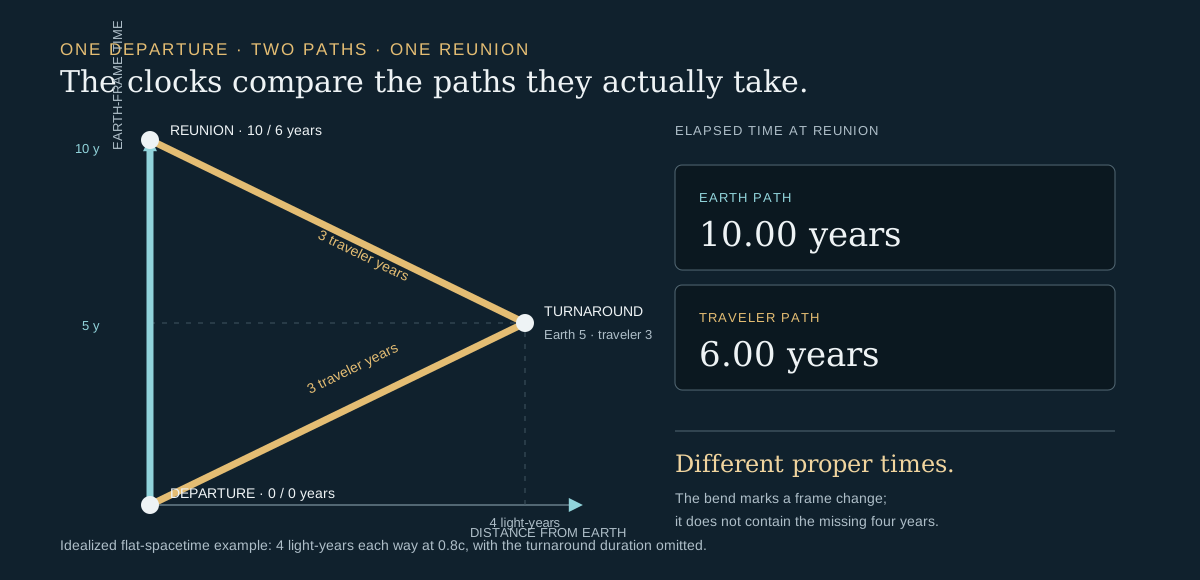
Special relativity can handle this. Acceleration alone does not require curved spacetime. Follow the entire trajectory to compare elapsed time, assuming gravitational effects can be neglected.
Two stationary clocks sit at different heights
A relativistic gravity calculation is needed. Near Earth, the higher stationary clock runs slightly faster. Ordinary instruments may not resolve the tiny difference. This scenario excludes a relative-motion contribution.
A tiny laboratory falls freely
Special relativity is a local approximation. For a sufficiently small region and short interval, tidal effects can be neglected. Weightlessness does not establish that gravity is absent everywhere.
Separated falling objects drift toward each other
General relativity describes the curvature behind tidal effects. A Newtonian tidal calculation can also be a useful approximation in weak fields. One freely falling frame cannot remove all spatial variation.
Conceptual scenarios, not a numerical simulation. Expand any combination; no answers are collected or stored. See the article’s sources for the physical assumptions.
The short answer
Special relativity describes physics in flat spacetime, without gravitational curvature. General relativity is a theory of gravity in which spacetime geometry responds to matter and energy. The second does not discard the first: sufficiently small freely falling laboratories recover special-relativistic physics to a good approximation. [1, 2]
A useful distinction is therefore not “slow versus fast,” nor simply “constant speed versus acceleration.” Ask instead: can gravity and spacetime curvature be neglected in the question you are trying to answer?
That shift matters. It prevents us from treating relativity as a collection of spectacular effects reserved for astronauts. Sometimes the relevant journey is a flight across space. Sometimes it is the distance between two shelves.
Special relativity: compare paths through flat spacetime
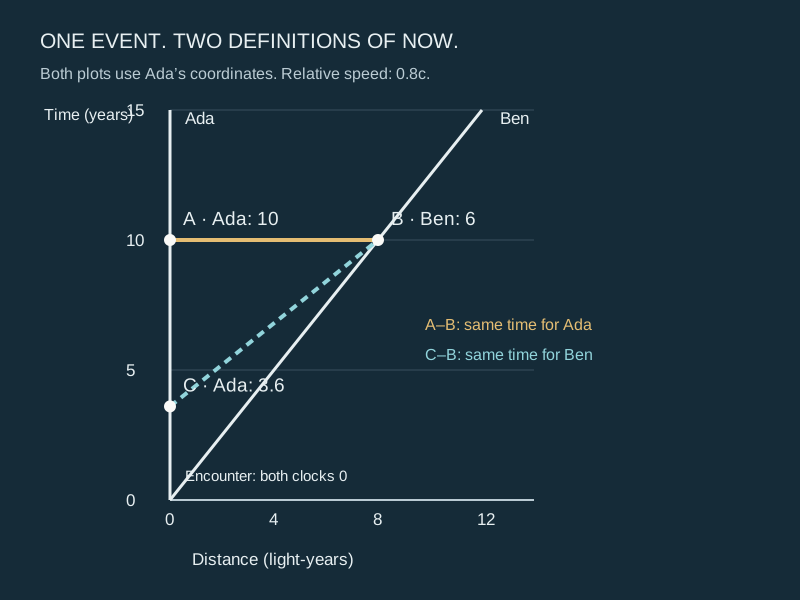
Our time-dilation guide begins with a moving clock. Compared using an inertial reference frame’s synchronized clocks, it accumulates less time than the corresponding reference-frame interval. The traveler still experiences their own seconds normally.
Acceleration can also be treated in special relativity. In the idealized traveling-twin problem, one twin changes direction and returns; calculating the elapsed time along both complete paths resolves the apparent contradiction. General relativity is not required merely because a rocket fires its engines. If gravitational effects matter, they must be included separately. [3]
The word flat describes spacetime geometry. It does not mean every object travels along a straight path on a drawing, or that every observer must move uniformly. A bent trajectory and curved spacetime are different things.
General relativity: free fall becomes the starting point
Picture a small sealed laboratory in free fall. A released object nearby floats relative to you because you and the object are falling together. Compare that with a freely drifting laboratory far from gravitating bodies: a brief local experiment can look the same.
This is the insight behind Einstein’s equivalence principle. The qualifications matter: the laboratory must be small enough, and the observation short enough, that tidal effects are negligible. It is not a license to equate every gravitational situation with one accelerating room. [5]
Now widen the experiment. Nearby freely falling objects can approach or separate from one another because the gravitational field varies across the region. These tidal effects cannot all be removed by choosing one freely falling frame. General relativity relates this behavior to spacetime curvature. [2]
Why Einstein needed a second theory
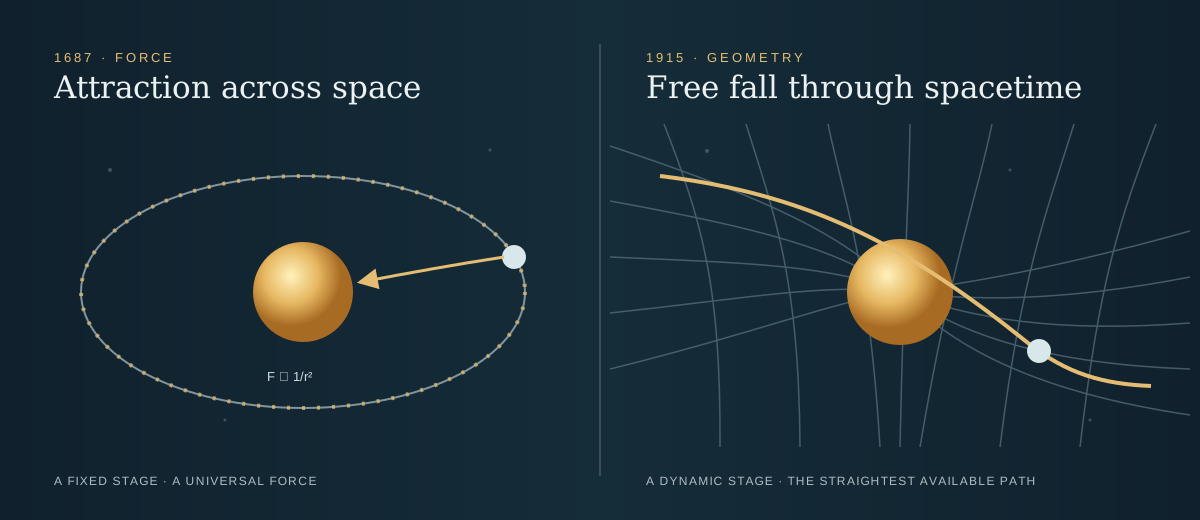
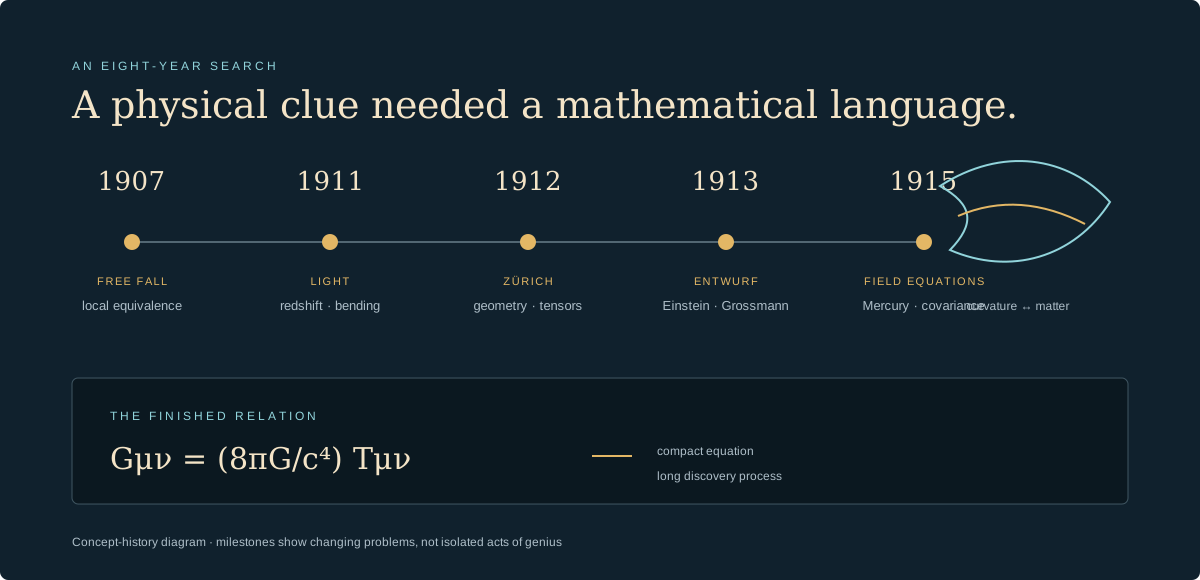
The special theory belongs to Einstein’s breakthrough year of 1905. Incorporating gravity demanded further work: Newton’s gravitational framework did not simply fit inside the new account of space and time. The equivalence principle supplied a starting point, not an instant finished theory. [1]
General relativity reached its familiar form in 1915. Seen in that sequence, “general” is not a marketing upgrade to “special.” It names a deeper change in how gravity is described. [4]
It cannot erase every tidal effect.
Two clocks, almost side by side
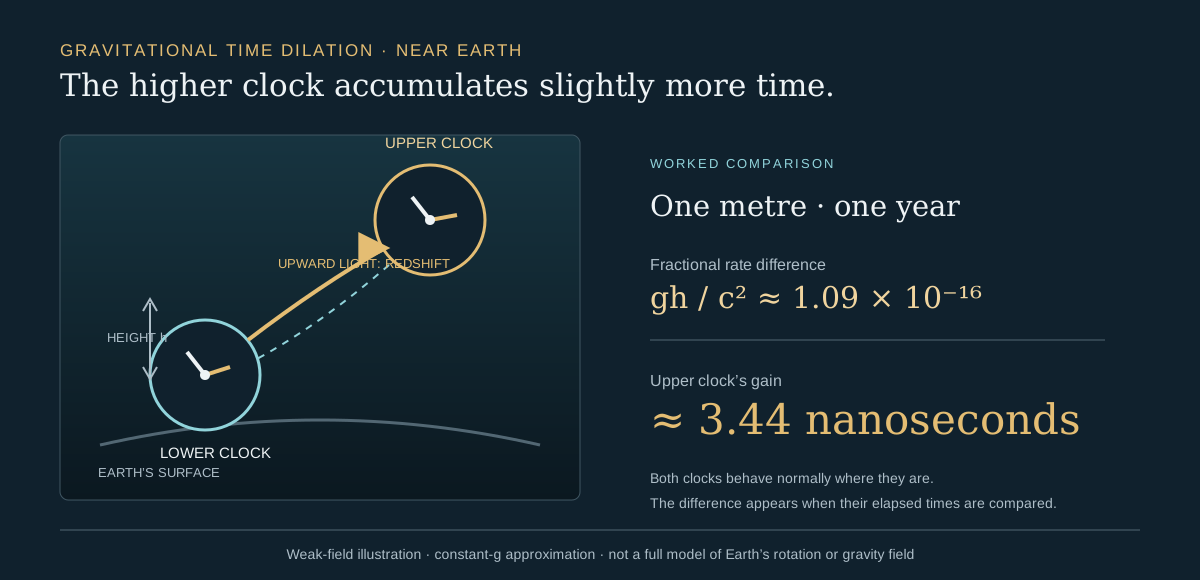
For stationary clocks near Earth, the clock at higher elevation runs slightly faster than the lower one. This gravitational comparison is distinct from the moving-clock example in special relativity.
In a 2022 result, JILA researchers measured the gravitational frequency difference across a millimeter-scale cloud of ultracold strontium atoms. NIST’s account describes comparisons between the top and bottom of the sample—not two everyday wristwatches sitting on a desk. [4]
The lesson is about precision, not science fiction. An effect can be present while remaining far too small for an ordinary instrument to detect. “I cannot notice it” and “the theory predicts nothing” are different statements.
Which description should you use?
If you are comparing fast-moving clocks while neglecting gravity, special relativity is the natural starting point. If you want a relativistic account of gravitational clock differences or tidal effects, you need the general theory. In many everyday calculations, simpler Newtonian approximations remain useful when the required accuracy permits. [6]
Choosing a model is not choosing a team. It is choosing which effects your question needs you to keep. Start by stating the assumptions; only then choose an equation.
One philosophical question remains after the calculation: does a successful spacetime model tell us everything about the reality of time? That is a further debate, explored in our introduction to the block universe, rather than a conclusion this comparison can settle.
Sources & further reading
- Markus Pössel, Einstein Online — The elevator, the rocket, and gravity: the equivalence principle ↗
- Markus Pössel, Einstein Online — Gravity: from weightlessness to curvature ↗
- Einstein Online — The case of the travelling twins ↗
- NIST, February 16, 2022 — JILA atomic clocks measure general relativity at millimeter scale ↗
- Einstein Online — Equivalence principle ↗
- Einstein Online — Step by step from Newton to Einstein ↗
Prepared with AI assistance. Sources are linked for verification. See our editorial approach.
Keep a little room for curiosity.
Save the journal for your next visit, or get new articles in a reading app.
Ways to stay updated ↗